Get your patient on Adapalene - Adapalene gel (Adapalene)
Adapalene - Adapalene gel prescribing information

INDICATIONS AND USAGE
Adapalene Gel, 0.3% is indicated for the topical treatment of acne vulgaris in patients 12 years of age and older.
DOSAGE AND ADMINISTRATION
Wash affected areas gently with a non-medicated soap. Apply a thin film of Adapalene Gel, 0.3% to the entire face and any other affected areas of the skin once daily in the evening. Avoid application to the areas of skin around eyes, lips, and mucous membranes. A mild transitory sensation of warmth or slight stinging may occur shortly after the application of Adapalene Gel, 0.3%.
Instruct patients to minimize sun exposure and to use moisturizers for relief of dry skin or irritation.
If therapeutic results are not noticed after 12 weeks of treatment, therapy should be re-evaluated. For topical use only. Not for ophthalmic, oral or intravaginal use.
DOSAGE FORMS AND STRENGTHS
Each gram of Adapalene Gel, 0.3% contains 3 mg adapalene in an off-white aqueous gel.
USE IN SPECIFIC POPULATIONS
Pregnancy
Risk Summary
Available data from clinical trials with Adapalene Gel, 0.3% use in pregnant women are insufficient to establish a drug-associated risk of major birth defects, miscarriage or other adverse maternal or fetal outcomes. In animal reproduction studies, oral administration of adapalene to pregnant rats and rabbits during organogenesis at dose exposures 40 and 81 times, respectively, the human exposure at the maximum recommended human dose (MRHD) of 2 g resulted in fetal skeletal and visceral malformations (see Data ) .
The background risk of major birth defects and miscarriage for the indicated population is unknown. All pregnancies have a background risk of birth defects, loss, or other adverse outcomes. In the U.S. general population the estimated background risk of major birth defects and miscarriage in clinically recognized pregnancies are 2 to 4% and 15 to 20%, respectively.
Data
Animal Data
No malformations were observed in rats treated with oral adapalene doses of 0.15 to 5 mg/kg/day, up to 8 times the MRHD based on a mg/m 2 comparison. However, malformations were observed in rats and rabbits when treated with oral doses of ≥ 25 mg/kg/day adapalene (40 and 81 times the MRHD, respectively, based on a mg/m 2 comparison). Findings included cleft palate, microphthalmia, encephalocele, and skeletal abnormalities in rats and umbilical hernia, exophthalmos, and kidney and skeletal abnormalities in rabbits.
Dermal adapalene embryofetal development studies in rats and rabbits at doses up to 6 mg/kg/day (9.7 and 19.5 times the MRHD, respectively, based on a mg/m 2 comparison) exhibited no fetotoxicity and only minimal increases in skeletal variations (supernumerary ribs in both species and delayed ossification in rabbits).
Lactation
Risk Summary
There are no data on the presence of topical adapalene gel or its metabolite in human milk, the effects on the breastfed infant, or the effects on milk production. In animal studies, adapalene is present in rat milk with oral administration of the drug. When a drug is present in animal milk, it is likely that the drug will be present in human milk. It is possible that topical administration of large amounts of adapalene could result in sufficient systemic absorption to produce detectable quantities in human milk (see Clinical Considerations ) . The developmental and health benefits of breastfeeding should be considered along with the mother's clinical need for Adapalene Gel, 0.3% and any potential adverse effects on the breastfed child from Adapalene Gel, 0.3%, or from the underlying maternal condition.
Clinical Considerations
To minimize potential exposure to the breastfed infant via breastmilk, use Adapalene Gel, 0.3% on the smallest area of skin and for the shortest duration possible while breastfeeding. Avoid application of Adapalene Gel, 0.3% to areas with increased risk for potential ingestion by or ocular exposure to the breastfeeding child.
Pediatric Use
Safety and effectiveness have not been established in pediatric patients below the age of 12.
Geriatric Use
Clinical studies of Adapalene Gel, 0.3% did not include subjects 65 years of age and older to determine whether they respond differently than younger subjects. Safety and effectiveness in geriatric patients age 65 and above have not been established.
CONTRAINDICATIONS
Adapalene Gel, 0.3% is contraindicated in patients who have known hypersensitivity to adapalene or any excipient of Adapalene Gel, 0.3% [see WARNINGS AND PRECAUTIONS (5.1) ] .
WARNINGS AND PRECAUTIONS
- Allergic/Hypersensitivity Reactions: Allergy/ hypersensitivity reactions include anaphylaxis, angioedema, face edema, eyelid edema, lip swelling, and pruritis. Discontinue Adapalene Gel, 0.3% in the event of an allergic/hypersensitivity reaction. (5.1 )
- Ultraviolet Light and Environmental Exposure: Avoid exposure to sunlight and sunlamps. Wear sunscreen when sun exposure cannot be avoided (5.2 ).
- Local Cutaneous Reactions: Erythema, scaling, dryness, and stinging/burning were reported with use of Adapalene Gel, 0.3%. Concomitant use of other potentially irritating topical products (medicated or abrasive soaps and cleansers, soaps and cosmetics that have a strong drying effect and products with high concentrations of alcohol, astringents, spices, or lime) should be approached with caution. (5.3 ).
Allergic/ Hypersensitivity Reactions
Adverse reactions including anaphylaxis angioedema, face edema, eyelid edema, lip swelling, and pruritus that sometimes required medical treatment have been reported during postmarketing use of adapalene. Advise a patient to stop using Adapalene Gel, 0.3% and seek medical attention if experiencing allergic or anaphylactoid/anaphylactic reactions during treatment.
Ultraviolet Light and Environmental Exposure
Exposure to sunlight, including sunlamps, should be minimized during use of Adapalene Gel, 0.3%. Patients who normally experience high levels of sun exposure, and those with inherent sensitivity to sun, should be warned to exercise caution. Use of sunscreen products and protective clothing over treated areas is recommended when exposure cannot be avoided. Weather extremes, such as wind or cold, also may be irritating to patients under treatment with Adapalene Gel, 0.3%.
Local Cutaneous Reactions
Cutaneous signs and symptoms such as erythema, scaling, dryness, and stinging/burning were reported with use of Adapalene Gel, 0.3%. These were most likely to occur during the first four weeks of treatment, were mostly mild to moderate in intensity, and usually lessened with continued use of the medication.
Depending upon the severity of these side effects, patients should be instructed to either use a moisturizer, reduce the frequency of application of Adapalene Gel, 0.3% or discontinue use.
Avoid application to cuts, abrasions, eczematous or sunburned skin. As with other retinoids, use of "waxing" as a depilatory method should be avoided on skin treated with adapalene.
As adapalene gel has the potential to induce local irritation in some patients, concomitant use of other potentially irritating topical products (medicated or abrasive soaps and cleansers, soaps and cosmetics that have a strong drying effect and products with high concentrations of alcohol, astringents, spices, or lime) should be approached with caution.
ADVERSE REACTIONS
The most frequently reported (≥ 1%) adverse reactions were erythema, scaling, dryness, and/or burning/stinging. (6.1 ) To report SUSPECTED ADVERSE REACTIONS, contact Taro Pharmaceuticals U.S.A., Inc. at 1-866-923-4914 or FDA at 1-800-FDA-1088 or www.fda.gov/medwatch.
Clinical Trials Experience
Because clinical trials are conducted under widely varying conditions, adverse reactions rates observed in the clinical trials of a drug cannot be directly compared to rates in the clinical trials of another drug and may not reflect the rates observed in practice.
In the multi-center, controlled clinical trial, signs and symptoms of local cutaneous irritation were monitored in 258 acne subjects who used Adapalene Gel, 0.3% once daily for 12 weeks. Of the subjects who experienced cutaneous irritation (erythema, scaling, dryness, and/or burning/stinging), the majority of cases were mild to moderate in severity, occurred early in treatment and decreased thereafter. The incidence of local cutaneous irritation with Adapalene Gel, 0.3% from the controlled clinical trial is provided in the following table:
| Mild | Moderate | Severe | |
|---|---|---|---|
| Erythema | 66 (26.1%) | 33 (13%) | 1 (0.4%) |
| Scaling | 110 (43.5%) | 47 (18.6%) | 3 (1.2%) |
| Dryness | 113 (44.7%) | 43 (17%) | 2 (0.8%) |
| Burning/Stinging | 72 (28.5%) | 36 (14.2%) | 9 (3.6%) |
| Adapalene Gel, 0.3% | Vehicle Gel | |
|---|---|---|
| N=258 | N=134 | |
| Related Selected adverse reactions defined by investigator as Possibly, Probably or Definitely Related Adverse Reactions | 57 (22.1%) | 6 (4.5%) |
| Dry Skin | 36 (14%) | 2 (1.5%) |
| Skin Discomfort | 15 (5.8%) | 0 (0%) |
| Desquamation | 4 (1.6%) | 0 (0%) |
The following adverse reactions occurred in less than 1% of subjects: acne flare, contact dermatitis, eyelid edema, conjunctivitis, erythema, pruritus, skin discoloration, rash, and eczema.
In a one-year, open-label safety trial of 551 subjects with acne who received Adapalene Gel, 0.3%, the pattern of adverse reactions was similar to the 12-week controlled study.
Post-Marketing Experience
The following adverse reactions have been identified during post approval use of adapalene:
Immune system disorders: angioedema, face edema, lip swelling
Skin disorders: application site pain
Because these reactions are reported voluntarily from a population of uncertain size, it is not always possible to reliably estimate the frequency or establish a causal relationship to drug exposure.
DESCRIPTION
Adapalene Gel, 0.3% contains adapalene 0.3% (3 mg/g) in a topical aqueous gel for use in the treatment of acne vulgaris, consisting of carbomer homopolymer type C, edetate disodium, methylparaben, poloxamer 182, propylene glycol, purified water and sodium hydroxide.
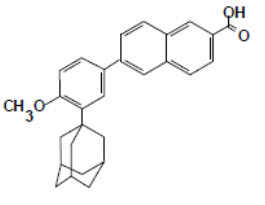
The chemical name of adapalene is 6-[3-(1-adamantyl)-4-methoxyphenyl]-2-naphthoic acid. It is a white to off-white powder, which is soluble in tetrahydrofuran, very slightly soluble in ethanol, and practically insoluble in water. The molecular formula is C 28 H 28 O 3 and molecular weight is 412.53. Adapalene is represented by the following structural formula.
CLINICAL PHARMACOLOGY
Mechanism of Action
Adapalene binds to specific retinoic acid nuclear receptors but does not bind to cytosolic receptor protein. Biochemical and pharmacological profile studies have demonstrated that adapalene is a modulator of cellular differentiation, keratinization, and inflammatory processes. However, the significance of these findings with regard to the mechanism of action of adapalene for the treatment of acne is unknown.
Pharmacodynamics
Clinical pharmacodynamic studies have not been conducted for Adapalene Gel, 0.3%.
Pharmacokinetics
Systemic exposure of adapalene following topical application of Adapalene Gel, 0.3% was evaluated in a clinical trial. Sixteen acne subjects were treated once daily for 10 days with 2 grams of Adapalene Gel, 0.3% applied to the face, chest and back, corresponding to approximately 2 mg/cm 2 . Fifteen subjects had quantifiable (LOQ = 0.1 ng/mL) adapalene levels resulting in a mean C max of 0.553 ± 0.466 ng/mL on Day 10 of treatment. The mean AUC 0-24hr was 8.37 ± 8.46 ng∙h/mL as determined in 15 of the 16 subjects on Day 10. The terminal apparent half-life, determined in 15 of 16 subjects, ranged from 7 to 51 hours, with a mean of 17.2 ± 10.2 hours. Adapalene was rapidly cleared from plasma and was not detected 72 hours after the last application for all but one subject. Exposure of potential circulating metabolites of adapalene was not measured. Excretion of adapalene appears to be primarily by the biliary route.
In another clinical trial in subjects with moderate to moderately severe acne, Adapalene Gel, 0.3% or Adapalene Gel, 0.1% was applied to the face and optionally to the trunk, once daily for 12 weeks. Seventy-eight (78) subjects had plasma adapalene levels evaluated at Weeks 2, 8, and 12. Of the 209 plasma samples analyzed, adapalene concentrations were below the limit of detection (LOD = 0.15 ng/mL) of the method in all samples but three. For the three samples, traces of adapalene below the limit of quantification (LOQ = 0.25 ng/mL) of the method were found. One of these samples was taken at Week 12 from a male subject treated with Adapalene Gel, 0.3% who treated the face and the trunk for eight weeks (thereafter, only the face was treated). The second and third samples were from the Week 2 and 12 visits of a female subject treated with Adapalene Gel, 0.1% who treated only the face for 12 weeks. In this study, the average daily usage of product was 1 g/day.
NONCLINICAL TOXICOLOGY
Carcinogenesis, Mutagenesis, Impairment of Fertility
No carcinogenicity, genotoxicity, or impairment of fertility studies were conducted with Adapalene Gel, 0.3%.
Carcinogenicity studies with adapalene were conducted in mice at topical doses of 0.4, 1.3, and 4 mg/kg/day (1.2, 3.9, and 12 mg/m 2 /day) and in rats at oral doses of 0.15, 0.5, and 1.5 mg/kg/day (0.9, 3, and 9.0 mg/m 2 /day). The highest dose levels are 3.2 (mice) and 2.4 (rats) times the MRHD based on a mg/m 2 comparison. In the rat study, an increased incidence of benign and malignant pheochromocytomas reported in the adrenal medulla of male rats was observed.
Adapalene was not mutagenic or genotoxic in vitro (Ames test, Chinese hamster ovary cell assay, or mouse lymphoma TK assay) or in vivo (mouse micronucleus test).
In rat oral studies, 20 mg/kg/day adapalene (32 times the MRHD based on a mg/m 2 comparison) did not affect the reproductive performance and fertility of F 0 males and females or the growth, development, or reproductive function of F 1 offspring.
CLINICAL STUDIES
The safety and efficacy of once daily use of Adapalene Gel, 0.3% for treatment of acne vulgaris were assessed in one 12 week, multi-center, controlled, clinical trial, conducted in a total of 653 subjects 12 to 52 years of age with acne vulgaris of mild to moderate severity. All female subjects of child-bearing potential enrolled in the trial were required to have a negative urine pregnancy test at the beginning of the trial and were required to practice a highly effective method of contraception during the trial. Female subjects who were pregnant, nursing or planning to become pregnant were excluded from the trial.
Subjects enrolled in the trial were Caucasian (72%), Hispanic (12%), African-American (10%), Asian (3%), and other (2%). An equal number of males (49.5%) and females (50.5%) enrolled. Success was defined as "Clear" or "Almost Clear" in the Investigator's Global Assessment (IGA). The success rate, mean reduction, and percent reduction in acne lesion counts from Baseline after 12 weeks of treatment are presented in the following table:
| Adapalene Gel, 0.3% | Adapalene Gel, 0.1% | Vehicle Gel | |
|---|---|---|---|
| N=258 | N=261 | N=134 | |
| IGA Success Rate | 53 (21%) | 41 (16%) | 12 (9%) |
| Inflammatory Lesions | |||
| Mean Baseline Count | 27.7 | 28.1 | 27.2 |
| Mean Absolute (%) Reduction | 14.4 (51.6%) | 13.9 (49.7%) | 11.2 (40.7%) |
| Non-inflammatory Lesions | |||
| Mean Baseline Count | 39.4 | 41 | 40 |
| Mean Absolute (%) Reduction | 16.3 (39.7%) | 15.2 (35.2%) | 10.3 (27.2%) |
| Total Lesions | |||
| Mean Baseline Count | 67.1 | 69.1 | 67.2 |
| Mean Absolute (%) Reduction | 30.6 (45.3%) | 29 (41.8%) | 21.4 (33.7%) |
HOW SUPPLIED/STORAGE AND HANDLING
Adapalene Gel, 0.3% is supplied in the following sizes.
45 g tube – NDC 51672-1377-6 45 g pump – NDC 51672-1377-9
S torage: Store at 20° to 25°C (68° to 77°F) [see USP Controlled Room Temperature].
Protect from freezing. Keep out of reach of children.
Mechanism of Action
Adapalene binds to specific retinoic acid nuclear receptors but does not bind to cytosolic receptor protein. Biochemical and pharmacological profile studies have demonstrated that adapalene is a modulator of cellular differentiation, keratinization, and inflammatory processes. However, the significance of these findings with regard to the mechanism of action of adapalene for the treatment of acne is unknown.
