Get your patient on Albuterol Sulfate - Albuterol Sulfate solution (Albuterol Sulfate)
Albuterol Sulfate - Albuterol Sulfate solution prescribing information

INDICATIONS AND USAGE
Albuterol sulfate inhalation solution is indicated for the relief of bronchospasm in patients 2 to 12 years of age with asthma (reversible obstructive airway disease).
DOSAGE AND ADMINISTRATION
The usual starting dosage for patients 2 to 12 years of age is 1.25 mg (0.042%) or 0.63 mg (0.021%) of albuterol sulfate inhalation solution administered 3 or 4 times daily, as needed, by nebulization. More frequent administration is not recommended.
To administer 1.25 mg or 0.63 mg of albuterol, use the entire contents of one unit-dose vial (3 mL of 0.042% [1.25 mg] or 3 mL of 0.021% [0.63 mg] inhalation solution) by nebulization. Adjust nebulizer flow rate to deliver albuterol sulfate inhalation solution over 5 to 15 minutes.
The use of albuterol sulfate inhalation solution can be continued as medically indicated to control recurring bouts of bronchospasm. During this time most patients gain optimum benefit from regular use of the inhalation solution.
Patients 6 to 12 years of age with more severe asthma (baseline FEV 1 less than 60% predicted), weight > 40 kg, or patients 11 to 12 years of age may achieve a better initial response with the 1.25 mg dose.
Albuterol sulfate inhalation solution has not been studied in the setting of acute attacks of bronchospasm. A 2.5 mg dose of albuterol provided by a higher concentration product (2.5 mg albuterol per 3 mL) may be more appropriate for treating acute exacerbations, particularly in children 6 years old and above.
If a previously effective dosage regimen fails to provide the usual relief, medical advice should be sought immediately, as this is often a sign of seriously worsening asthma which would require reassessment of therapy.
The drug compatibility (physical and chemical), clinical efficacy and safety of albuterol sulfate inhalation solution, when mixed with other drugs in a nebulizer have not been established.
The safety and efficacy of albuterol sulfate inhalation solution have been established in clinical trials when administered using the Pari LC Plus™ nebulizer and Pari PRONEB™ compressor. The safety and efficacy of albuterol sulfate inhalation solution when administered with other nebulizer systems have not been established.
Albuterol sulfate inhalation solution should be administered via jet nebulizer connected to an air compressor with adequate air flow, equipped with a mouthpiece or suitable face mask.
CONTRAINDICATIONS
Albuterol sulfate inhalation solution is contraindicated in patients with a history of hypersensitivity to any of its components.
ADVERSE REACTIONS
Clinical Trial Experience: Adverse events reported in >1% of patients receiving albuterol sulfate and more frequently than in patients receiving placebo in a four-week double-blind study are listed in the following table.
Table 1: Adverse Events with an Incidence of >1% of Patients Receiving Albuterol Sulfate Inhalation Solution and Greater than Placebo (expressed as % of treatment group)
1.25 mg (0.042%) Albuterol Sulfate Inhalation Solution (n = 115) | 0.63 mg (0.021%) Albuterol Sulfate Inhalation Solution (n = 117) | Placebo (n = 117) | |
Asthma Exacerbation | 13 | 11.1 | 8.5 |
Otitis Media | 4.3 | 0.9 | 0 |
Allergic Reaction | 0.9 | 3.4 | 1.7 |
Gastroenteritis | 0.9 | 3.4 | 0.9 |
Cold Symptoms | 0 | 3.4 | 1.7 |
Flu Syndrome | 2.6 | 2.6 | 1.7 |
Lymphadenopathy | 2.6 | 0.9 | 1.7 |
Skin/Appendage Infection | 1.7 | 0 | 0 |
Urticaria | 1.7 | 0.9 | 0 |
Migraine | 0.9 | 1.7 | 0 |
Chest Pain | 0.9 | 1.7 | 0 |
Bronchitis | 0.9 | 1.7 | 0.9 |
Nausea | 1.7 | 0.9 | 0.9 |
There was one case of ST segment depression in the 1.25 mg (0.042%) albuterol sulfate inhalation solution treatment group.
No clinically relevant laboratory abnormalities related to albuterol sulfate inhalation solution administration were seen in this study.
Postmarketing Experience: Metabolic acidosis has been reported after the use of albuterol sulfate inhalation solution. Because this reaction is reported voluntarily from a population of uncertain size, it is not always possible to reliably estimate its frequency or establish a causal relationship to drug exposure.
DESCRIPTION
Albuterol sulfate inhalation solution is a sterile, clear, colorless solution of the sulfate salt of racemic albuterol, albuterol sulfate. Albuterol sulfate is a relatively selective beta 2 -adrenergic bronchodilator (see CLINICAL PHARMACOLOGY ). The chemical name for albuterol sulfate is α 1-[( tert -Butylamino)methyl]-4-hydroxy- m -xylene-α,α'-diol sulfate (2:1) (salt), and its established chemical structure is as follows:
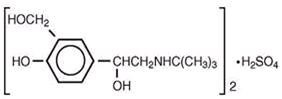
The molecular weight of albuterol sulfate is 576.7 and the empirical formula is (C 13 H 21 NO 3 ) 2 • H 2 SO 4 . Albuterol sulfate is a white crystalline powder, soluble in water and slightly soluble in ethanol. The World Health Organization’s recommended name for albuterol is salbutamol.
Albuterol sulfate inhalation solution is supplied in two strengths in unit-dose vials. Each unit-dose vial contains either 0.75 mg of albuterol sulfate (equivalent to 0.021% or 0.63 mg of albuterol) or 1.5 mg of albuterol sulfate (equivalent to 0.042% or 1.25 mg of albuterol) with sodium chloride and sulfuric acid in a 3 mL isotonic, sterile, aqueous solution. Sodium chloride is added to adjust isotonicity of the solution and sulfuric acid is added to adjust pH of the solution to between 3 and 5 (see HOW SUPPLIED ).
Albuterol sulfate inhalation solution does not require dilution prior to administration by nebulization. For albuterol sulfate inhalation solution, like all other nebulized treatments, the amount delivered to the lungs will depend on patient factors, the jet nebulizer utilized, and compressor performance. Using the Pari LC Plus™ nebulizer (with face mask or mouthpiece) connected to a Pari PRONEB™ compressor, under in vitro conditions, the mean delivered dose from the mouth piece (% nominal dose) was approximately 43% of albuterol (0.042% or 1.25 mg strength) and 39% of albuterol (0.021% or 0.63 mg strength) at a mean flow rate of 3.6 L/min. The mean nebulization time was 15 minutes or less. Albuterol sulfate inhalation solution should be administered from a jet nebulizer at an adequate flow rate, via a mouthpiece or face mask (see DOSAGE AND ADMINISTRATION ).
CLINICAL PHARMACOLOGY
The prime action of beta-adrenergic drugs is to stimulate adenyl cyclase, the enzyme which catalyzes the formation of cyclic-3',-5'-adenosine monophosphate (cyclic AMP) from adenosine triphosphate (ATP). The cyclic AMP thus formed mediates the cellular responses. In vitro studies and in vivo pharmacologic studies have demonstrated that albuterol has a preferential effect on beta 2 -adrenergic receptors compared with isoproterenol. While it is recognized that beta2 -adrenergic receptors are the predominant receptors in bronchial smooth muscle, recent data indicate that 10% to 50% of the beta-receptors in the human heart may be beta 2 -receptors. The precise function of these receptors, however, is not yet established. Controlled clinical studies and other clinical experience have shown that inhaled albuterol, like other beta-adrenergic agonist drugs, can produce a significant cardiovascular effect in some patients, as measured by pulse rate, blood pressure, symptoms, and/or electrocardiographic changes. Albuterol is longer acting than isoproterenol in most patients by any route of administration because it is not a substrate for the cellular uptake processes for catecholamines nor for catechol- O -methyl transferase.
Pharmacokinetics
Studies in asthmatic patients have shown that less than 20% of a single albuterol dose was absorbed following either intermittent positive-pressure breathing (IPPB) or nebulizer administration; the remaining amount was recovered from the nebulizer and apparatus, and expired air. Most of the absorbed dose was recovered in urine collected during the 24 hours after drug administration. Following oral administration of 4 mg albuterol, the elimination half-life was five to six hours. Following a 3 mg dose of nebulized albuterol in adults, the mean maximum albuterol plasma level at 0.5 hours was 2.1 ng/mL (range, 1.4 to 3.2 ng/mL). The pharmacokinetics of albuterol following administration of 0.63 mg (0.021%) or 1.25 mg (0.042%) albuterol sulfate inhalation solution by nebulization have not been determined in children 2 to 12 years old.
CLINICAL STUDIES
The safety and efficacy of albuterol sulfate inhalation solution was evaluated in a 4-week, multi-center, randomized, double-blind, placebo-controlled, parallel group study in 349 children 6 to 12 years of age with mild-to-moderate asthma (mean baseline FEV 1 60% to 70% of predicted). Approximately half of the patients were also receiving inhaled corticosteroids. Patients were randomized to receive albuterol sulfate inhalation solution 0.63 mg (0.021%), albuterol sulfate inhalation solution 1.25 mg (0.042%), or placebo three times a day administered via a Pari LC Plus™ nebulizer and a Pari PRONEB™ compressor. Racemic albuterol, delivered by a chlorofluorocarbon (CFC) metered dose inhaler (MDI) or nebulized, was used on an as-needed basis as the rescue medication.
Efficacy, as measured by the mean percent change from baseline in the area under the 6-hour curve for FEV 1 , was demonstrated for both active treatment regimens (n=112 [1.25 mg or 0.042% group] and n=110 [0.63 mg or 0.021% group]) compared with placebo (n=110) on day 1 and day 28. Figures 1 and 2 illustrate the mean percentage change from pre-dose FEV 1 on day 1 and day 28, respectively. The mean baseline FEV 1 for all patients was 1.49 L.
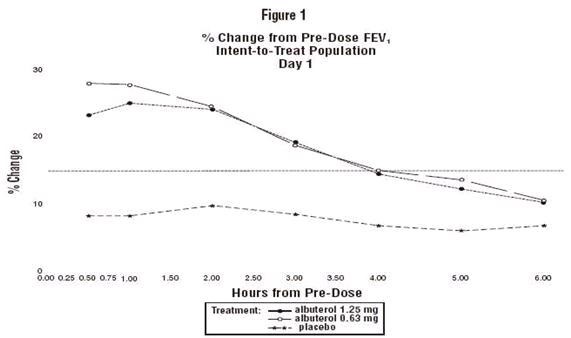
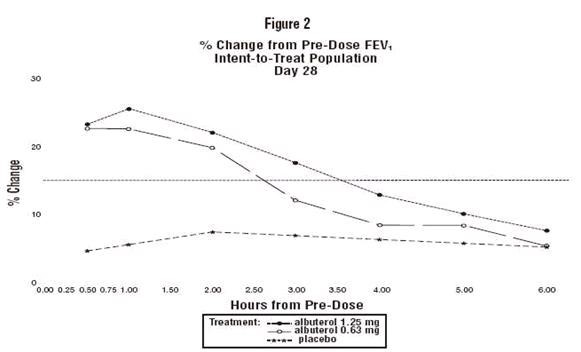
The onset of a 15% increase in FEV 1 over baseline for both doses of albuterol sulfate inhalation solution was seen at 30 minutes (the first post-dose assessment). The mean time to peak effect was approximately 30 to 60 minutes for both doses on day 1 and after 4 weeks of treatment. The mean duration of effect, as measured by a >15% increase from baseline in FEV 1 , was approximately 2.5 hours for both doses on day 1 and approximately 2 hours for both doses after 4 weeks of treatment. In some patients, the duration of effect was as long as 6 hours.
HOW SUPPLIED
Albuterol sulfate inhalation solution is supplied as a 3 mL, clear, colorless, sterile, preservative-free, aqueous solution in two different strengths, 0.63 mg (0.021%) of albuterol (equivalent to 0.75 mg of albuterol sulfate in 3 mL) and 1.25 mg (0.042%) of albuterol (equivalent to 1.5 mg of albuterol sulfate in 3 mL) in unit-dose low-density polyethylene (LDPE) vials. Each unit-dose LDPE vial is protected in a foil pouch, and each foil pouch contains 1 unit-dose LDPE vial. Each strength of albuterol sulfate inhalation solution is available in a shelf carton containing multiple foil pouches.
Albuterol Sulfate Inhalation Solution 0.021% (0.63 mg / 3 mL) (potency expressed as albuterol equivalent to 0.75 mg albuterol sulfate per 3 mL) in unit-dose vials and is available in the following packaging configurations:
- NDC 62135-826-84: 30 foil pouches, each containing 1 vial, total 30 vials per carton
Albuterol Sulfate Inhalation Solution, 0.042% (1.25 mg / 3 mL) (potency expressed as albuterol equivalent to 1.5 mg albuterol sulfate per 3 mL) in unit-dose vials and is available in the following packaging configurations:
- NDC 62135-827-84 30 foil pouches, each containing 1 vial, total 30 vials per carton
Storage and Handling
Store between 2°C and 25°C (36°F and 77°F). Protect from light and excessive heat.
Store unit-dose vials in protective foil pouch at all times. Once removed from the foil pouch, use vial within one week. Discard the vial if the solution is not colorless.
Keep out of the reach of children.
Rx Only
Manufactured for:
Chartwell RX, LLC.
Congers, NY 10920
L71912
Rev. 01/2024
