Get your patient on Buphenyl - Sodium Phenylbutyrate tablet (Sodium Phenylbutyrate)
Buphenyl - Sodium Phenylbutyrate tablet prescribing information

INDICATIONS AND USAGE
BUPHENYL is indicated as adjunctive therapy in the chronic management of patients with urea cycle disorders involving deficiencies of carbamoyl phosphate synthetase (CPS), ornithine transcarbamylase (OTC), or argininosuccinic acid synthetase (AS). It is indicated in all patients with neonatal-onset deficiency (complete enzymatic deficiency, presenting within the first 28 days of life). It is also indicated in patients with late-onset disease (partial enzymatic deficiency, presenting after the first month of life) who have a history of hyperammonemic encephalopathy. It is important that the diagnosis be made early and treatment initiated immediately to improve survival. Any episode of acute hyperammonemia should be treated as a life-threatening emergency.
BUPHENYL must be combined with dietary protein restriction and, in some cases, essential amino acid supplementation. (See Nutritional Supplementation subsection of the DOSAGE AND ADMINISTRATION section.)
Previously, neonatal-onset disease was almost universally fatal within the first year of life, even when treated with peritoneal dialysis and essential amino acids or their nitrogen-free analogs. However, with hemodialysis, use of alternative waste nitrogen excretion pathways (sodium phenylbutyrate, sodium benzoate, and sodium phenylacetate), dietary protein restriction, and, in some cases, essential amino acid supplementation, the survival rate in newborns diagnosed after birth but within the first month of life is almost 80%. Most deaths have occurred during an episode of acute hyperammonemic encephalopathy. Patients with neonatal-onset disease have a high incidence of mental retardation. Those who had IQ tests administered had an incidence of mental retardation as follows: ornithine transcarbamylase deficiency, 100% (14/14 patients tested); argininosuccinic acid synthetase deficiency, 88% (15/17 patients tested); and carbamoyl phosphate synthetase deficiency, 57% (4/7 patients tested). Retardation was severe in the majority of the retarded patients.
In patients diagnosed during gestation and treated prior to any episode of hyperammonemic encephalopathy, survival is 100%, but even in these patients, most subsequently demonstrate cognitive impairment or other neurologic deficits.
In late-onset deficiency patients, including females heterozygous for ornithine transcarbamylase deficiency, who recover from hyperammonemic encephalopathy and are then treated chronically with sodium phenylbutyrate and dietary protein restriction, the survival rate is 98%. The two deaths in this group of patients occurred during episodes of hyperammonemic encephalopathy. However, compliance with the therapeutic regimen has not been adequately documented to allow evaluation of the potential for BUPHENYL and dietary protein restriction to prevent mental deterioration and recurrence of hyperammonemic encephalopathy if carefully adhered to. The majority of these patients tested (30/46 or 65%) have IQ's in the average to low average/borderline mentally retarded range. Reversal of preexisting neurologic impairment is not likely to occur with treatment and neurologic deterioration may continue in some patients.
Even on therapy, acute hyperammonemic encephalopathy recurred in the majority of patients for whom the drug is indicated.
BUPHENYL may be required lifelong unless orthotopic liver transplantation is elected.
(See CLINICAL PHARMACOLOGY, Pharmacodynamics subsection for the biochemical effects of BUPHENYL).
DOSAGE AND ADMINISTRATION
For oral use only.
The use of BUPHENYL Tablets is indicated for children weighing more than 20 kg and for adults.
The usual total daily dose of BUPHENYL Tablets and Powder for patients with urea cycle disorders is 450–600 mg/kg/day in patients weighing less than 20 kg, or 9.9–13.0 g/m2/day in larger patients. The tablets and powder are to be taken in equally divided amounts with each meal or feeding (i.e., three to six times per day).
BUPHENYL Powder is indicated for oral use (via mouth, gastrostomy, or nasogastric tube) only. The powder is to be mixed with food (solid or liquid) for immediate use; however, when dissolved in water, BUPHENYL Powder has been shown to be stable for up to one week at room temperature or refrigerated. Sodium phenylbutyrate is very soluble in water (5 grams per 10 mL). When BUPHENYL Powder is added to a liquid, only sodium phenylbutyrate will dissolve, the excipients will not. The effect of food on sodium phenylbutyrate has not been determined.
Each level teaspoon (enclosed) dispenses 3.2 grams of powder and 3.0 grams of sodium phenylbutyrate. Each level tablespoon (enclosed) dispenses 9.1 grams of powder and 8.6 grams of sodium phenylbutyrate.
Shake lightly before use.
The safety or efficacy of doses in excess of 20 grams (40 tablets) per day has not been established.
NUTRITIONAL MANAGEMENT
To promote growth and development, plasma levels of ammonia, arginine, branched-chain amino acids, and serum protein should be maintained within normal limits while plasma glutamine is maintained at levels less than 1,000 µmol/L. Minimum daily protein intake for a patient of a particular age should be taken from, for example, "Recommended Dietary Allowances", 10th ed., Food and Nutrition Board, National Academy of Sciences, 1989. The allocation of dietary nitrogen into natural protein and essential amino acids is a function of age, residual urea cycle enzyme activity, and the dose of sodium phenylbutyrate.
At the recommended dose of sodium phenylbutyrate, it is suggested that infants with neonatal-onset CPS and OTC deficiencies initially receive a daily dietary protein intake limited to approximately 1.6 g/kg/day for the first 4 months of life. If tolerated, the daily protein intake may be increased to 1.9 g/kg/day during this period. Protein tolerance will decrease as the growth rate decreases, requiring a reduction in dietary nitrogen intake. From 4 months to 1 year of age, it is recommended that the infant receive at least 1.4 g/kg/day, but 1.7 g/kg/day is advisable. From 1 to 3 years of age, the protein intake should not be less than 1.2 g/kg/day; 1.4 g/kg/day is advisable during this period. For neonatal-onset patients with carbamoyl phosphate synthetase deficiency or ornithine transcarbamylase deficiency who are at least 6 months of age, it is recommended that the daily protein intake be equally divided between natural protein and supplemental essential amino acids.
Patients with argininosuccinic acid synthetase deficiency and those with late-onset disease (partial deficiencies, including females heterozygous for ornithine transcarbamylase), initially may receive a diet containing the age-determined minimal daily natural protein allowance. The protein intake may be increased as tolerated and determined by plasma glutamine and other amino acid levels. However, many patients with partial deficiencies avoid dietary protein.
Citrulline supplementation is required and recommended for patients diagnosed with neonatal-onset deficiency of carbamoyl phosphate synthetase or ornithine transcarbamylase; citrulline daily intake is recommended at 0.17 g/kg/day or 3.8 g/m 2 /day.
The free-base form of arginine may be used instead of citrulline in patients with milder forms of carbamoyl phosphate synthetase and ornithine transcarbamylase deficiency (daily intake is recommended at 0.17 g/kg/day or 3.8 g/m 2 /day).
Arginine supplementation is needed for patients diagnosed with deficiency of argininosuccinic acid synthetase; arginine (free base) daily intake is recommended at 0.4–0.7 g/kg/day or 8.8–15.4 g/m 2 /day.
If caloric supplementation is indicated, a protein-free product is recommended. Caloric intake should be based upon the "Recommended Dietary Allowances", 10th ed., Food and Nutrition Board, National Research Council, National Academy of Sciences, 1989.
CONTRAINDICATIONS
BUPHENYL should not be used to manage acute hyperammonemia, which is a medical emergency.
ADVERSE REACTIONS
The assessment of clinical adverse events came from 206 patients treated with sodium phenylbutyrate. Adverse events (both clinical and laboratory) were not collected systematically in these patients, but were obtained from patient visit reports by the 65 co-investigators. Causality of adverse effects is sometimes difficult to determine in this patient population because they may result from either the underlying disease, the patient's restricted diet, intercurrent illness, or BUPHENYL. Furthermore, the rates may be underestimated because they were reported primarily by parent or guardian and not the patient.
Clinical Adverse Events
In female patients, the most common clinical adverse event reported was amenorrhea/menstrual dysfunction (irregular menstrual cycles), which occurred in 23% of the menstruating patients.
Decreased appetite occurred in 4% of all patients. Body odor (probably caused by the metabolite, phenylacetate) and bad taste or taste aversion were each reported in 3% of patients.
Other adverse events reported in 2% or fewer patients were:
Gastrointestinal : abdominal pain, gastritis, nausea and vomiting; constipation, rectal bleeding, peptic ulcer disease, and pancreatitis each occurred in one patient.
Hematologic : aplastic anemia and ecchymoses each occurred in one patient.
Cardiovascular : arrhythmia and edema each occurred in one patient.
Renal : renal tubular acidosis
Psychiatric : depression
Skin : rash
Miscellaneous : headache, syncope, and weight gain
Neurotoxicity was reported in cancer patients receiving intravenous phenylacetate, 250–300 mg/kg/day for 14 days, repeated at 4-week intervals. Manifestations were predominately somnolence, fatigue, and lightheadedness; with less frequent headache, dysgeusia, hypoacusis, disorientation, impaired memory, and exacerbation of a pre-existing neuropathy. These adverse events were mainly mild in severity. The acute onset and reversibility when the phenylacetate infusion was discontinued suggest a drug effect.
Laboratory Adverse Events
In patients with urea cycle disorders, the frequency of laboratory adverse events by body system were:
Metabolic : acidosis (14%), alkalosis and hyperchloremia (each 7%), hypophosphatemia (6%), hyperuricemia and hyperphosphatemia (each 2%), and hypernatremia and hypokalemia (each 1%).
Nutritional : hypoalbuminemia (11%) and decreased total protein (3%).
Hepatic : increased alkaline phosphatase (6%), increased liver transaminases (4%), and hyperbilirubinemia (1%).
Hematologic : anemia (9%), leukopenia and leukocytosis (each 4%), thrombocytopenia (3%), and thrombocytosis (1%).
The clinician is advised to routinely perform urinalysis, blood chemistry profiles, and hematologic tests.
DESCRIPTION
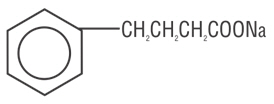
BUPHENYL (sodium phenylbutyrate) Tablets for oral administration and BUPHENYL (sodium phenylbutyrate) Powder for oral, nasogastric, or gastrostomy tube administration contain sodium phenylbutyrate. Sodium phenylbutyrate is an off-white crystalline substance which is soluble in water and has a strong salty taste. Sodium phenylbutyrate also is freely soluble in methanol and practically insoluble in acetone and diethyl ether. It is known chemically as 4-phenylbutyric acid, sodium salt with a molecular weight of 186 and the molecular formula C 10 H 11 O 2 Na.
Chemical Structure:
Each tablet of BUPHENYL contains 500 mg of sodium phenylbutyrate and the inactive ingredients microcrystalline cellulose NF, magnesium stearate NF, and colloidal silicon dioxide NF.
Each gram of BUPHENYL Powder contains 0.94 grams of sodium phenylbutyrate and the inactive ingredients calcium stearate NF, and colloidal silicon dioxide NF.
CLINICAL PHARMACOLOGY
Sodium phenylbutyrate is a pro-drug and is rapidly metabolized to phenylacetate. Phenylacetate is a metabolically active compound that conjugates with glutamine via acetylation to form phenylacetylglutamine. Phenylacetylglutamine then is excreted by the kidneys. On a molar basis, it is comparable to urea (each containing two moles of nitrogen). Therefore, phenylacetylglutamine provides an alternate vehicle for waste nitrogen excretion.
HOW SUPPLIED
BUPHENYL Tablets are available in 250 cc bottles which contain 250 sodium phenylbutyrate tablets (NDC 75987-060-08). The bottles are equipped with child-resistant caps. Each tablet is off-white, oval, and embossed with "UCY 500". Each tablet contains 500 mg of sodium phenylbutyrate. STORE AT ROOM TEMPERATURE 15°C–30°C (59°F–86°F). AFTER OPENING, KEEP BOTTLE TIGHTLY CLOSED.
BUPHENYL Powder is available in 500 cc bottles, which hold 266 grams of powder, containing 250 grams of sodium phenylbutyrate (NDC 75987-070-09). The bottles are equipped with child-resistant caps. Measurers are provided. Each level teaspoon (enclosed) dispenses 3.2 grams of powder and 3.0 grams of sodium phenylbutyrate. Each level tablespoon (enclosed) dispenses 9.1 grams of powder and 8.6 grams of sodium phenylbutyrate. STORE AT ROOM TEMPERATURE 15ºC–30ºC (59ºF–86ºF). AFTER OPENING, KEEP BOTTLE TIGHTLY CLOSED.
