Get your patient on Cesamet - Nabilone capsule (Nabilone)
Cesamet - Nabilone capsule prescribing information

INDICATIONS AND USAGE
Cesamet capsules are indicated for the treatment of the nausea and vomiting associated with cancer chemotherapy in patients who have failed to respond adequately to conventional antiemetic treatments. This restriction is required because a substantial proportion of any group of patients treated with Cesamet can be expected to experience disturbing psychotomimetic reactions not observed with other antiemetic agents.
Because of its potential to alter the mental state, Cesamet is intended for use under circumstances that permit close supervision of the patient by a responsible individual particularly during initial use of Cesamet and during dose adjustments.
Cesamet contains nabilone, which is controlled in Schedule II of the Controlled Substances Act. Schedule II substances have a high potential for abuse. Prescriptions for Cesamet should be limited to the amount necessary for a single cycle of chemotherapy (i.e., a few days).
Cesamet capsules are not intended to be used on as needed basis or as a first antiemetic product prescribed for a patient.
As with all controlled drugs, prescribers should monitor patients receiving nabilone for signs of excessive use, abuse and misuse. Patients who may be at increased risk for substance abuse include those with a personal or family history of substance abuse (including drug or alcohol abuse) or mental illness.
DOSAGE AND ADMINISTRATION
The usual adult dosage is 1 or 2 mg 2 times a day. On the day of chemotherapy, the initial dose should be given 1 to 3 hours before the chemotherapeutic agent is administered. To minimize side effects, it is recommended that the lower starting dose be used and that the dose be increased as necessary. A dose of 1 or 2 mg the night before may be useful. The maximum recommended daily dose is 6 mg given in divided doses 3 times a day.
Cesamet may be administered 2 or 3 times a day during the entire course of each cycle of chemotherapy and, if needed, for 48 hours after the last dose of each cycle of chemotherapy.
CONTRAINDICATIONS
Cesamet is contraindicated in any patient who has a history of hypersensitivity to any cannabinoid.
ADVERSE REACTIONS
Commonly Encountered Reactions: During controlled clinical trials of Cesamet, virtually all patients experienced at least one adverse reaction. The most commonly encountered events were drowsiness, vertigo, dry mouth, euphoria (feeling “high”), ataxia, headache, and concentration difficulties.
Comparative Incidence of Reactions: Accurate estimates of the incidence of adverse events associated with the use of any drug are difficult to obtain. Estimates are influenced by factors such as drug dose, detection technique, setting, and physician judgments, among others. Consequently, the tables presented below are presented solely to indicate the relative frequency of adverse events reported in representative controlled clinical studies conducted to evaluate the safety and efficacy of Cesamet under relatively similar conditions of use. The figures cited cannot be used to predict precisely the incidence of untoward events in the course of usual medical practice, in which patient characteristics and other factors may differ from those that prevailed in the clinical trials. These incidence figures also cannot be compared with those obtained from other clinical studies involving related drug products because each group of drug trials is conducted under a different set of conditions.
Finally, it is important to emphasize that these tabulations do not reflect the relative severity and/or clinical importance of the adverse events. A better perspective on the serious adverse events associated with the use of Cesamet is provided in the WARNINGS and PRECAUTIONS sections.
The following tables list in order of decreasing frequency the adverse reactions encountered by a substantial proportion of patients treated with Cesamet participating in representative controlled clinical trials.
Incidence of Adverse Reactions in Placebo-Controlled Studies | ||||
Nabilone (n=132) | Placebo (n=119) | |||
Adverse Event | Patients | Percent | Patients | Percent |
Vertigo | 69 | 52 | 3 | 3 |
Drowsiness | 69 | 52 | 6 | 5 |
Dry Mouth | 47 | 36 | 2 | 2 |
Ataxia | 19 | 14 | 0 | 0 |
Euphoria | 14 | 11 | 1 | 1 |
Sleep Disturbance | 14 | 11 | 1 | 1 |
Dysphoria | 12 | 9 | 0 | 0 |
Headache | 8 | 6 | 0 | 0 |
Nausea | 5 | 4 | 0 | 0 |
Disorientation | 3 | 2 | 0 | 0 |
Depersonalization | 2 | 2 | 1 | 1 |
Incidence of Adverse Reactions in Active-Controlled Studies | ||||
Nabilone (n=250) | Prochlorperazine (n=232) | |||
Adverse Event | Patients | Percent | Patients | Percent |
Drowsiness | 165 | 66 | 108 | 47 |
Vertigo/Dizziness | 147 | 59 | 53 | 23 |
Euphoria | 95 | 38 | 12 | 5 |
Dry Mouth | 54 | 22 | 11 | 5 |
Depression | 35 | 14 | 37 | 16 |
Ataxia | 32 | 13 | 4 | 2 |
Visual Disturbance | 32 | 13 | 9 | 4 |
Concentration Difficulties | 31 | 12 | 3 | 1 |
Hypotension | 20 | 8 | 3 | 1 |
Asthenia | 19 | 8 | 10 | 4 |
Anorexia | 19 | 8 | 22 | 9 |
Headache | 18 | 7 | 14 | 6 |
Sedation | 7 | 3 | 2 | 1 |
Increased Appetite | 6 | 2 | 2 | 1 |
Adverse Reactions by Body System —The following list of adverse events is organized by decreasing frequency within body systems for patients treated with Cesamet in controlled clinical trials. All events are listed regardless of causality assessment.
Blood and Hematopoietic —Anemia
Cardiovascular —Orthostatic hypotension, hypotension, tachycardia, syncope, palpitation, flushing, hypertension, arrhythmia, and cerebral vascular accident.
Eye and Ear —Vision disturbance, ear tightness, eye irritation, eye dryness, equilibrium dysfunction, tinnitus, eye disorder, amblyopia, eye swelling, eyelid diseases, pupil dilation, photophobia, and visual field defect.
Gastrointestinal —Dry mouth, nausea, anorexia, vomiting, diarrhea, abdominal pain, constipation, aphthous ulcer, mouth irritation, gastritis, and dyspepsia.
Genitourinary —Increased urination, decreased urination, hot flashes, urinary retention, and frequency of micturition.
Infection —Bacterial infection
Metabolic and Endocrine —Thirst
Musculoskeletal —Muscle pain, back pain, neck pain, joint pain, and unspecified pain.
Nervous System —Drowsiness, vertigo, ataxia, decreased concentration, sedation, hallucinations, paresthesia, tremor, memory disturbance, perception disturbance, convulsions, dystonia, numbness, and akathisia.
Psychiatric —Euphoria (feeling “high”), sleep disturbance, depression, confusion, disorientation, anxiety, depersonalization syndrome, speech disorder, abnormal dreams, insomnia, mood swings, inebriated feeling, toxic psychosis, paranoia, apathy, thought disorder, withdrawal, panic disorder, phobic neurosis, emotional disorder, and hyperactivity.
Respiratory —Dyspnea, pharyngitis, nasal congestion, sinus headache, thick tongue, dry throat, dry nose, wheezing, nosebleed, cough, voice change, and chest pain.
Skin and Appendages —Anhidrosis, photosensitivity, pruritus, rash, and allergic reactions.
Miscellaneous and Ill-Defined Conditions —Headache, fatigue, lightheadedness, coordination disturbance, asthesia, dysphoria, dizziness, taste change, excessive appetite, chills, excessive sweating, nervousness, malaise, postural dizziness, twitch, irritability, fever, inhibited walking, unconsciousness, hypotonia, and impaired urination.
Postmarketing Adverse Reactions —Cesamet has been marketed internationally since 1982. The following adverse reactions listed in order of decreasing frequency by body system have been reported since Cesamet has been marketed. All events are listed regardless of causality assessment.
Blood and Hematopoietic —Leukopenia
Cardiovascular —Hypotension and tachycardia
Eye and Ear —Visual disturbances
Gastrointestinal —Dry mouth, nausea, vomiting, and constipation
Nervous System —Hallucinations, CNS depression, CNS stimulation, ataxia, stupor, vertigo, convulsion, and circumoral paresthesia
Psychiatric —Somnolence, confusion, euphoria, depression, dysphoria, depersonalization, anxiety, psychosis, and emotional lability
Miscellaneous and Ill-Defined Conditions —Dizziness, headache, insomnia, abnormal thinking, chest pain, lack of effect, and face edema
To report SUSPECTED ADVERSE REACTIONS, contact Bausch Health US, LLC at 1-800-321-4576 or FDA at 1-800-FDA-1088 or www.fda.gov/medwatch.
Drug Interactions
Potential interactions between Cesamet 2 mg, and diazepam 5 mg; sodium secobarbital 100 mg; alcohol 45 mL (absolute laboratory alcohol); or codeine 65 mg, were evaluated in 15 subjects. Only a single combination was utilized at any one time. The subjects were evaluated according to physiologic (i.e., heart rate and blood pressure), psychometric, psychomotor, and subjective parameters. In this study, as expected, the depressant effects of the combinations were additive. Psychomotor function was particularly impaired with concurrent use of diazepam. Caution must thus be used when administering nabilone in combination with any CNS depressant.
Nabilone is purportedly highly bound to plasma proteins, and therefore, might displace other protein-bound drugs. Therefore, practitioners should monitor patients for a change in dosage requirements when administering nabilone to patients receiving other highly protein-bound drugs. Published reports of drug-drug interactions involving cannabinoids are summarized in the following table.
CONCOMITANT DRUG | CLINICAL EFFECT(S) |
Amphetamines, cocaine, other sympathomimetic agents | Additive hypertension, tachycardia, possibly cardiotoxicity |
Atropine, scopolamine, antihistamines, other anticholinergic agents | Additive or super-additive tachycardia, drowsiness |
Amitriptyline, amoxapine, desipramine, other tricyclic antidepressants | Additive tachycardia, hypertension, drowsiness |
Barbiturates, benzodiazepines, ethanol, lithium, opioids, buspirone, antihistamines, muscle relaxants, other CNS depressants | Additive drowsiness and CNS depression |
Disulfiram | A reversible hypomanic reaction was reported in a 28 y/o man who smoked marijuana; confirmed by dechallenge and rechallenge |
Fluoxetine | A 21 y/o female with depression and bulimia receiving 20 mg/day fluoxetine X 4 wks became hypomanic after smoking marijuana; symptoms resolved after 4 days |
Antipyrine, barbiturates | Decreased clearance of these agents, presumably via competitive inhibition of metabolism |
Theophylline | Increased theophylline metabolism reported with smoking of marijuana; effect similar to that following smoking tobacco |
Opioids | Cross-tolerance and mutual potentiation |
Naltrexone | Oral THC effects were enhanced by opioid receptor blockade. |
Alcohol | Increase in the positive subjective mood effects of smoked marijuana |
Animal Pharmacology and/or Toxicology
Monkeys treated with Cesamet at doses as high as 2 mg/kg/day for a year experienced no significant adverse events. This result contrasts with the findings in a planned 1-year dog study that was prematurely terminated because of deaths associated with convulsions in dogs receiving as little as 0.5 mg/kg/day. The earliest deaths, however, occurred at 56 days in dogs receiving 2 mg/kg/day. The unusual vulnerability of the dog to Cesamet is not understood; it is hypothesized, however, that the explanation lies in the fact that the dog differs markedly from other species in its metabolism of Cesamet.
DESCRIPTION
Cesamet® (nabilone) is a synthetic cannabinoid for oral administration. Nabilone as a raw material occurs as a white to off-white polymorphic crystalline powder. In aqueous media, the solubility of nabilone is less than 0.5 mg/L, with pH values ranging from 1.2 to 7.0.
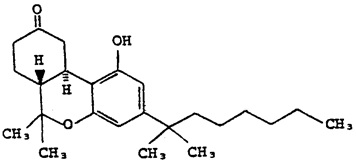
Chemically, nabilone is similar to the active ingredient found in naturally occurring Cannabis sativa L. [Marijuana; delta-9-tetrahydrocannabinol (delta-9-THC)]. Nabilone is (±)- trans -3-(1,1-dimethylheptyl)-6,6a,7,8,10,10a-hexahydro-1-hydroxy-6-6-dimethyl-9H-dibenzo[b,d]pyran-9-one and has the empirical formula C24H36O3. It has a molecular weight of 372.55. The structural formula is as follows:
Each 1 mg Cesamet capsule contains 1 mg of nabilone and the following inactive ingredients: povidone and corn starch. The capsule shells contain the following inactive ingredients: FD&C Blue No. 2 (indigo carmine), red iron oxide, gelatin, and titanium dioxide.
CLINICAL PHARMACOLOGY
Pharmacodynamics
Cesamet (nabilone) is an orally active synthetic cannabinoid which, like other cannabinoids, has complex effects on the central nervous system (CNS). It has been suggested that the antiemetic effect of nabilone is caused by interaction with the cannabinoid receptor system, i.e., the CB (1) receptor, which has been discovered in neural tissues.
Nontherapeutic Effects: Cesamet, a synthetic cannabinoid, has the potential to be abused and to produce psychological dependence. Cesamet has complex effects on the central nervous system. Its effects on the mental state (i.e., “inner mental life”) are similar to those of cannabis. Subjects given Cesamet may experience changes in mood (euphoria, detachment, depression, anxiety, panic, paranoia), decrements in cognitive performance and memory, a decreased ability to control drives and impulses, and alterations in the experience of reality (e.g., distortions in the perception of objects and the sense of time, hallucinations). These phenomena appear to be more common when larger doses of Cesamet are administered; however, a full-blown picture of psychosis (psychotic organic brain syndrome) may occur in patients receiving doses within the lower portion of the therapeutic range.
Data on the chronic use of Cesamet are not available; experience with cannabis suggests that chronic use of cannabinoids may be associated with a variety of untoward effects on motivation, cognition, judgment, as well as other mental status changes. Whether these phenomena reflect the underlying character of individuals chronically abusing cannabis or are a result of the use of cannabis is not known.
The simultaneous use of Cesamet and alcohol or barbiturates may produce additive depressive effects on central nervous system function. Possible changes in mood and other adverse behavioral effects may occur in patients receiving Cesamet. Patients should remain under supervision of a responsible adult while using Cesamet.
Cesamet has central nervous system activity. It produces relaxation, drowsiness, and euphoria in the recommended dosage range. Tolerance to these effects develops rapidly and is readily reversible.
In addition to effects on the mental state, Cesamet has several systemic actions; most prominent are dry mouth and hypotension. Cesamet has been observed to elevate supine and standing heart rates and to cause supine and orthostatic hypotension. In clinical studies, oral administration of 2 mg of Cesamet did produce some decrease in airway resistance in normal controls but had no effect in patients with asthma. No other nontherapeutic effects of clinical significance due to Cesamet have been reported.
Pharmacokinetics
Absorption and Distribution: Cesamet (nabilone) appears to be completely absorbed from the human gastrointestinal tract when administered orally. Following oral administration of a 2 mg dose of radiolabeled nabilone, peak plasma concentrations of approximately 2 ng/mL nabilone and 10 ng equivalents/mL total radioactivity are achieved within 2.0 hours. The plasma half-life (T ½ ) values for nabilone and total radioactivity of identified and unidentified metabolites are about 2 and 35 hours, respectively. The initial rapid disappearance of radioactivity represents uptake and distribution of nabilone into tissue and the slower phase elimination by metabolism and excretion. The apparent volume of distribution of nabilone is about 12.5 L/kg.
Nabilone exhibits dose linearity within its therapeutic range. Clinical data suggests that the intake of food does not significantly affect either the rate or extent of absorption.
Metabolism: Metabolism of nabilone is extensive and several metabolites have been identified. Precise information concerning the metabolites that may accumulate is not available. The relative activities of the metabolites and the parent drug have not been established. There are at least two metabolic pathways involved in the biotransformation of nabilone. A minor pathway is initiated by the stereospecific enzymatic reduction of the 9-keto moiety of nabilone to produce the isomeric carbinol metabolite. The peak concentrations of nabilone and its carbinol metabolites are comparable, but their combined exposures in plasma do not account for more than 20% of that of total radioactivity. Secondly, a metabolite of nabilone in feces has been identified as a diol formed by reduction of the 9-keto group plus oxidation at the penultimate carbon of the dimethylheptyl side chain. In addition, there is evidence of extensive metabolism of Cesamet by multiple P450 enzyme isoforms. In vitro P450 inhibition studies using human liver microsomes showed that nabilone did not significantly inhibit CYP1A2, 2A6, 2C19, 2D6, and 3A4 (using midazolam and nifedipine as substrates). Nabilone had a weak inhibitory effect on CYP 2E1 and 3A4 (testosterone; IC 50 > 50 µM) and had a moderate inhibitory effect on CYP2C8 and 2C9 (IC 50 > 10 µM). However, in clinical use, the very low nabilone plasma concentration is unlikely to interfere with the P450-mediated degradation of co-administered drugs. Chronic oral administration of 1 mg t.i.d. for 14 days to 3 subjects gave no indication there was any significant accumulation of nabilone. Available evidence suggests that one or more of the metabolites has a terminal elimination half-life that exceeds that of nabilone. Consequently, in repeated use, the metabolites may accumulate at concentrations in excess of the parent drug.
Elimination: The route and rate of the elimination of nabilone and its metabolites are similar to those observed with other cannabinoids, including delta-9-THC (dronabinol). When nabilone is administered intravenously, the drug and its metabolites are eliminated mainly in the feces (approximately 67%) and to a lesser extent in the urine (approximately 22%) within 7 days. Of the 67% recovered from the feces, 5% corresponded to the parent compound and 16% to its carbinol metabolite. Following oral administration about 60% of nabilone and its metabolites were recovered in the feces and about 24% in urine. Therefore, it appears that the major excretory pathway is the biliary system.
The effects of age, gender, hepatic dysfunction, and renal insufficiency on the metabolism and elimination of nabilone have not been determined.
Special Populations: The pharmacokinetic profile of Cesamet has not been investigated in either pediatric (see PRECAUTIONS, Pediatric Use ) or geriatric patients (see PRECAUTIONS, Geriatric Use ).
Clinical Trials
Cesamet was evaluated for its effectiveness and safety in the treatment of nausea and vomiting induced by cancer chemotherapy in patients receiving a wide variety of chemotherapy regimens, including low-dose cisplatin (20 mg/m2) in both placebo-controlled and active controlled (prochlorperazine) trials.
During Cesamet treatment patients reported a higher incidence of adverse effects. The most frequent were drowsiness, vertigo, dry mouth and euphoria. However, most of the adverse effects occurring with Cesamet were of mild to moderate severity (see ADVERSE REACTIONS ).
HOW SUPPLIED
Cesamet® capsules (blue and white): 1 mg (bottles of 50 capsules) NDC 0187-1231-50. Capsules are imprinted with ICN on the blue cap and a four-digit code (3101) on the white body. Store at controlled room temperature 25°C (77°F); excursions permitted to 15° to 30°C (59° to 86°F) [see USP Controlled Room Temperature].
Distributed by:
Bausch Health US, LLC Bridgewater, NJ 08807 USA
Manufactured by: Bausch Health Companies Inc. Laval, Quebec H7L 4A8, Canada
Cesamet is a trademark of Bausch Health Companies Inc. or its affiliates.
© 2021 Bausch Health Companies Inc. or its affiliates
9754700 Rev. 02/2021
