Ciloxan - Ciprofloxacin Hydrochloride ointment prescribing information

INDICATIONS AND USAGE:
CILOXAN ® (ciprofloxacin ophthalmic ointment) 0.3% is indicated for the treatment of bacterial conjunctivitis caused by susceptible strains of the microorganisms listed below:
- Gram-Positive: Staphylococcus aureus Staphylococcus epidermidis Streptococcus pneumoniae Streptococcus Viridans Group
Gram-Negative: Haemophilus influenzae
DOSAGE AND ADMINISTRATION:
Apply a ½ inch ribbon into the conjunctival sac three times a day on the first two days, then apply a ½ inch ribbon two times a day for the next five days.
CONTRAINDICATIONS:
A history of hypersensitivity to ciprofloxacin or any other component of the medication is a contraindication to its use. A history of hypersensitivity to other quinolones may also contraindicate the use of ciprofloxacin.
ADVERSE REACTIONS:
The following adverse reactions (incidences) were reported in 2% of the patients in clinical studies for CILOXAN ® (ciprofloxacin ophthalmic ointment) 0.3%: discomfort and keratopathy. Other reactions associated with ciprofloxacin therapy occurring in less than 1% of patients included allergic reactions, blurred vision, corneal staining, decreased visual acuity, dry eye, edema, epitheliopathy, eye pain, foreign body sensation, hyperemia, irritation, keratoconjunctivitis, lid erythema, lid margin hyperemia, photophobia, pruritus, and tearing. Systemic adverse reactions related to ciprofloxacin therapy occurred at an incidence below 1% and included dermatitis, nausea and taste perversion.
- Drug Interactions: Specific drug interaction studies have not been conducted with ophthalmic ciprofloxacin. However, the systemic administration of some quinolones has been shown to elevate plasma concentrations of theophylline, interfere with the metabolism of caffeine, enhance the effects of the oral anticoagulant, warfarin, and its derivatives, and has been associated with transient elevations in serum creatinine in patients receiving cyclosporine concomitantly.
DESCRIPTION:
CILOXAN ® (ciprofloxacin ophthalmic ointment) 0.3% is a synthetic, sterile, multiple dose, antimicrobial for topical use. Ciprofloxacin is a fluoroquinolone antibacterial. It is available as the monohydrochloride monohydrate salt of 1-cyclopropyl-6-fluoro-1,4-dihydro-4-oxo-7-(1-piperazinyl)-3-quinolinecarboxylic acid. Ciprofloxacin is a faint to light yellow crystalline powder with a molecular weight of 385.82 g/mol. Its empirical formula is C 17 H 18 FN 3 O 3 •HCl•H 2 O and its chemical structure is as follows:
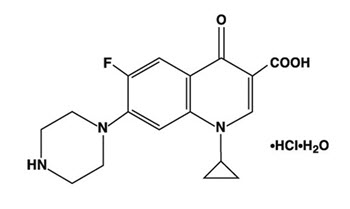
Ciprofloxacin differs from other quinolones in that it has a fluorine atom at the 6-position, a piperazine moiety at the 7-position, and a cyclopropyl ring at the 1-position.
Each gram of CILOXAN ® (ciprofloxacin ophthalmic ointment) 0.3% contains: Active: ciprofloxacin HCl 3.33 mg equivalent to 3 mg base. Inactives: mineral oil, white petrolatum.
CLINICAL PHARMACOLOGY:
Systemic Absorption: Absorption studies in humans with the ciprofloxacin ointment have not been conducted, however, based on studies with ciprofloxacin solution, 0.3%, mean maximal concentrations are expected to be less than 2.5 ng/mL.
Microbiology: Ciprofloxacin has in vitro activity against a wide range of gram-negative and gram-positive organisms. The bactericidal action of ciprofloxacin results from interference with the enzyme DNA gyrase which is needed for the synthesis of bacterial DNA.
Ciprofloxacin has been shown to be active against most strains of the following microorganisms both in vitro and in clinical infections (see INDICATIONS AND USAGE section).
Aerobic gram-positive microorganisms: Staphylococcus aureus (methicillin-susceptible strains) Staphylococcus epidermidis (methicillin-susceptible strains) Streptococcus pneumoniae Streptococcus Viridans Group
Aerobic gram-negative microorganisms: Haemophilus influenzae
The following in vitro data are available; but their clinical significance in ophthalmologic infections is unknown . The safety and effectiveness of ciprofloxacin in treating conjunctivitis due to these microorganisms have not been established in adequate and well-controlled trials.
The following organisms are considered susceptible when evaluated using systemic breakpoints. However, a correlation between the in vitro systemic breakpoint and ophthalmological efficacy has not been established. Ciprofloxacin exhibits in vitro minimal inhibitory concentrations (MIC’s) of 1 mcg/mL or less (systemic susceptible breakpoint) against most (greater than or equal to 90%) strains of the following ocular pathogens.
Aerobic gram-positive microorganisms: Bacillus species Corynebacterium species Staphylococcus haemolyticus Staphylococcus hominis
Aerobic gram-negative microorganisms: Acinetobacter calcoaceticus Enterobacter aerogenes Escherichia coli Haemophilus parainfluenzae Klebsielle pneumoniae Moraxella catarrhalis Neisseria gonorrhoeae Proteus mirabilis Pseudomonas aeruginosa Serratia marcesens
Most strains of Burkholderia cepacia and some strains of Stenotrophomonas maltophilia are resistant to ciprofloxacin as are most anaerobic bacteria, including Bacteroides fragilis and Clostridium difficile .
The minimal bactericidal concentration (MBC) generally does not exceed the minimal inhibitory concentration (MIC) by more than a factor of 2. Resistance to ciprofloxacin in vitro usually develops slowly (multiple-step mutation). Ciprofloxacin does not cross-react with other antimicrobial agents such as beta-lactams or aminoglycosides; therefore, organisms resistant to these drugs may be susceptible to ciprofloxacin. Organisms resistant to ciprofloxacin may be susceptible to beta-lactams or aminoglycosides.
Clinical Studies: In multi-center clinical trials, approximately 75% of the patients with signs and symptoms of bacterial conjunctivitis and positive conjunctival cultures were clinically cured and approximately 80% had presumed pathogens eradicated by the end of treatment (Day 7).
HOW SUPPLIED:
3.5 g STERILE ointment supplied in an aluminum tube with a white polyethylene tip and white polyethylene cap.
3.5 g NDC 66758-071-38
- Storage: Store at 2°C to 25°C (36°F to 77°F).
