Get your patient on Citanest Plain - Prilocaine Hydrochloride injection, Solution (Prilocaine Hydrochloride)
Citanest Plain - Prilocaine Hydrochloride injection, Solution prescribing information

INDICATIONS AND USAGE
4% Citanest Plain Dental Injection, Prilocaine Hydrochloride Injection, USP, 4% (72 mg/1.8 mL) (40 mg/mL), is indicated for the production of local anesthesia in dentistry by nerve block or infiltration techniques. Only accepted procedures for these techniques as described in standard textbooks are recommended.
DOSAGE AND ADMINISTRATION
The dosage of 4% Citanest Plain Dental Injection, Prilocaine Hydrochloride Injection, USP, 4% (72 mg/1.8 mL) (40 mg/mL), varies and depends on the physical status of the patient, the area of the oral cavity to be anesthetized, the vascularity of the oral tissues, and the technique of anesthesia. The least volume of injection that results in effective local anesthesia should be administered. For specific techniques and procedures of local anesthesia in the oral cavity, refer to standard textbooks.
Inferior Alveolar Block
There are no practical clinical differences between prilocaine with and without epinephrine when used for inferior alveolar blocks.
Maxillary Infiltration
4% Citanest Plain Dental, Prilocaine Hydrochloride Injection, USP, 4% (72 mg/1.8 mL) (40 mg/mL), is recommended for use in maxillary infiltration anesthesia for procedures in which the painful aspects can be completed within 15 minutes after the injection. 4% Citanest Plain Dental, Prilocaine Hydrochloride Injection, USP, 4% (72 mg/1.8 mL) (40 mg/mL), is therefore especially suited to short procedures in the maxillary anterior teeth. For long procedures, or those involving maxillary posterior teeth where soft tissue numbness is not troublesome to the patient, Prilocaine HCl 4% with epinephrine 1:200,000 is recommended.
For most routine procedures, initial dosages of 1 to 2 mL of 4% Citanest Plain Dental Injection, Prilocaine Hydrochloride Injection, USP, 4% (72 mg/1.8 mL) (40 mg/mL), will usually provide adequate infiltration or major nerve block anesthesia.
The maximum recommended dose that should ever be administered within a twohour period in normal healthy adults should be calculated based upon the patient’s weight as follows:
| Weight | Maximum recommended dose |
|---|---|
| <150 lb (<70 kg) | 4 mg/lb (8 mg/kg) |
| ≥150 lb (≥70 kg) | 600 mg (15 mL) or 8 cartridges |
In children under 10 years of age it is rarely necessary to administer more than onehalf cartridge (40 mg) of 4% Citanest Plain Dental Injection, Prilocaine Hydrochloride Injection, USP, 4% (72 mg/1.8 mL) (40 mg/mL), per procedure to achieve local anesthesia for a procedure involving a single tooth. In maxillary infiltration, this amount will often suffice to the treatment of two or even three teeth. In the mandibular block, however, satisfactory anesthesia achieved with this amount of drug will allow treatment of the teeth in an entire quadrant.
ASPIRATION PRIOR TO INJECTION IS RECOMMENDED, since it reduces the possibility of intravascular injection, thereby keeping the incidence of side effects and anesthetic failure to a minimum.
NOTE: Parenteral drug products should be inspected visually for particulate matter and discoloration prior to administration whenever the solution and container permit. Solutions that are discolored and/or contain particulate matter should not be used.
Any unused portion of a cartridge should be discarded.
Maximum Recommended Dosages
In patients weighing <150 lb (70 kg), no more than 4 mg/lb (8 mg/kg) should be administered. In patients weighing ≥150 lb, no more than 600 mg (8 cartridges) of prilocaine HCl should be administered as a single injection.
Children
It is difficult to recommend a maximum dose of any drug for children since this varies as a function of age and weight. For children of less than ten years who have a normal lean body mass and normal body development, the maximum dose may be determined by the application of one of the standard pediatric drug formulas (e.g., Clark's rule). For example, in a child of five years weighing 50 lb, the dose of prilocaine hydrochloride should not exceed 150 to 200 mg (6.6 to 8.8 mg/kg or 3 to 4 mg/lb of body weight) when calculated according to Clark's rule.
CONTRAINDICATIONS
Prilocaine is contraindicated in patients with a known history of hypersensitivity to local anesthetics of the amide type and in those rare patients with congenital or idiopathic methemoglobinemia.
ADVERSE REACTIONS
Swelling and persistent paresthesia of the lips and oral tissues may occur. Persistent paresthesias lasting weeks to months, and in rare instances paresthesia lasting greater than one year, have been reported.
Adverse experiences following the administration of prilocaine are similar in nature to those observed with other amide local anesthetic agents. These adverse experiences are, in general, dose-related and may result from high plasma levels caused by excessive dosage, rapid absorption or unintentional intravascular injection, or may result from a hypersensitivity, idiosyncrasy or diminished tolerance on the part of the patient. Serious adverse experiences are generally systemic in nature. The following types are those most commonly reported:
Central Nervous System
CNS manifestations are excitatory and/or depressant and may be characterized by lightheadedness, nervousness, apprehension, euphoria, confusion, dizziness, drowsiness, tinnitus, blurred or double vision, vomiting, sensations of heat, cold or numbness, twitching, tremors, convulsions, unconsciousness, respiratory depression, and arrest. The excitatory manifestations may be very brief or may not occur at all, in which case the first manifestation of toxicity may be drowsiness merging into unconsciousness and respiratory arrest.
Drowsiness following the administration of prilocaine is usually an early sign of a high blood level of the drug and may occur as a consequence of rapid absorption.
Cardiovascular System
Cardiovascular manifestations are usually depressant and are characterized by bradycardia, hypotension, and cardiovascular collapse, which may lead to cardiac arrest.
Signs and symptoms of depressed cardiovascular function may commonly result from a vasovagal reaction, particularly if the patient is in an upright position. Less commonly, they may result from a direct effect of the drug. Failure to recognize the premonitory signs such as sweating, a feeling of faintness, changes in pulse or sensorium may result in progressive cerebral hypoxia and seizure or serious cardiovascular catastrophe. Management consists of placing the patient in the recumbent position and ventilation with oxygen. Supportive treatment of circulatory depression may require the administration of intravenous fluids, and, when appropriate, a vasopressor (e.g., ephedrine) as directed by the clinical situation.
Allergic
Allergic reactions are characterized by cutaneous lesions, urticaria, edema, or anaphylactoid reactions. Allergic reactions as a result of sensitivity to prilocaine are extremely rare and, if they occur, should be managed by conventional means. The detection of sensitivity by skin testing is of doubtful value.
Neurologic
The incidences of adverse reactions (e.g., persistent neurologic deficit) associated with the use of local anesthetics may be related to the technique employed, the total dose of local anesthetic administered, the particular drug used, the route of administration, and the physical condition of the patient.
Clinically Significant Drug Interactions
Patients who are administered local anesthetics are at increased risk of developing methemoglobinemia when concurrently exposed to the following drugs, which could include other local anesthetics:
| Class | Examples |
|---|---|
| Nitrates/Nitrites | nitric oxide, nitroglycerin, nitroprusside, nitrous oxide |
| Local anesthetics | articaine, benzocaine, bupivacaine, lidocaine, mepivacaine, prilocaine, procaine, ropivacaine, tetracaine |
| Antineoplastic Agents | cyclophosphamide, flutamide, hydroxyurea, ifosfamide, rasburicase |
| Antibiotics | dapsone, nitrofurantoin, para-aminosalicylic acid, sulfonamides |
| Antimalarials | chloroquine, primaquine |
| Anticonvulsants | Phenobarbital, phenytoin, sodium valproate |
| Other drugs | acetaminophen, metoclopramide, quinine, sulfasalazine |
Concurrent administration of vasopressor drugs and ergot-type oxytocic drugs may cause severe, persistent hypertension or cerebrovascular accidents.
DESCRIPTION
4% Citanest Plain Dental, Prilocaine Hydrochloride Injection, USP, 4% (72 mg/1.8 mL) (40 mg/mL), (prilocaine HCl Injection, USP), is a sterile, non pyrogenic isotonic solution that contains a local anesthetic agent and is administered parenterally by injection. See INDICATIONS AND USAGE for specific uses. The quantitative composition is shown in Table 1.
4% Citanest Plain Dental, Prilocaine Hydrochloride Injection, USP, 4% (72 mg/1.8 mL) (40 mg/mL), contains prilocaine HCl, which is chemically designated as propanamide, N-(2-methyl-phenyl) -2- (propylamino)-, monohydrochloride and has the following structural formula:
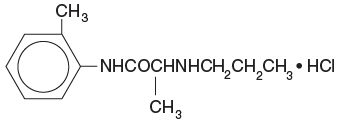
C 13 H 20 N 2 O ∙ HCl molecular wt = 256.77
Parenteral drug products should be inspected visually for particulate matter and discoloration prior to administration.
The specific quantitative composition is shown in Table 1.
| Product Identification | Formula (mg/mL) | |
|---|---|---|
| Prilocaine HCl | pH | |
| Note: Sodium hydroxide or hydrochloric acid may be used to adjust the pH of 4% Citanest Plain Dental Injection (Prilocaine Hydrochloride Injection, USP, 4% (72 mg/1.8 mL) (40 mg/mL)). | ||
| 4% Citanest Plain Dental (Prilocaine Hydrochloride Injection, USP, 4% (72 mg/1.8 mL) (40 mg/mL)) | 40.0 | 6.0 to 7.0 |
CLINICAL PHARMACOLOGY
Mechanism of Action
Prilocaine stabilizes the neuronal membrane by inhibiting the ionic fluxes required for the initiation and conduction of impulses, thereby effecting local anesthetic action.
Onset and Duration of Action
When used for infiltration injection in dental patients, the time of onset of anesthesia averages less than 2 minutes with an average duration of soft tissue anesthesia of approximately 2 hours. Based on electrical stimulation studies, 4% Citanest Plain Dental Injection, Prilocaine Hydrochloride Injection, USP, 4% (72 mg/1.8 mL) (40 mg/mL), provides a duration of pulpal anesthesia of approximately 10 minutes in maxillary infiltration injections. In clinical studies, this has been found to provide complete anesthesia for procedures lasting an average of 20 minutes. When used for inferior alveolar nerve block, the time of onset of 4% Citanest Plain Dental Injection, Prilocaine Hydrochloride Injection, USP, 4% (72 mg/1.8 mL) (40 mg/mL), averages less than three minutes with an average duration of soft tissue anesthesia of approximately 2 1/2 hours.
Hemodynamics
Excessive blood levels may cause changes in cardiac output, total peripheral resistance, and mean arterial pressure. These changes may be attributable to a direct depressant effect of the local anesthetic agent on various components of the cardiovascular system.
Pharmacokinetics and Metabolism
Information derived from diverse formulations, concentrations and usages reveals that prilocaine is completely absorbed following parenteral administration, its rate of absorption depending, for example, upon such factors as the site of administration and the presence or absence of a vasoconstrictor agent. Prilocaine is metabolized in both the liver and the kidney and excreted via the kidney. It is not metabolized by plasma esterases. Hydrolysis of prilocaine by amidases yields ortho-toluidine and N-proylalanine. Both of these compounds may undergo ring hydroxylation.
O-toluidine has been found to produce methemoglobin, both in vitro and in vivo (see ADVERSE REACTIONS ).
Because prilocaine is metabolized in both the liver and kidneys, hepatic and renal dysfunction may alter prilocaine kinetics.
As with other local anesthetic agents, the plasma binding of prilocaine may be dependent on drug concentration. At 0.5 to 1.0 mg/mL it is 55% protein bound.
Prilocaine crosses the blood-brain and placental barriers, presumably by passive diffusion.
Factors such as acidosis and the use of CNS stimulants and depressants affect the CNS levels of prilocaine required to produce overt systemic effects. In the rhesus monkey, arterial blood levels of 20 mg/mL have been shown to be the threshold for convulsive activity.
HOW SUPPLIED
4% Citanest Plain Dental Injection, Prilocaine Hydrochloride Injection, USP, 4% (72 mg/1.8 mL) (40 mg/mL), (NDC 66312-630-14) is dispensed in 1.8 mL single-dose cartridges, packed 50 per box.
Sterilization, Storage and Technical Procedures
- Cartridges should not be autoclaved, because the closures employed in cartridges cannot withstand autoclaving temperatures and pressures.
- If chemical disinfection of anesthetic cartridges is desired, either 91% isopropyl alcohol or 70% ethyl alcohol is recommended. Many commercially available brands of rubbing alcohol, as well as solutions of ethyl alcohol not of U.S.P. grade, contain denaturants that are injurious to rubber and, therefore, are not to be used. It is recommended that chemical disinfection be accomplished by wiping the cartridge cap thoroughly with a pledget of cotton that has been moistened with the recommended alcohol just prior to use. IMMERSION IS NOT RECOMMENDED.
- Certain metallic ions (mercury, zinc, copper, etc.) have been related to swelling and edema after local anesthesia in dentistry. Therefore, chemical disinfectants containing or releasing those ions are not recommended. Antirust tablets usually contain metal ions. Accordingly, aluminum sealed cartridges should not be kept in such solutions.
- Quaternary ammonium salts, such as benzalkonium chloride, are electrolytically incompatible with aluminum. Cartridges are sealed with aluminum caps and therefore should not be immersed in any solution containing these salts.
- To avoid leakage of solutions during injection, be sure to penetrate the center of the rubber diaphragm when loading the syringe. An off-center penetration produces an oval shaped puncture that allows leakage around the needle. Other causes of leakage and breakage include badly worn syringes, aspirating syringes with bent harpoons, the use of syringes not designed to take 1.8 mL cartridges, and inadvertent freezing.
- Cracking of glass cartridges is most often the result of an attempt to use a cartridge with an extruded plunger. An extruded plunger loses its lubrication and can be forced back into the cartridge only with difficulty. Cartridges with extruded plungers should be discarded.
- Store at 20° to 25°C (68° to 77°F); excursions permitted between 15° to 30°C (59° to 86°F) [see USP Controlled Room Temperature].
Mechanism of Action
Prilocaine stabilizes the neuronal membrane by inhibiting the ionic fluxes required for the initiation and conduction of impulses, thereby effecting local anesthetic action.
