Clindamycin Phosphate - Clindamycin Phosphate solution prescribing information

INDICATIONS AND USAGE
Clindamycin phosphate topical solution USP, 1% is indicated in the treatment of acne vulgaris. In view of the potential for diarrhea, bloody diarrhea and pseudomembranous colitis, the physician should consider whether other agents are more appropriate (see CONTRAINDICATIONS, WARNINGS and ADVERSE REACTIONS).
DOSAGE AND ADMINISTRATION
Apply a thin film of Clindamycin phosphate topical solution, twice daily to affected area.
Clindamycin phosphate topical solution USP, 1% is flammable. Avoid fire, flame, and smoking during and immediately following application.
Keep all liquid dosage forms in containers tightly closed.
CONTRAINDICATIONS
Clindamycin phosphate topical solution is contraindicated in individuals with a history of hypersensitivity to preparations containing clindamycin or lincomycin, a history of regional enteritis or ulcerative colitis, or a history of antibiotic-associated colitis.
ADVERSE REACTIONS
In 18 clinical studies of various formulations of Clindamycin phosphate using placebo vehicle and/or active comparator drugs as controls, patients experienced a number of treatment emergent adverse dermatologic events [see table below].
# not recorded | |||
• of 126 subjects | |||
| Treatment Emergent Adverse Event | Number of Patients Reporting Events | ||
| Solution n=553(%) | Gel n=148(%) | Lotion n=160(%) | |
| Burning | 62 (11) | 15 (10) | 17 (11) |
| Itching | 36 ( 7) | 15 (10) | 17 (11) |
| Burning/Itching | 60 (11) | # ( – ) | # ( – ) |
| Dryness | 105 (19) | 34 (23) | 29 (18) |
| Erythema | 86 (16) | 10 ( 7) | 22 (14) |
| Oiliness/Oily Skin | 8 ( 1) | 26 (18) | 12• (10) |
| Peeling | 61 (11) | # ( – ) | 11 ( 7) |
Orally and parenterally administered clindamycin has been associated with severe colitis which may end fatally.
Cases of diarrhea, bloody diarrhea and colitis (including pseudomembranous colitis) have been reported as adverse reactions in patients treated with oral and parenteral formulations of clindamycin and rarely with topical clindamycin (see WARNINGS).
Abdominal pain, gastrointestinal disturbances, gram-negative folliculitis, eye pain and contact dermatitis have also been reported in association with the use of topical formulations of clindamycin.
DESCRIPTION
Clindamycin phosphate topical solution USP, 1% contains clindamycin phosphate, USP, at a concentration equivalent to 10 mg clindamycin per milliliter.
Clindamycin phosphate is a water soluble ester of the semi-synthetic antibacterial produced by a 7(S)-chloro-substitution of the 7(R)-hydroxyl group of the parent compound lincomycin.
The structural formula is represented below:
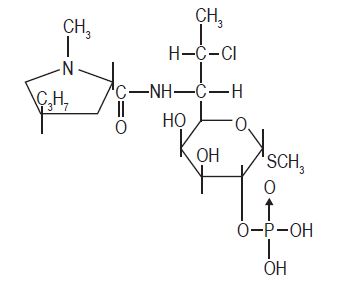
The chemical name for clindamycin phosphate is Methyl 7-chloro-6,7,8-trideoxy-6-(1 methyl- trans -4-propyl-L-2-pyrrolidinecarboxamido)-1-thio-L- threo -α-D- galacto octopyranoside 2-(dihydrogen phosphate).
Clindamycin phosphate topical solution USP, 1% contains isopropyl alcohol, 50% v/v; propylene glycol and purified water. Sodium hydroxide or hydrochloric acid may be added to adjust pH between 4.0 to 7.0.
CLINICAL PHARMACOLOGY
Mechanism of Action
The mechanism of action of clindamycin in treating acne vulgaris is unknown.
Pharmacokinetics
Following multiple topical applications of clindamycin phosphate at a concentration equivalent to 10 mg clindamycin per mL in an isopropyl alcohol and water solution, very low levels of clindamycin are present in the serum (0 to 3 ng/mL) and less than 0.2% of the dose is recovered in urine as clindamycin.
Although clindamycin phosphate is inactive in vitro , rapid in vivo hydrolysis converts this compound to the antibacterially active clindamycin.
Microbiology
Clindamycin inhibits bacterial protein synthesis by binding to the 23S RNA of the 50S subunit of the ribosome. Clindamycin is bacteriostatic.
Antimicrobial Activity
Clindamycin is active in vitro against most isolates of Propionibacterium acnes ; however, the clinical significance is unknown.
Resistance
Resistance to clindamycin is most often caused by modification of specific bases of the 23S ribosomal RNA. Cross-resistance between clindamycin and lincomycin is complete. Because the binding sites for these antibacterial drugs overlap, cross resistance is sometimes observed among lincosamides, macrolides and streptogramin B. Macrolideinducible resistance to clindamycin occurs in some isolates of macrolide-resistant bacteria.
HOW SUPPLIED
Clindamycin phosphate topical solution USP, 1% containing clindamycin phosphate equivalent to 10 mg clindamycin per milliliter are clear solution with characteristics odor free from particulate matter. Filled in white HDPE bottle fitted with white PP cap and is available in the following sizes:
Clindamycin phosphate topical solution USP, 1% is
NDC 72578-084-02 in applicator bottle of 30 mL
NDC 72578-084-03 in applicator bottle of 60 mL
Storage Conditions
Store at 20°C to 25°C (68°F to 77°F) [See USP Controlled Room Temperature].
Protect from freezing.
Clindamycin phosphate topical solution USP, 1% is flammable. Keep away from heat, sparks or open flames.
Call your doctor for medical advice about side effects. You may report side effects to Viona Pharmaceuticals Inc. at 1-888-304-5011 or FDA at 1-800-FDA-1088.
