Get your patient on Cyclogyl - Cyclopentolate Hydrochloride solution/ Drops (Cyclopentolate Hydrochloride)
Cyclogyl - Cyclopentolate Hydrochloride solution/ Drops prescribing information

INDICATIONS AND USAGE: Cyclopentolate hydrochloride is used to produce mydriasis and cycloplegia.
DOSAGE AND ADMINISTRATION: Adults: Instill one or two drops of 0.5%, 1% or 2% solution in the eye which may be repeated in five to ten minutes if necessary. Complete recovery usually occurs in 24 hours. Complete recovery from mydriasis in some individuals may require several days. Children: Instill one or two drops of 0.5%, 1% or 2% solution in the eye which may be repeated five to ten minutes later by a second application of 0.5% or 1% solution if necessary. Small Infants: A single instillation of one drop of 0.5% in the eye. To minimize absorption, apply pressure over the nasolacrimal sac for two to three minutes. Observe infant closely for at least 30 minutes following instillation. Individuals with heavily pigmented irides may require higher strengths.
CONTRAINDICATIONS: Should not be used if the patient is hypersensitive to any component of this preparation.
ADVERSE REACTIONS:
Ocular: Increased intraocular pressure, burning, photophobia, blurred vision, irritation, hyperemia, conjunctivitis, blepharoconjunctivitis, punctate keratitis, synechiae have been reported.
Non-ocular: Use of cyclopentolate has been associated with psychotic reactions and behavioral disturbances, usually in children, especially with 2% concentration. These disturbances include ataxia, incoherent speech, restlessness, hallucinations, hyperactivity, seizures, disorientation as to time and place, and failure to recognize people. This drug produces reactions similar to those of other anticholinergic drugs, but the central nervous system manifestations as noted above are more common. Other toxic manifestations of anticholinergic drugs are skin rash, abdominal distention in infants, unusual drowsiness, tachycardia, hyperpyrexia, vasodilation, urinary retention, diminished gastrointestinal motility and decreased secretion in salivary and sweat glands, pharynx, bronchi and nasal passages. Severe manifestations of toxicity include coma, medullary paralysis and death.
Drug Interactions: Cyclopentolate may interfere with the ocular anti-hypertensive action of carbachol, pilocarpine, or ophthalmic cholinesterase inhibitors.
Rx Only
DESCRIPTION: CYCLOGYL ® (cyclopentolate hydrochloride ophthalmic solution, USP) is an anticholinergic prepared as a sterile, borate buffered, solution for topical ocular use. It is supplied in three strengths. The active ingredient is represented by the structural formula:
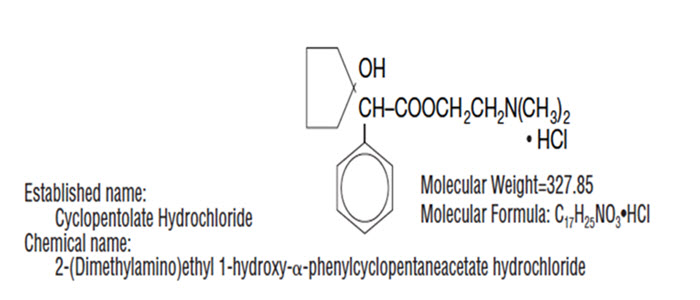
Each mL of CYCLOGYL ® (cyclopentolate hydrochloride ophthalmic solution, USP) contains: Active: cyclopentolate hydrochloride 0.5%, 1% or 2%. Preservative: benzalkonium chloride 0.01%. Inactives: boric acid, edetate disodium, potassium chloride (except 2% strength), sodium carbonate and/or hydrochloric acid (to adjust pH), purified water. The pH range is between 3.0 and 5.5.
CLINICAL PHARMACOLOGY: This anticholinergic preparation blocks the responses of the sphincter muscle of the iris and the accommodative muscle of the ciliary body to cholinergic stimulation, producing pupillary dilation (mydriasis) and paralysis of accommodation (cycloplegia). It acts rapidly, but has a shorter duration than atropine. Maximal cycloplegia occurs within 25 to 75 minutes after instillation. Complete recovery of accommodation usually takes 6 to 24 hours. Complete recovery from mydriasis in some individuals may require several days. Heavily pigmented irides may require more doses than lightly pigmented irides.
HOW SUPPLIED: In multiple-dose plastic DROP-TAINER® dispensers:
0.5% CYCLOGYL 1% CYCLOGYL 2% CYCLOGYL
15 mL NDC 0065-0395-15 2 mL NDC 0065-0396-02 2 mL NDC 0065-0397-02
5 mL NDC 0065-0396-05 5 mL NDC 0065-0397-05
15 mL NDC 0065-0396-15 15 mL NDC 0065-0397-15
Storage: Store at 8°C to 25°C (46°F to 77°F). After opening, Cyclogyl can be used until the expiration date on the bottle.
