Get your patient on Desonide - Desonide cream (Desonide)
Desonide - Desonide cream prescribing information

INDICATIONS AND USAGE
Desonide cream, 0.05% is a low potency corticosteroid indicated for the relief of the inflammatory and pruritic manifestations of corticosteroid responsive dermatoses.
It should not be used for longer than two weeks unless directed by a physician.
DOSAGE AND ADMINISTRATION
Desonide cream, 0.05% should be applied to the affected area as a thin film two to four times daily depending on the severity of the condition.
As with other corticosteroids, therapy should be discontinued when control is achieved. If no improvement is seen within two weeks, reassessment of diagnosis may be necessary.
Desonide cream, 0.05% should not be used with occlusive dressings.
CONTRAINDICATIONS
Desonide cream, 0.05% is contraindicated in those patients with a history of hypersensitivity to any of the components of the preparation.
ADVERSE REACTIONS
In controlled clinical trials, the total incidence of adverse reactions associated with the use of desonide cream, 0.05% was approximately 1%. These adverse reactions were pruritus, pain, folliculitis, rash, peripheral edema, pustular rash, sweating, erythema, irritation, and burning. Laboratory abnormalities were found in 3% of the patients. These were hyperglycemia (2%) and liver function abnormality (1%).
The following additional local adverse reactions have been reported infrequently with topical corticosteroids, and they may occur more frequently with the use of occlusive dressings and higher potency corticosteroids. These reactions are listed in approximate decreasing order of occurrence: dryness, folliculitis, acneiform eruptions, perioral dermatitis, allergic contact dermatitis, secondary infection, skin atrophy, striae, miliaria, burning and hypopigmentation.
Call your doctor for medical advice about side effects. You may report side effects to FDA at 1-800-FDA-1088.
DESCRIPTION
Desonide cream USP, 0.05% contains desonide (Pregna-1, 4-diene-3, 20-dione, 11, 21-dihydroxy-16, 17-[(1- methylethylidene)bis(oxy)]-,(11β,16α)) a synthetic corticosteroid for topical dermatologic use. The corticosteroids constitute a class of primary synthetic steroids used topically as anti-inflammatory and antipruritic agents.
Chemically, desonide, the active ingredient in desonide cream, 0.05% is C 24 H 32 O 6 . It has the following structural formula:
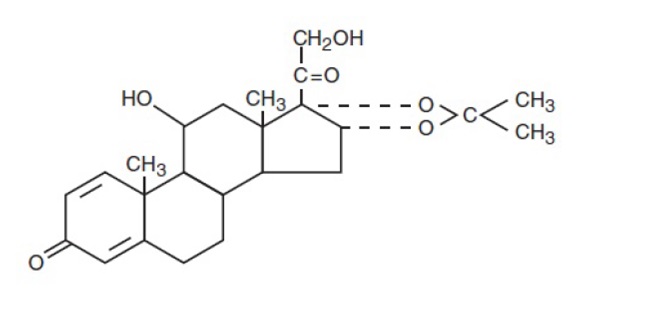
The molecular weight of desonide is 416.51. It is a white to almost white crystalline powder. It is insoluble in water, soluble in methylene chloride, sparingly soluble in ethanol (96%), slightly soluble in ethyl ether.
Each gram of desonide cream USP, 0.05% contains 0.5 milligram of desonide micro dispersed in a base of aluminum sulfate, calcium acetate, cetostearyl alcohol, dextrin, glycerin, light mineral oil, purified water, sodium lauryl sulfate, synthetic beeswax, and white petrolatum. Desonide cream, 0.05% is preserved with methylparaben and buffered to pH 4.2 to 5.0.
CLINICAL PHARMACOLOGY
Like other topical corticosteroids, desonide has anti-inflammatory, antipruritic, and vasoconstrictive properties. The mechanism of the anti-inflammatory activity of the topical steroids, in general, is unclear. However corticosteroids are thought to act by the induction of phospholipase A 2 inhibitory proteins, collectively called lipocortins. It is postulated that these proteins control the biosynthesis of potent mediators of inflammation such as prostaglandins and leukotrienes by inhibiting the release of their common precursor arachidonic acid. Arachidonic acid is released from membrane phospholipids by phospholipase A 2 .
Pharmacokinetics
The extent of percutaneous absorption of topical corticosteroids is determined by many factors, including the vehicle and the integrity of the epidermal barrier. Occlusive dressings with hydrocortisone for up to 24 hours have not been demonstrated to increase penetration; however, occlusion of hydrocortisone for 96 hours markedly enhances penetration. Topical corticosteroids can be absorbed from normal intact skin. Inflammation and/or other disease processes in the skin may increase percutaneous absorption.
Studies performed with desonide cream, 0.05% indicate that it is in the low range of potency as compared with other topical corticosteroids.
HOW SUPPLIED
Desonide cream USP, 0.05% is white to off white cream and is available as follows:
NDC 72578-086-01 in tube of 15 g
NDC 72578-086-02 in tube of 60 g
Storage
Store at 20° to 25°C (68° to 77°F) [see USP Controlled Room Temperature].
Call your doctor for medical advice about side effects. You may report side effects to Viona Pharmaceuticals Inc. at 1-888-304-5011 or FDA at 1-800-FDA-1088.
