Get your patient on Dexamethasone Sodium Phosphate - Dexamethasone Sodium Phosphate injection, Solution (Dexamethasone Sodium Phosphate)
Dexamethasone Sodium Phosphate - Dexamethasone Sodium Phosphate injection, Solution prescribing information

INDICATIONS AND USAGE
A. By intravenous or intramuscular injection when oral therapy is not feasible
1. Endocrine disorders:
Primary or secondary adrenocortical insufficiency (hydrocortisone or cortisone is the drug of choice; synthetic analogs may be used in conjunction with mineralocorticoids where applicable; in infancy, mineralocorticoid supplementation is of particular importance).
Acute adrenocortical insufficiency (hydrocortisone or cortisone is the drug of choice; mineralocorticoid supplementation may be necessary, particularly when synthetic analogs are used).
Preoperatively, and in the event of serious trauma or illness, in patients with known adrenal insufficiency or when adrenocortical reserve is doubtful.
Shock unresponsive to conventional therapy if adrenocortical insufficiency exists or is suspected.
Congenital adrenal hyperplasia.
Nonsuppurative thyroiditis.
Hypercalcemia associated with cancer.
2. Rheumatic Disorders:
As adjunctive therapy for short-term administration (to tide the patient over an acute episode or exacerbation) in:
Post-traumatic osteoarthritis.
Synovitis of osteoarthritis.
Rheumatoid arthritis, including juvenile rheumatoid arthritis (selected cases may require low-dose maintenance therapy).
Acute and subacute bursitis.
Epicondylitis.
Acute nonspecific tenosynovitis.
Acute gouty arthritis.
Psoriatic arthritis.
Ankylosing spondylitis.
3. Collagen Diseases:
During an exacerbation or as maintenance therapy in selected cases of:
Systemic lupus erythematosus.
Acute rheumatic carditis.
4. Dermatologic Diseases:
Pemphigus.
Severe erythema multiforme. (Stevens-Johnson Syndrome)
Exfoliative dermatitis.
Bullous dermatitis herpetiformis.
Severe seborrheic dermatitis.
Severe psoriasis.
Mycosis fungoides.
5. Allergic States:
Control of severe or incapacitating allergic conditions intractable to adequate trials of conventional treatment in:
Bronchial asthma.
Contact dermatitis.
Atopic dermatitis.
Serum sickness.
Seasonal or perennial allergic rhinitis.
Drug hypersensitivity reactions.
Urticarial transfusion reactions.
Acute noninfectious laryngeal edema (epinephrine is the drug of first choice).
6. Ophthalmic Diseases:
Severe acute and chronic allergic and inflammatory processes involving the eye, such as:
Herpes zoster ophthalmicus.
Iritis, iridocyclitis.
Chorioretinitis.
Diffuse posterior uveitis and choroiditis.
Optic neuritis.
Sympathetic ophthalmia.
Anterior segment inflammation.
Allergic conjunctivitis.
Keratitis.
Allergic corneal marginal ulcers.
7. Gastrointestinal Diseases:
To tide the patient over a critical period of the disease in:
Ulcerative colitis (systemic therapy).
Regional enteritis (systemic therapy).
8. Respiratory Diseases:
Symptomatic sarcoidosis.
Berylliosis.
Fulminating or disseminated pulmonary tuberculosis when used concurrently with appropriate antituberculous chemotherapy.
Loeffler's syndrome not manageable by other means.
Aspiration pneumonitis.
9. Hematologic Disorders:
Acquired (autoimmune) hemolytic anemia.
Idiopathic thrombocytopenic purpura in adults (IV only; IM administration is contraindicated).
Secondary thrombocytopenia in adults.
Erythroblastopenia (RBC anemia).
Congenital (erythroid) hypoplastic anemia.
10. Neoplastic Diseases:
For palliative management of:
Leukemias and lymphomas in adults.
Acute leukemia of childhood.
11. Edematous States:
To induce diuresis or remission of proteinuria in the nephrotic syndrome, without uremia, of the idiopathic type or that due to lupus erythematosus.
12. Miscellaneous:
Tuberculosis meningitis with subarachnoid block or impending block when used concurrently with appropriate antituberculous chemotherapy.
Trichinosis with neurologic or myocardial involvement.
13. Diagnostic testing of adrenocortical hyperfunction.
14. Cerebral Edema associated with primary or metastatic brain tumor, craniotomy, or head injury. Use in cerebral edema is not a substitute for careful neurosurgical evaluation and definitive management such as neurosurgery or other specific therapy.
B. By intra-articular or soft tissue injection
As adjunctive therapy for short-term administration (to tide the patient over an acute episode or exacerbation) in:
Synovitis of osteoarthritis.
Rheumatoid arthritis.
Acute and subacute bursitis.
Acute gouty arthritis.
Epicondylitis.
Acute nonspecific tenosynovitis.
Post-traumatic osteoarthritis.
C. By intralesional injection
Keloids.
Localized hypertrophic, infiltrated, inflammatory lesions of: lichen planus, psoriatic plaques, granuloma annulare, and lichen simplex chronicus (neurodermatitis).
Discoid lupus erythematosus.
Necrobiosis lipoidica diabeticorum.
Alopecia areata.
May also be useful in cystic tumors of an aponeurosis or tendon (ganglia).
DOSAGE AND ADMINISTRATION
Dexamethasone sodium phosphate injection, USP 4 mg/mL is for intravenous, intramuscular, intra-articular, intralesional and soft tissue injection.
Dexamethasone sodium phosphate injection, USP 10 mg/mL is for intravenous or intramuscular use only.
Dexamethasone sodium phosphate injection, USP can be given directly from the vial, or it can be added to sodium chloride injection or dextrose injection and administered by intravenous drip.
Solutions used for intravenous administration or further dilution of this product should be preservative-free when used in the neonate, especially the premature infant.
When it is mixed with an infusion solution, sterile precautions should be observed. Since infusion solutions generally do not contain preservatives, mixtures should be used within 24 hours.
DOSAGE REQUIREMENTS ARE VARIABLE AND MUST BE INDIVIDUALIZED ON THE BASIS OF THE DISEASE AND THE RESPONSE OF THE PATIENT.
A. Intravenous and Intramuscular Injection
The initial dosage of dexamethasone sodium phosphate injection varies from 0.5 to 9 mg a day depending on the disease being treated. In less severe diseases doses lower than 0.5 mg may suffice, while in severe diseases doses higher than 9 mg may be required.
The initial dosage should be maintained or adjusted until the patient's response is satisfactory. If a satisfactory clinical response does not occur after a reasonable period of time, discontinue dexamethasone sodium phosphate injection and transfer the patient to other therapy.
After a favorable initial response, the proper maintenance dosage should be determined by decreasing the initial dosage in small amounts to the lowest dosage that maintains an adequate clinical response.
Patients should be observed closely for signs that might require dosage adjustment, including changes in clinical status resulting from remissions or exacerbations of the disease, individual drug responsiveness, and the effect of stress (e.g., surgery, infection, trauma). During stress it may be necessary to increase dosage temporarily.
If the drug is to be stopped after more than a few days of treatment, it usually should be withdrawn gradually.
When the intravenous route of administration is used, dosage usually should be the same as the oral dosage. In certain overwhelming, acute, life-threatening situations, however, administration in dosages exceeding the usual dosages may be justified and may be in multiples of the oral dosages. The slower rate of absorption by intramuscular administration should be recognized.
Shock
There is a tendency in current medical practice to use high (pharmacologic) doses of corticosteroids for the treatment of unresponsive shock. The following dosages of dexamethasone sodium phosphate injection have been suggested by various authors:
Author• | Dosage |
Cavanagh 1 | 3 mg/kg of body weight per 24 hours by constant intravenous infusion after an initial |
Dietzman 2 | intravenous injection of 20 mg |
Frank 3 | 2 to 6 mg/kg of body weight as a single intravenous injection |
Oaks 4 | 40 mg initially followed by repeat intravenous injection every 4 to 6 hours while shock persists |
Schumer 5 | 1 mg/kg of body weight as a single intravenous injection |
Administration of high dose corticosteroid therapy should be continued only until the patient's condition has stabilized and usually not longer than 48 to 72 hours.
Although adverse reactions associated with high dose, short term corticosteroid therapy are uncommon, peptic ulceration may occur.
Cerebral Edema
Dexamethasone sodium phosphate injection is generally administered initially in a dosage of 10 mg intravenously followed by four mg every six hours intramuscularly until the symptoms of cerebral edema subside. Response is usually noted within 12 to 24 hours and dosage may be reduced after two to four days and gradually discontinued over a period of five to seven days. For palliative management of patients with recurrent or inoperable brain tumors, maintenance therapy with two mg two or three times a day may be effective.
Acute Allergic Disorders
In acute, self-limited allergic disorders or acute exacerbations of chronic allergic disorders, the following dosage schedule combining parenteral and oral therapy is suggested:
Dexamethasone sodium phosphate injection, USP 4 mg/mL; first day, 1 or 2 mL (4 or 8 mg), intramuscularly.
Dexamethasone sodium phosphate tablets, 0.75 mg; second and third days, 4 tablets in two divided doses each day; fourth day, 2 tablets in two divided doses; fifth and sixth days, 1 tablet each day; seventh day, no treatment; eighth day, follow-up visit.
This schedule is designed to ensure adequate therapy during acute episodes, while minimizing the risk of overdosage in chronic cases.
B. Intra-Articular, Intralesional and Soft Tissue Injection
Intra-articular, intralesional and soft tissue injections are generally employed when affected joints or areas are limited to one or two sites. Dosage and frequency of injection varies depending on the condition and the site of injection. The usual dose is from 0.2 to 6 mg. The frequency usually ranges from once every three to five days to once every two to three weeks. Frequent intra-articular injection may result in damage to joint tissues.
Some of the usual single doses are:
Site of Injection | Amount of Dexamethasone Phosphate (mg) |
Large joints (e.g., Knee) | 2 to 4 |
Small joints (e.g., Interphalangeal, Temporomandibular) | 0.8 to 1 |
Bursae | 2 to 3 |
Tendon sheaths | 0.4 to 1 |
Soft tissue infiltration | 2 to 6 |
Ganglia | 1 to 2 |
Parenteral drug products should be inspected visually for particulate matter and discoloration prior to administration, whenever the solution and container permit.
Dexamethasone sodium phosphate injection, USP is particularly recommended for use in conjunction with one of the less soluble, longer-acting steroids for intra-articular and soft tissue injection.
CONTRAINDICATIONS
Systemic fungal infections. (See WARNINGS regarding amphotericin B)
ADVERSE REACTIONS
Fluid and electrolyte disturbances
Sodium retention
Fluid retention
Congestive heart failure in susceptible patients
Potassium loss
Hypokalemic alkalosis
Hypertension
Musculoskeletal
Muscle weakness
Steroid myopathy
Loss of muscle mass
Osteoporosis
Vertebral compression fractures
Aseptic necrosis of femoral and humeral heads
Tendon rupture
Pathologic fracture of long bones
Gastrointestinal
Peptic ulcer with possible subsequent perforation and hemorrhage
Perforation of the small and large bowel; particularly in patients with inflammatory bowel disease
Pancreatitis
Abdominal distention
Ulcerative esophagitis
Dermatologic
Impaired wound healing
Thin fragile skin
Petechiae and ecchymoses
Erythema
Increased sweating
May suppress reactions to skin tests
Burning or tingling especially in the perineal area (after IV injection) other cutaneous reactions, such as allergic dermatitis, urticaria, angioneurotic edema
Neurologic
Convulsions
Increased intracranial pressure with papilledema (pseudotumor cerebri) usually after treatment
Vertigo
Headache
Psychic disturbances
Endocrine
Menstrual irregularities
Development of cushingoid state
Suppression of growth in children
Secondary adrenocortical and pituitary unresponsiveness, particularly in times of stress, as in trauma, surgery, or illness
Decreased carbohydrate tolerance
Manifestations of latent diabetes mellitus
Increased requirements for insulin or oral hypoglycemic agents in diabetics
Hirsutism
Ophthalmic
Posterior subcapsular cataracts
Increased intraocular pressure
Glaucoma
Exophthalmos
Metabolic
Negative nitrogen balance due to protein catabolism
Cardiovascular
Myocardial rupture following recent myocardial infarction. (See WARNINGS ).
Other
Anaphylactoid or hypersensitivity reactions
Thromboembolism
Weight gain
Increased appetite
Nausea
Malaise
Hiccups
The following additional adverse reactions are related to parenteral corticosteroid therapy:
Rare instances of blindness associated with intralesional therapy around the face and head
Hyperpigmentation or hypopigmentation
Subcutaneous and cutaneous atrophy
Sterile abscess
Post-injection flare (following intra-articular use)
Charcot-like arthropathy
DESCRIPTION
Dexamethasone sodium phosphate, a synthetic adrenocortical steroid, is a white or slightly yellow, crystalline powder. It is freely soluble in water and is exceedingly hygroscopic. The molecular weight is 516.41. It is designated chemically as 9-fluoro-11β,17-dihydroxy-16α-methyl-21-(phosphonooxy)pregna-1,4-diene-3,20-dione disodium salt. The empirical formula is C 22 H 28 FNa 2 O 8 P and the structural formula is:
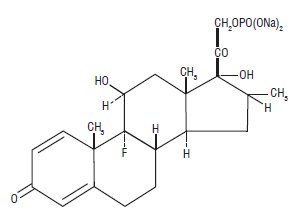
Dexamethasone sodium phosphate injection, USP is a sterile solution of dexamethasone sodium phosphate, and is supplied in 4 mg/ mL and 10 mg /mL.
Dexamethasone sodium phosphate injection, USP 4 mg/mL is a sterile solution for intravenous, intramuscular, intra-articular, intralesional and soft tissue administration. Each mL contains:
Active: Dexamethasone sodium phosphate 4.4 mg (equivalent to dexamethasone phosphate 4 mg). Preservatives: Methylparaben 1.5 mg; Propylparaben 0.2 mg. Inactives: Edetate Disodium 0.11 mg; Sodium Citrate Anhydrous 10 mg; Citric Acid and/or Sodium Hydroxide q.s to adjust pH 7.0 to 8.5 and Water for Injection q.s to 1 mL.
Dexamethasone sodium phosphate injection, USP 10 mg/mL is a sterile solution for intravenous or intramuscular use only. Each mL contains:
Actives: Dexamethasone sodium phosphate 11 mg (equivalent to dexamethasone phosphate 10 mg). Preservatives: Methylparaben 1.5 mg; Propylparaben 0.2 mg. Inactives: Edetate Disodium 0.11 mg; Sodium Citrate Anhydrous 10 mg; Citric Acid and/or Sodium Hydroxide q.s to adjust pH 7.0 to 8.5 and Water for Injection q.s to 1 mL.
CLINICAL PHARMACOLOGY
Dexamethasone sodium phosphate injection has a rapid onset but short duration of action when compared with less soluble preparations. Because of this, it is suitable for the treatment of acute disorders responsive to adrenocortical steroid therapy.
Naturally occurring glucocorticoids (hydrocortisone and cortisone), which also have salt-retaining properties, are used as replacement therapy in adrenocortical deficiency states. Their synthetic analogs, including dexamethasone, are primarily used for their potent anti-inflammatory effects in disorders of many organ systems.
Glucocorticoids cause profound and varied metabolic effects. In addition, they modify the body's immune responses to diverse stimuli.
At equipotent anti-inflammatory doses, dexamethasone almost completely lacks the sodium-retaining property of hydrocortisone and closely related derivatives of hydrocortisone.
HOW SUPPLIED
Dexamethasone sodium phosphate injection, USP 4 mg/mL is for-intravenous, intramuscular, intra-articular, intralesional and soft tissue administration available as follows:
NDC Number | Fill volume | Pack size |
67457-423-12 | 1 mL Single-Dose Vial | 25’s |
67457-422-54 | 5 mL Multi-Dose Vial | 25’s |
67457-421-30 | 30 mL Multi-Dose Vial | 25’s |
Dexamethasone sodium phosphate injection, USP 10 mg/mL is for intravenous and intramuscular injection only available as follows:
NDC Number | Fill volume | Pack size |
67457-420-10 | 10 mL Multi-Dose Vial | 10’s |
Store at 20° to 25°C (68° to 77°F). [See USP Controlled Room Temperature.]
Protect from light.
Sensitive to heat. Do not autoclave. Protect from freezing.
Manufactured for: Mylan Institutional LLC Morgantown, WV 26505 U.S.A.
Manufactured by: Mylan Laboratories Limited Bangalore, India
MARCH 2024
