Diethylpropion Hydrochloride er - Diethylpropion Hydrochloride tablet, Extended Release prescribing information

INDICATIONS AND USAGE
Diethylpropion hydrochloride extended release tablets, 75 mg are indicated in the management of exogenous obesity as a short-term adjunct (a few weeks) in a regimen of weight reduction based on caloric restriction in patients with an initial body mass index (BMI) of 30 kg/m 2 or higher and who have not responded to appropriate weight reducing regimen (diet and/or exercise) alone. Below is a chart of BMI based on various heights and weights. BMI is calculated by taking the patient’s weight, in kilograms (kg), divided by the patient’s height, in meters (m), squared. Metric conversions are as follows: pounds divided by 2.2 = kg; inches x 0.0254 = meters.
Body Mass Index (BMI), kg/m 2 | ||||||
Weight (pounds) | Height (feet, inches) | |||||
5’0” | 5’3” | 5’6” | 5’9” | 6’0” | 6’3” | |
140 | 27 | 25 | 23 | 21 | 19 | 18 |
150 | 29 | 27 | 24 | 22 | 20 | 19 |
160 | 31 | 28 | 26 | 24 | 22 | 20 |
170 | 33 | 30 | 28 | 25 | 23 | 21 |
180 | 35 | 32 | 29 | 27 | 25 | 23 |
190 | 37 | 34 | 31 | 28 | 26 | 24 |
200 | 39 | 36 | 32 | 30 | 27 | 25 |
210 | 41 | 37 | 34 | 31 | 29 | 26 |
220 | 43 | 39 | 36 | 33 | 30 | 28 |
230 | 45 | 41 | 37 | 34 | 31 | 29 |
240 | 47 | 43 | 39 | 36 | 33 | 30 |
250 | 49 | 44 | 40 | 37 | 34 | 31 |
The usefulness of agents of this class (See CLINICAL PHARMACOLOGY ) should be measured against possible risk factors inherent in their use such as those described below. Diethylpropion hydrochloride extended release tablets, 75 mg are indicated for use as monotherapy only.
DOSAGE AND ADMINISTRATION
Diethylpropion Hydrochloride Extended Release Tablets, 75 mg:
One extended-release 75 mg tablet daily, swallowed whole, in midmorning.
Geriatric use:
This drug is known to be substantially excreted by the kidney, and the risk of toxic reactions to this drug may be greater in patients with impaired renal function. Because elderly patients are more likely to have decreased renal function, care should be taken in dose selection, and it may be useful to monitor renal function (See PRECAUTIONS , Geriatric Use ).
CONTRAINDICATIONS
Pulmonary hypertension, advanced arteriosclerosis, hyperthyroidism, known hypersensitivity or idiosyncrasy to the sympathomimetic amines, glaucoma, severe hypertension (See PRECAUTIONS ).
Agitated states.
Patients with a history of drug abuse.
Use in combination with other anorectic agents is contraindicated.
During or within 14 days following the administration of monoamine oxidase inhibitors, hypertensive crises may result.
ADVERSE REACTIONS
Cardiovascular: Precordial pain, arrhythmia (including ventricular), ECG changes, tachycardia, elevation of blood pressure, palpitation and rare reports of pulmonary hypertension. Valvular heart disease associated with the use of some anorectic agents such as fenfluramine and dexfenfluramine, both independently and especially when used in combination, have been reported. Valvulopathy has been very rarely reported with diethylpropion hydrochloride extended release tablets, 75 mg monotherapy, but the causal relationship remains uncertain.
Central Nervous System: In a few epileptics an increase in convulsive episodes has been reported; rarely psychotic episodes at recommended doses; dyskinesia, blurred vision, overstimulation, nervousness, restlessness, dizziness, jitteriness, insomnia, anxiety, euphoria, depression, dysphoria, tremor, mydriasis, drowsiness, malaise, headache, and cerebrovascular accident
Gastrointestinal: Vomiting, diarrhea, abdominal discomfort, dryness of the mouth, unpleasant taste, nausea, constipation, other gastrointestinal disturbances
Allergic: Urticaria, rash, ecchymosis, erythema
Endocrine: Impotence, changes in libido, gynecomastia, menstrual upset
Hematopoietic System: Bone marrow depression, agranulocytosis, leukopenia
Miscellaneous: A variety of miscellaneous adverse reactions has been reported by physicians. These include complaints such as dysuria, dyspnea, hair loss, muscle pain, increased sweating, and polyuria.
Drug Interactions
Because diethylpropion hydrochloride extended release tablets, 75 mg are monoamines, hypertension may result when either agent is used with monoamine oxidase (MAO) inhibitors (See CONTRAINDICATIONS ).
Efficacy of diethylpropion with other anorectic agents has not been studied and the combined use may have the potential for serious cardiac problems; therefore, the concomitant use with other anorectic agents is contraindicated.
Antidiabetic drug requirements (i.e., insulin) may be altered. Concurrent use with general anesthetics may result in arrhythmias. The pressor effects of diethylpropion and those of other drugs may be additive when the drugs are used concomitantly; conversely, diethylpropion may interfere with antihypertensive drugs (i.e., guanethidine, a-methyldopa). Concurrent use of phenothiazines may antagonize the anorectic effect of diethylpropion.
DESCRIPTION
Diethylpropion Hydrochloride Extended Release Tablets, 75 mg are available for oral administration as extended release tablets containing 75 mg diethylpropion hydrochloride, USP. The inactive ingredients in each extended release tablet are: mannitol, carbomer homopolymer, tartaric acid, hydroxypropyl methylcellulose, povidone, and magnesium stearate.
Diethylpropion hydrochloride is a sympathomimetic agent. The chemical name for diethylpropion hydrochloride is 1-phenyl-2-diethyl-amino-1-propanone hydrochloride.
Its chemical structure is:
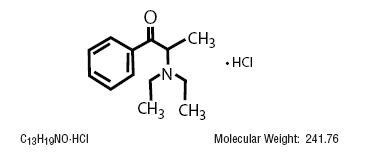
In diethylpropion hydrochloride extended release tablets, 75 mg, diethylpropion hydrochloride is dispersed in a hydrophilic matrix. On exposure to water, the diethylpropion hydrochloride is released at a relatively uniform rate as a result of slow hydration of the matrix. The result is controlled release of the anorectic agent.
CLINICAL PHARMACOLOGY
Diethylpropion hydrochloride is a sympathomimetic amine with some pharmacologic activity similar to that of the prototype drugs of this class used in obesity, the amphetamines. Actions include some central nervous system stimulation and elevation of blood pressure. Tolerance has been demonstrated with all drugs of this class in which these phenomena have been looked for.
Drugs of this class used in obesity are commonly known as "anorectics" or "anorexigenics." It has not been established, however, that the action of such drugs in treating obesity is primarily one of appetite suppression. For example, other central nervous system actions or metabolic effects may be involved.
Adult obese subjects instructed in dietary management and treated with "anorectic" drugs lose more weight on the average than those treated with placebo and diet, as determined in relatively short-term clinical trials.
The magnitude of increased weight loss of drug-treated patients over placebo-treated patients averages some fraction of a pound a week. However, individual weight loss may vary substantially from patient to patient. The rate of weight loss is greatest in the first weeks of therapy for both drug and placebo subjects and tends to decrease in succeeding weeks. The possible origins of the increased weight loss due to the various drug effects are not established. The amount of weight loss associated with the use of an "anorectic" drug varies from trial to trial, and the increased weight loss appears to be related in part to variables other than the drug prescribed, such as the physician/investigator relationship, the population treated, and the diet prescribed. Studies do not permit conclusions as to the relative importance of the drug and non-drug factors on weight loss.
The natural history of obesity is measured in years, whereas most studies cited are restricted to a few weeks duration; thus, the total impact of drug-induced weight loss over that of diet alone is unknown.
Diethylpropion is rapidly absorbed from the GI tract after oral administration and is extensively metabolized through a complex pathway of biotransformation involving N-dealkylation and reduction. Many of these metabolites are biologically active and may participate in the therapeutic action of diethylpropion hydrochloride extended release tablets, 75 mg. Due to the varying lipid solubilities of these metabolites, their circulating levels are affected by urinary pH. Diethylpropion and/or its active metabolites are believed to cross the blood-brain barrier and the placenta.
Diethylpropion and its metabolites are excreted mainly by the kidney. It has been reported that between 75-106% of the dose is recovered in the urine within 48 hours after dosing. Using a phosphorescence assay that is specific for basic compounds containing benzoyl group, the plasma half-life of the aminoketone metabolites is estimated to be between 4 to 6 hours.
The controlled-release characteristics of diethylpropion hydrochloride extended release tablets, 75 mg have been demonstrated by studies in humans in which plasma levels of diethylpropion-related materials were measured by phosphorescence analysis. Plasma levels obtained with the diethylpropion hydrochloride extended release tablets, 75 mg formulation administered once daily indicated a more gradual release than the immediate-release formulation (three 25 mg tablets given in a single dose).
Diethylpropion hydrochloride extended release tablets, 75 mg have not been shown superior in effectiveness to the same dosage of the immediate-release formulation (one 25 mg tablet three times daily). After administration of a single dose of diethylpropion hydrochloride extended release tablets, 75 mg (one 75 mg extended release tablet) or diethylpropion hydrochloride solution (75 mg dose) in a cross-over study using normal human subjects, the amount of parent compound and its active metabolites recovered in the urine within 48 hours for the two dosage forms were not statistically different.
HOW SUPPLIED
Diethylpropion Hydrochloride Extended Release Tablets, 75 mg are supplied in bottles of 100 (NDC 0527-1477-01) and 250 (0527-1477-25).
Each white to off-white capsule-shaped tablet is debossed “LCI” on one side and “1477” on the other side.
Store at 20 to 25°C (68 to 77°F) [See USP Controlled Room Temperature].
Keep tightly closed and protect from excessive heat.
Distributed by: Lannett Company, Inc. Philadelphia, PA 19136
CIB70603D
Rev. 12/19
