Get your patient on Diltiazem Hydrochloride - Diltiazem Hydrochloride capsule, Extended Release (Diltiazem Hydrochloride)
Diltiazem Hydrochloride - Diltiazem Hydrochloride capsule, Extended Release prescribing information

INDICATIONS AND USAGE
Diltiazem Hydrochloride Extended-Release Capsules (Twice-a-Day Dosage) are indicated for the treatment of hypertension. They may be used alone or in combination with other antihypertensive medications, such as diuretics.
DOSAGE AND ADMINISTRATION
Dosages must be adjusted to each patient’s needs, starting with 60 to 120 mg twice daily. Maximum antihypertensive effect is usually observed by 14 days of chronic therapy; therefore, dosage adjustments should be scheduled accordingly. Although individual patients may respond to lower doses, the usual optimum dosage range in clinical trials was 240 to 360 mg/day.
Diltiazem Hydrochloride Extended-Release Capsules have an additive antihypertensive effect when used with other antihypertensive agents. Therefore, the dosage of Diltiazem Hydrochloride Extended-Release Capsules or the concomitant antihypertensives may need to be adjusted when adding one to the other. See WARNINGS and PRECAUTIONS regarding use with beta-blockers.
CONTRAINDICATIONS
Diltiazem hydrochloride is contraindicated in (1) patients with sick sinus syndrome except in the presence of a functioning ventricular pacemaker, (2) patients with second- or third-degree AV block except in the presence of a functioning ventricular pacemaker, (3) patients with hypotension (less than 90 mm Hg systolic), (4) patients who have demonstrated hypersensitivity to the drug, and (5) patients with acute myocardial infarction and pulmonary congestion documented by X-ray on admission.
ADVERSE REACTIONS
Serious adverse reactions have been rare in studies carried out to date, but it should be recognized that patients with impaired ventricular function and cardiac conduction abnormalities have usually been excluded from these studies.
The adverse events described below represent events observed in clinical studies of hypertensive patients receiving either diltiazem hydrochloride tablets or Diltiazem Hydrochloride Extended-Release Capsules, as well as experiences observed in studies of angina and during marketing. The most common events in hypertension studies are shown in a table with rates in placebo patients shown for comparison. Less common events are listed by body system; these include any adverse reactions seen in angina studies that were not observed in hypertension studies. In all hypertensive patients studied (over 900), the most common adverse events were edema (9%), headache (8%), dizziness (6%), asthenia (5%), sinus bradycardia (3%), flushing (3%), and first- degree AV block (3%). Only edema and perhaps bradycardia and dizziness were dose related. The most common events observed in clinical studies (over 2,100 patients) of angina patients and hypertensive patients receiving diltiazem hydrochloride tablets or Diltiazem Hydrochloride Extended-Release Capsules were (i.e., greater than 1%) edema (5.4%), headache (4.5%), dizziness (3.4%), asthenia (2.8%), first-degree AV block (1.8%), flushing (1.7%), nausea (1.6%), bradycardia (1.5%), and rash (1.5%).
| ||
|
|
|
|
|
|
|
|
|
|
|
|
|
|
|
|
|
|
|
|
|
|
|
|
|
|
|
|
|
|
|
|
|
|
|
|
|
|
|
|
| |
|
|
|
|
|
|
|
|
|
|
|
|
|
| |
In addition, the following events were reported infrequently (less than 1%) with Diltiazem Hydrochloride Extended-Release Capsules or diltiazem hydrochloride tablets or have been observed in angina or hypertension trials.
Cardiovascular: Angina, arrhythmia, second- or third-degree AV block (see Conduction Warning), bundle branch block, congestive heart failure, syncope, tachycardia, ventricular extrasystoles.
Nervous System: Abnormal dreams, amnesia, depression, gait abnormality, hallucinations, nervousness, paresthesia, personality change, tremor.
Gastrointestinal: Anorexia, diarrhea, dry mouth, dysgeusia, mild elevations of SGOT, SGPT, and LDH (see Hepatic Warnings), thirst, vomiting, weight increase.
Dermatological: Petechiae, photosensitivity, pruritus, urticaria.
Other : Amblyopia, CPK increase, dyspnea, epistaxis, eye irritation, hyperglycemia, hyperuricemia, impotence, muscle cramps, nasal congestion, nocturia, osteoarticular pain, sexual difficulties, tinnitus.
The following post-marketing events have been reported infrequently in patients receiving diltiazem hydrochloride: acute generalized exanthematous pustulosis, allergic reactions, alopecia, angioedema (including facial or periorbital edema), asystole, erythema multiforme (including Stevens-Johnson Syndrome, toxic epidermal necrolysis), extrapyramidal symptoms, gingival hyperplasia, hemolytic anemia, increased bleeding time, leukopenia, photosensitivity (including lichenoid keratosis and hyperpigmentation at sun-exposed skin areas), purpura, retinopathy, myopathy, and thrombocytopenia. There have been observed cases of a generalized rash, some characterized as leukocytoclastic vasculitis. In addition, events such as myocardial infarction have been observed which are not readily distinguishable from the natural history of the disease in these patients. A definitive cause and effect relationship between these events and diltiazem hydrochloride therapy cannot yet be established. Exfoliative dermatitis (proven by rechallenge) has also been reported.
DESCRIPTION
Diltiazem hydrochloride is a calcium ion cellular influx inhibitor (slow channel blocker or calcium antagonist). Chemically, diltiazem hydrochloride is 1,5-Benzothiazepin-4(5H)-one, 3-(acetyloxy)-5-[2-(dimethylamino) ethyl]-2, 3-dihydro-2-(4-methoxyphenyl)-, monohydrochloride, (+)-cis-. The chemical structure is
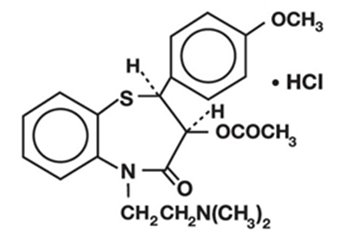
- Molecular formula: C 22 H 26 N 2 O 4 S•HCl
Diltiazem hydrochloride, USP is a white crystalline powder or small crystals. It is freely soluble in chloroform, formic acid, methanol, water, sparingly soluble in dehydrated alcohol and insoluble in ether. It has a molecular weight of 450.98 g/mol. Each Diltiazem Hydrochloride Extended-Release Capsules, USP contains either 60 mg diltiazem hydrochloride (equivalent to 55.1 mg diltiazem), 90 mg diltiazem hydrochloride (equivalent to 82.7 mg diltiazem), or 120 mg diltiazem hydrochloride (equivalent to 110.3 mg diltiazem).
Also contains: Diethyl phthalate, ethyl cellulose, methacrylic acid and ethyl acrylate copolymer, polysorbate, povidone, sodium lauryl sulfate, sugar spheres (corn starch, hypromellose and sucrose) and talc. The capsule shells contain D&C Yellow No. 10 (90 mg only), FD&C Red No. 3, FD&C Red No.40, FD&C Yellow No. 6, gelatin, sodium lauryl sulfate and titanium dioxide. The black printing ink contains black iron oxide, potassium hydroxide and shellac.
For oral administration.
FDA approved dissolution test specifications differ from USP.
CLINICAL PHARMACOLOGY
The therapeutic effects of diltiazem hydrochloride are believed to be related to its ability to inhibit the influx of calcium ions during membrane depolarization of cardiac and vascular smooth muscle.
Mechanism of Action
Diltiazem Hydrochloride Extended-Release Capsules produces its antihypertensive effect primarily by relaxation of vascular smooth muscle and the resultant decrease in peripheral vascular resistance. The magnitude of blood pressure reduction is related to the degree of hypertension; thus, hypertensive individuals experience an antihypertensive effect, whereas there is only a modest fall in blood pressure in normotensives.
Hemodynamic and Electrophysiological Effects
Like other calcium channel antagonists, diltiazem decreases sinoatrial and atrioventricular conduction in isolated tissues and has a negative inotropic effect in isolated preparations. In the intact animal, prolongation of the AH interval can be seen at higher doses.
In man, diltiazem prevents spontaneous and ergonovine-provoked coronary artery spasm. It causes a decrease in peripheral vascular resistance and a modest fall in blood pressure in normotensive individuals and, in exercise tolerance studies in patients with ischemic heart disease, reduces the heart rate-blood pressure product for any given workload. Studies to date, primarily in patients with good ventricular function, have not revealed evidence of a negative inotropic effect; cardiac output, ejection fraction, and left ventricular end diastolic pressure have not been affected. Increased heart failure has, however, been reported in occasional patients with preexisting impairment of ventricular function. There are as yet few data on the interaction of diltiazem and beta-blockers in patients with poor ventricular function. Resting heart rate is usually slightly reduced by diltiazem.
Diltiazem Hydrochloride Extended-Release Capsules produces antihypertensive effects both in the supine and standing positions. Postural hypotension is infrequently noted upon suddenly assuming an upright position. No reflex tachycardia is associated with the chronic antihypertensive effects. Diltiazem Hydrochloride Extended-Release Capsules decrease vascular resistance, increase cardiac output (by increasing stroke volume), and produce a slight decrease or no change in heart rate. During dynamic exercise, increases in diastolic pressure are inhibited, while maximum achievable systolic pressure is usually reduced. Heart rate at maximum exercise does not change or is slightly reduced. Chronic therapy with diltiazem hydrochloride produces no change or an increase in plasma catecholamines. No increased activity of the renin- angiotensin-aldosterone axis has been observed. Diltiazem Hydrochloride Extended-Release Capsules antagonize the renal and peripheral effects of angiotensin II. Hypertensive animal models respond to diltiazem with reductions in blood pressure and increased urinary output and natriuresis without a change in urinary sodium/potassium ratio.
Intravenous diltiazem hydrochloride in doses of 20 mg prolongs AH conduction time and AV node functional and effective refractory periods by approximately 20%. In a study involving single oral doses of 300 mg of diltiazem hydrochloride in six normal volunteers, the average maximum PR prolongation was 14% with no instances of greater than first-degree AV block. Diltiazem-associated prolongation of the AH interval is not more pronounced in patients with first-degree heart block. In patients with sick sinus syndrome, diltiazem significantly prolongs sinus cycle length (up to 50% in some cases).
Chronic oral administration of diltiazem hydrochloride in doses of up to 360 mg/day has resulted in small increases in PR interval, and on occasion produces abnormal prolongation (see WARNINGS ).
Pharmacokinetics and Metabolism
Diltiazem is well absorbed from the gastrointestinal tract and is subject to an extensive first-pass effect, giving an absolute bioavailability (compared to intravenous administration) of about 40%. Diltiazem hydrochloride undergoes extensive metabolism in which 2% to 4% of the unchanged drug appears in the urine. In vitro binding studies show diltiazem hydrochloride is 70% to 80% bound to plasma proteins. Competitive in vitro ligand binding studies have also shown diltiazem hydrochloride binding is not altered by therapeutic concentrations of digoxin, hydrochlorothiazide, phenylbutazone, propranolol, salicylic acid, or warfarin. The plasma elimination half-life following single or multiple drug administration is approximately 3.0 to 4.5 hours. Desacetyl diltiazem is also present in the plasma at levels of 10% to 20% of the parent drug and is 25% to 50% as potent a coronary vasodilator as diltiazem. Minimum therapeutic plasma levels of diltiazem hydrochloride appear to be in the range of 50 to 200 ng/mL. There is a departure from linearity when dose strengths are increased; the half-life is slightly increased with dose. A study that compared patients with normal hepatic function to patients with cirrhosis found an increase in half-life and a 69% increase in bioavailability in the hepatically impaired patients. A single study in nine patients with severely impaired renal function showed no difference in the pharmacokinetic profile of diltiazem compared to patients with normal renal function.
Diltiazem Hydrochloride Extended-Release Capsules (Twice-a-Day Dosage)
A single 120 mg dose of the capsule results in detectable plasma levels within 2 to 3 hours and peak plasma levels at 6 to 11 hours. The apparent elimination half-life after single or multiple dosing is 5 to 7 hours. A departure from linearity similar to that observed with the diltiazem hydrochloride tablet is observed. As the dose of diltiazem hydrochloride extended-release capsules is increased from a daily dose of 120 mg (60 mg b.i.d.) to 240 mg (120 mg b.i.d.) daily, there is an increase in area-under-the-curve of 2.6 times. When the dose is increased from 240 mg to 360 mg daily, there is an increase in area-under-the-curve of 1.8 times. The average plasma levels of the capsule dosed twice daily at steady-state are equivalent to the tablet dosed four times daily when the same total daily dose is administered.
HOW SUPPLIED
Diltiazem Hydrochloride Extended-Release Capsules, USP (Twice-a-Day Dosage) are available as following:
Diltiazem Hydrochloride Extended-Release Capsules, USP | |||
Strength | Quantity | NDC Number | Description |
60 mg | Bottles of 100 with child-resistant closure | 68462-850-01 | The 60 mg capsules are hard shell gelatin capsules with a dark pink opaque cap and a white opaque body, imprinted with “Y” on the cap and “689” on the body with black ink, filled with white to off-white pellets. |
90 mg | Bottles of 100 with child-resistant closure | 68462-851-01 | The 90 mg capsules are hard shell gelatin capsules with a dark pink opaque cap and a yellow opaque body, imprinted with “Y” on the cap and “688” on the body with black ink, filled with white to off-white pellets. |
120 mg | Bottles of 100 with child-resistant closure | 68462-562-01 | The 120 mg capsules are hard shell gelatin capsules with a dark pink opaque cap and a dark pink opaque body, imprinted with “Y” on the cap and “562” on the body with black ink, filled with white to off-white pellets. |
Store at 20°C to 25°C (68°F to 77 ° F); excursions permitted to 15 ° C to 30 ° C (59°F to 86 ° F) [see USP Controlled Room Temperature]. Avoid excessive humidity.
Dispense in a tight, light-resistant container as defined in the USP using a child-resistant closure.
Distributed by:

Glenmark Pharmaceuticals Inc., USA
Elmwood Park, NJ 07407
Questions? 1 (888) 721-7115
July 2025
