Get your patient on Erythromycin - Erythromycin ointment (Erythromycin)
Erythromycin - Erythromycin ointment prescribing information

INDICATIONS AND USAGE:
For the treatment of superficial ocular infections involving the conjunctiva and/or cornea caused by organisms susceptible to erythromycin.
For prophylaxis of ophthalmia neonatorum due to N. gonorrhoeae or C. trachomatis . The effectiveness of erythromycin in the prevention of ophthalmia caused by penicillinase-producing N. gonorrheae is not established.
For infants born to mothers with clinically apparent gonorrhea, intravenous or intramuscular injections of aqueous crystalline penicillin G should be given; a single dose of 50,000 units for term infants or 20,000 units for infants of low birth weight. Topical prophylaxis alone is inadequate for these infants.
DOSAGE AND ADMINISTRATION:
In the treatment of superficial ocular infections, a ribbon approximately 1 cm in length of Erythromycin Ophthalmic Ointment should be applied directly to the infected structure up to 6 times daily, depending on the severity of the infection. For prophylaxis of neonatal gonococcal or chlamydial conjunctivitis, a ribbon of ointment approximately 1 cm in length should be instilled into each lower conjunctival sac. The ointment should not be flushed from the eye following instillation. A new tube should be used for each infant.
CONTRAINDICATIONS:
This drug is contraindicated in patients with a history of hypersensitivity to erythromycin.
ADVERSE REACTIONS:
The most frequently reported adverse reactions are minor ocular irritations, redness, and hypersensitivity reactions.
To report SUSPECTED ADVERSE REACTIONS, contact Padagis ® at 1-866-634-9120 or FDA at 1-800-FDA-1088 or www.fda.gov/medwatch .
DESCRIPTION:
Erythromycin Ophthalmic Ointment belongs to the macrolide group of antibiotics. It is basic and readily forms a salt when combined with an acid. The base, as crystals or powder, is slightly soluble in water, moderately soluble in ether, and readily soluble in alcohol or chloroform. Erythromycin ((3R•,4S•,5S•,6R•,7R•,9R•,11R•,12R•,13S•,14R•)-4-[(2,6-dideoxy-3- C -methyl-3- 0 -methyl-α-L- ribo -hexopyranosyl)oxy]-14-ethyl-7,12,13-trihydroxy-3,5,7,9,11,13-hexamethyl-6-[[3,4,6-trideoxy-3-(dimethylamino)-ß-D- xylo -hexopyranosyl]oxy]oxacyclotetradecane-2,10-dione) is antibiotic produced from a strain of Streptomyces erythraeus . It has the following structural formula:
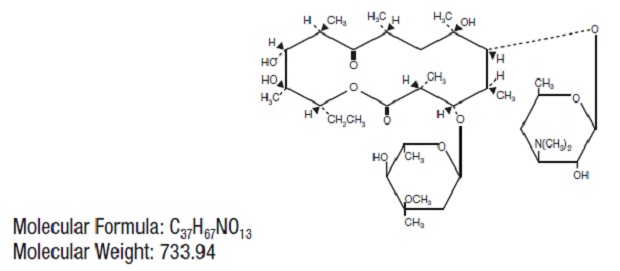
Each gram contains Erythromycin USP 5 mg in a sterile ophthalmic base of mineral oil and white petrolatum.
CLINICAL PHARMACOLOGY:
Microbiology:
Erythromycin inhibits protein synthesis without affecting nucleic acid synthesis. Erythromycin is usually active against the following organisms in vitro and in clinical infections:
Streptococcus pyogenes (group A ß-hemolytic)
Alpha-hemolytic streptococci (viridans group)
Staphylococcus aureus , including penicillinase-producing strains (methicillin-resistant staphylococci are uniformly resistant to erythromycin)
Streptococcus pneumonia
Mycoplasma pneumoniae (Eaton Agent, PPLO)
Haemophilus influenzae (not all strains of this organism are susceptible at the erythromycin concentrations ordinarily achieved)
Treponema pallidum
Corynebacterium diphtheriae
Neisseria gonorrhoeae
Chlamydia trachomatis
HOW SUPPLIED
Sterile Erythromycin Ophthalmic Ointment USP, 5 mg/g as follows:
3.5 g (1/8 oz) tamper-evident tubes NDC 0574- 4024 -35
24 x 3.5 g (1/8 oz) Hospital-Pak (for hospital use only) NDC 0574- 4024 -39
Carton of fifty (50) Unit Dose 1 g tubes NDC 0574- 4024 -50
Store at controlled room temperature 15°-30°C (59°-86°F). Avoid excessive heat.
Protect from freezing.
Manufactured for Padagis® Minneapolis, MN 55427
www.padagis.com
Rev 02-23 5W700 RC PH
