Get your patient on Erythromycin - Erythromycin gel (Erythromycin)
Erythromycin - Erythromycin gel prescribing information

INDICATIONS AND USAGE
Erythromycin Topical Gel USP, 2% is indicated for the topical treatment of acne vulgaris.
DOSAGE AND ADMINISTRATION
Erythromycin Topical Gel USP, 2% should be applied sparingly as a thin film to affected area(s) once or twice a day after the skin is thoroughly cleansed and patted dry. If there has been no improvement after 6 to 8 weeks, or if the condition becomes worse, treatment should be discontinued, and the physician should be reconsulted. Spread the medication lightly rather than rubbing it in. There are no data directly comparing the safety and efficacy of b.i.d. versus q.d. dosing.
CONTRAINDICATIONS
Erythromycin Topical Gel USP, 2% is contraindicated in those individuals who have shown hypersensitivity to any of its components.
ADVERSE REACTIONS
In controlled clinical trials, the incidence of burning associated with erythromycin topical gel USP, 2% was approximately 25%. The following additional local adverse reactions have been reported occasionally: peeling, dryness, itching, erythema, and oiliness. Irritation of the eyes and tenderness of the skin have also been reported with the topical use of erythromycin. A generalized urticarial reaction, possibly related to the use of erythromycin, which required systemic steroid therapy has been reported.
DESCRIPTION
Erythromycin Topical Gel USP, 2% contains erythromycin (3R•, 4S•, 5S•, 6R•, 7R•, 9R•, 11R•, 12R•, 13S•, 14R•)-4-[(2,6-Dideoxy-3- C -methyl-3- O -methyl-α-L- ribo -hexopyranosyl)oxy]-14-ethyl-7, 12, 13-trihydroxy-3, 5, 7, 9, 11, 13-hexamethyl-6-[[3, 4, 6,-trideoxy-3-(dimethylamino)-β-D- xylo -hexopyranosyl]oxy]oxacyclotetradecane-2,10-dione), for topical dermatological use. Erythromycin is a macrolide antibiotic produced from a strain of Saccaropolyspora erythraea (formerly Streptomyces erythreus ). It is a base and readily forms salts with acids.
Chemically, erythromycin is C 37 H 67 NO 13 . It has the following structural formula:
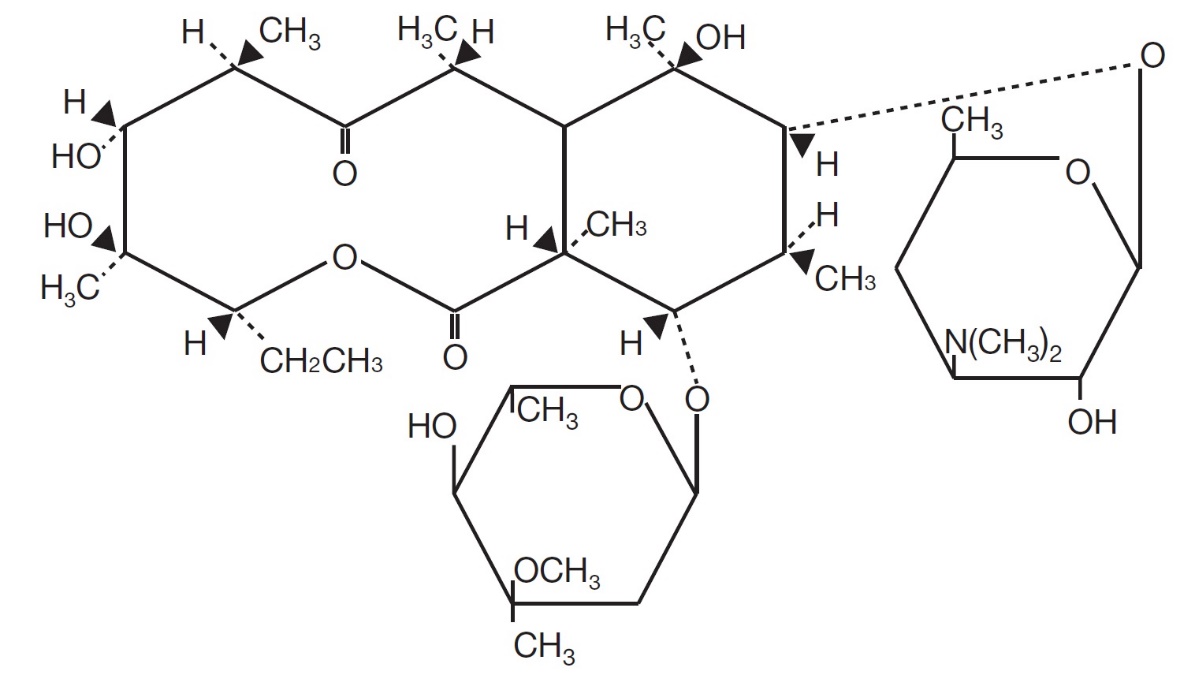
Erythromycin has a molecular weight of 733.94. It is a white or slightly yellow, odorless or practically odorless, bitter crystalline powder. Erythromycin is very soluble in very polar organic solvents such as alcohols, acetone, chloroform, acetonitrile and ethyl acetate. It is moderately soluble in less polar solvents such as ether, dichloroethylene and amyl acetate. It is slightly soluble in nonpolar solvents such as hexane. It is very poorly soluble in water.
Each gram of Erythromycin Topical Gel USP, 2% contains 20 mg of erythromycin USP in a vehicle consisting of dehydrated alcohol and hydroxypropyl cellulose.
CLINICAL PHARMACOLOGY
The exact mechanism by which erythromycin reduces lesions of acne vulgaris is not fully known; however, the effect appears to be due in part to the antibacterial activity of the drug.
MICROBIOLOGY
Erythromycin acts by inhibition of protein synthesis in susceptible organisms by reversibly binding to 50S ribosomal subunits, thereby inhibiting translocation of aminoacyl transfer-RNA and inhibiting polypeptide synthesis. Antagonism has been demonstrated in vitro between erythromycin, lincomycin, chloramphenicol, and clindamycin.
HOW SUPPLIED
Erythromycin Topical Gel USP, 2% is available as follows:
30 g sealed metal tube (NDC 45802- 966 -94)
60 g sealed metal tube (NDC 45802- 966 -96)
