Get your patient on Fluorescein Sodium And Benoxinate Hydrochloride - Fluorescein Sodium And Benoxinate Hydrochloride solution/ Drops (Fluorescein Sodium And Benoxinate Hydrochloride)
Fluorescein Sodium And Benoxinate Hydrochloride - Fluorescein Sodium And Benoxinate Hydrochloride solution/ Drops prescribing information

INDICATIONS AND USAGE
Fluorescein Sodium and Benoxinate Hydrochloride Ophthalmic Solution, 0.3%/0.4% is indicated for ophthalmic procedures in adult and pediatric patients requiring a disclosing agent in combination with a topical ophthalmic anesthetic agent.
DOSAGE AND ADMINISTRATION
Instill 1 to 2 drops topically in the eye as needed.
DOSAGE FORMS AND STRENGTHS
Fluorescein Sodium and Benoxinate Hydrochloride Ophthalmic Solution, 0.3%/0.4% is a yellow to orange-red ophthalmic solution containing fluorescein sodium 2.6 mg/mL (0.3%) and benoxinate hydrochloride 4.4 mg/mL (0.4%).
USE IN SPECIFIC POPULATIONS
Pregnancy
Risk Summary
There are no available data on the use of Fluorescein Sodium and Benoxinate Hydrochloride Ophthalmic Solution, 0.3%/0.4% in pregnant women to inform any drug associated risk.
Adequate animal reproduction studies have not been conducted with fluorescein sodium and/or benoxinate hydrochloride. Fluorescein Sodium and Benoxinate Hydrochloride Ophthalmic Solution, 0.3%/0.4% should be given to a pregnant woman only if clearly needed.
Lactation
Risk Summary
There are no data on the presence of fluorescein sodium or benoxinate hydrochloride in human milk after ocular administration of Fluorescein Sodium and Benoxinate Hydrochloride Ophthalmic Solution, 0.3%/0.4%, the effects on the breastfed infant, or the effects on milk production.
The developmental and health benefits of breastfeeding should be considered, along with the mother’s clinical need for Fluorescein Sodium and Benoxinate Hydrochloride Ophthalmic Solution, 0.3%/0.4%, and any potential adverse effects on the breastfed infant from Fluorescein Sodium and Benoxinate Hydrochloride Ophthalmic Solution, 0.3%/0.4%.
Pediatric Use
The safety and effectiveness of Fluorescein Sodium and Benoxinate Hydrochloride Ophthalmic Solution, 0.3%/0.4% have been established for pediatric patients. Use of Fluorescein Sodium and Benoxinate Hydrochloride Ophthalmic Solution, 0.3%/0.4% is supported in pediatric patients by evidence from adequate and well controlled studies.
Geriatric Use
No overall differences in safety or effectiveness have been observed between elderly and younger patients.
CONTRAINDICATIONS
Fluorescein Sodium and Benoxinate Hydrochloride Ophthalmic Solution, 0.3%/0.4% is contraindicated in patients with known hypersensitivity to any component of this product.
WARNINGS AND PRECAUTIONS
- Corneal Toxicity : Prolonged use or abuse may lead to corneal epithelial toxicity and manifest as epithelial defects which may progress to permanent corneal damage. ( Error! Hyperlink reference not valid. )
- Corneal Injury : Patients should not touch the eye for approximately 20 minutes after using anesthetic as accidental injuries can occur due to insensitivity of the eye. (5.2 )
Corneal Toxicity
Prolonged use or abuse may lead to corneal epithelial toxicity and may manifest as epithelial defects which may progress to permanent corneal damage with accompanying visual loss.
Corneal Injury Due to Insensitivity
Patients should not touch the eye for approximately 20 minutes after using this anesthetic as accidental injuries can occur due to insensitivity of the eye.
ADVERSE REACTIONS
The following serious ocular adverse reactions are described elsewhere in the labeling:
- Corneal Toxicity [see Warnings and Precautions (5.1) ]
- Corneal Injury Due to Insensitivity [see Warnings and Precautions (5.2) ]
The following adverse reactions have been identified following use of Fluorescein Sodium and Benoxinate Hydrochloride Ophthalmic Solution, 0.3%/0.4%: ocular hyperemia, burning, stinging, eye irritation, blurred vision and punctate keratitis. Because these reactions are reported voluntarily from a population of uncertain size, it is not always possible to reliably estimate their frequency or establish a causal relationship to drug exposure.
DESCRIPTION
Fluorescein Sodium and Benoxinate Hydrochloride Ophthalmic Solution, 0.3%/0.4% is a sterile solution containing a disclosing agent in combination with a short-acting ester anesthetic for topical ophthalmic use.
Fluorescein sodium is represented by the following structural formula:
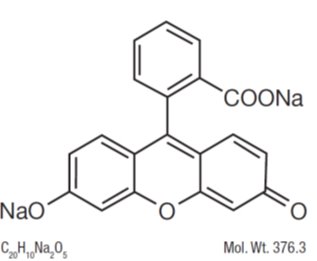
Chemical Name: 3’,6’ Dihydroxy-3H-spiro[isobenzofuran-1,9-xanthen]-3-one disodium salt.
Benoxinate hydrochloride is represented by the following structural formula:
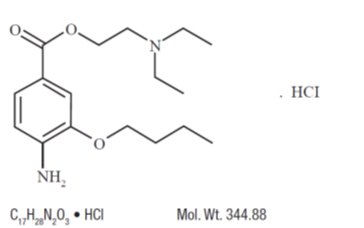
Chemical Name: 2-(Diethylamino) ethyl 4-amino-3-butoxybenzoate hydrochloride.
Each mL of Fluorescein Sodium and Benoxinate Hydrochloride Ophthalmic Solution 0.3%/0.4% contains:
- Active ingredients: fluorescein sodium 2.6 mg (0.3%) equivalent to fluorescein 2.3 mg (0.2%), benoxinate hydrochloride 4.4 mg (0.4%) equivalent to benoxinate 3.9 mg (0.4%)
- Preservative: chlorobutanol 12.6 mg (1.3%)
- Inactive ingredients: povidone, hydrochloric acid, boric acid, water for injection. Hydrochloric acid may be added to adjust pH (4.3 – 5.3).
CLINICAL PHARMACOLOGY
Pharmacodynamics
Maximal corneal anesthesia usually occurs in about 5-45 seconds and lasts about 20 minutes after single administration. The anesthetic effect may be extended by subsequent administration 10-20 minutes after the last administration.
NONCLINICAL TOXICOLOGY
Carcinogenesis, Mutagenesis, Impairment of Fertility
Studies to evaluate the mutagenic or carcinogenic potential of Fluorescein Sodium and Benoxinate Hydrochloride Ophthalmic Solution, 0.3%/0.4% have not been conducted. Studies to evaluate impairment of fertility have not been conducted.
CLINICAL STUDIES
Controlled clinical studies in adults and pediatric patients have demonstrated that topical administration of Fluorescein Sodium and Benoxinate Hydrochloride Ophthalmic Solution, 0.3%/0.4% enables visualization and corneal anesthesia sufficient to enable applanation tonometry, tear fluid dynamics evaluation and short conjunctival and corneal procedures. Maximal corneal anesthesia usually occurs in about 5-45 seconds and lasts about 20 minutes after single administration.
HOW SUPPLIED/STORAGE AND HANDLING
Fluorescein Sodium and Benoxinate Hydrochloride Ophthalmic Solution, 0.3%/0.4% is supplied as a sterile, aqueous, topical ophthalmic solution with a fill volume of 5 mL in a 6 mL amber glass bottle and a black polypropylene cap with a sterilized rubber dropper bulb and glass pipette.
NDC 82260-734-05
Storage: Store in a refrigerator at 2°C to 8°C (36°F to 46°F). Protect from light. After opening, can be stored up to one month if stored at room temperature or until the expiration date on the bottle if stored in refrigerated conditions. Keep tightly closed.
