Get your patient on Gastrografin - Diatrizoate Meglumine And Diatrizoate Sodium liquid (Diatrizoate Meglumine And Diatrizoate Sodium)
Gastrografin - Diatrizoate Meglumine And Diatrizoate Sodium liquid prescribing information

INDICATIONS AND USAGE
Gastrografin (Diatrizoate Meglumine and Diatrizoate Sodium Solution) is indicated for radiographic examination of segments of the gastrointestinal tract (esophagus, stomach, proximal small intestine, and colon). The preparation is particularly indicated when a more viscous agent such as barium sulfate, which is not water-soluble, is not feasible or is potentially dangerous.
Gastrografin may also be used as an adjunct to contrast enhancement in computed tomography of the torso (body imaging); the preparation is indicated, in conjunction with intravenous administration of a radiopaque contrast agent, when unenhanced imaging may not provide sufficient definition in distinguishing normal loops of bowel from adjacent organs or areas of suspected pathology.
DOSAGE AND ADMINISTRATION
General
This medium is not to be used for the preparation of solutions for parenteral administration. Oral or rectal administration only. Discard any unused portion after procedure.
The routine preparatory measures employed for barium studies are also appropriate for this agent.
For pediatric and severely cachectic patients the maintenance of an intravenous fluid line may be advisable.
Radiographic Examination of Segments of the Gastrointestinal Tract
Oral Administration: Adult oral dosage may range from 30 to 90 mL (11 to 33 g iodine), depending on the nature of the examination and the size of the patient. For infants and children less than 5 years of age, 30 mL (11 g iodine) are usually adequate; for children 5 to 10 years of age, the suggested dose is 60 mL (22 g iodine). These pediatric doses may be diluted 1:1, if desired, with water, carbonated beverage, milk, or mineral oil. When used in infants, the solution may be given in a nursing bottle. Pediatric doses may also be used in dehydrated and/or debilitated adult patients. A 1:1 dilution is also recommended when the contrast medium is used in elderly cachectic individuals.
For very young (under 10 kg) and debilitated children the dose should be diluted: 1 part Gastrografin (Diatrizoate Meglumine and Diatrizoate Sodium Solution) in 3 parts water is recommended.
For Enemas or Enterostomy Instillations: Gastrografin should be diluted when it is used for enemas and enterostomy instillations. When used as an enema, the suggested dilution for adults is 240 mL (88 g iodine) in 1,000 mL of tap water. For children under 5 years of age, a 1:5 dilution in tap water is suggested; for children over 5 years of age, 90 mL (33 g iodine) in 500 mL of tap water is a suitable dilution.
Tomography (Body Imaging)
A usual adult dose is 240 mL of a dilute Gastrografin solution prepared by diluting 25 mL (9.17 g iodine) to one liter with tap water. Less dilute solutions [up to 77 mL (28.26 g iodine) diluted to one liter with tap water] may be used when indicated. The dose is administered orally about 15 to 30 minutes prior to imaging in order to permit the contrast medium to reach the pelvic loops.
CONTRAINDICATIONS
Do not administer to patients with a known hypersensitivity to Gastrografin or any of its components.
ADVERSE REACTIONS
Most adverse reactions to enteral diagnostic radiopaque agents are mild and transitory. Nausea, vomiting and/or diarrhea, urticaria with erythema, hypoxia, acute dyspnea, tachyarrhythmia, and anaphylaxis have occurred following ingestion of the contrast medium, particularly when high concentrations of large volumes of solution are administered. Severe changes in serum osmolarity and electrolyte concentrations may produce shock-like states (see WARNINGS ). It should be kept in mind that serious or anaphylactoid reactions that may occur with intravascular administration of radiopaque contrast agents are theoretically possible following administration by other routes.
DESCRIPTION
Gastrografin (Diatrizoate Meglumine and Diatrizoate Sodium Solution) is a palatable lemon-flavored water-soluble iodinated radiopaque contrast medium for oral or rectal administration only. Each mL contains 660 mg diatrizoate meglumine and 100 mg diatrizoate sodium; pH has been adjusted to 6.0 to 7.6 with sodium hydroxide. Each mL contains approximately 4.8 mg (0.21 mEq) sodium and 367 mg organically bound iodine. Inactive ingredients: edetate disodium, flavor, polysorbate 80, purified water, saccharin sodium, simethicone, and sodium citrate.
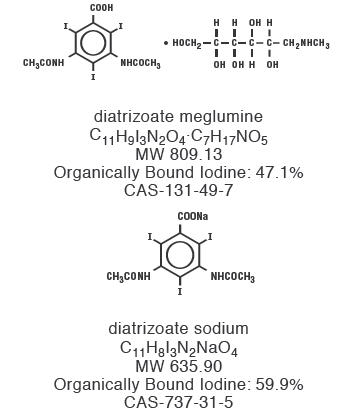
Diatrizoate meglumine is designated chemically as 1-deoxy-1-(methylamino)-D-glucitol 3,5-diacetamido-2,4,6-triiodo-benzoate (salt); diatrizoate sodium is monosodium 3, 5-diacetamido-2,4,6-triiodobenzoate. Structural formulas:
CLINICAL PHARMACOLOGY
The most important characteristic of contrast media is the iodine content. The relatively high atomic weight of iodine contributes sufficient radiodensity for radiographic contrast with surrounding tissues.
Diagnostic enteral radiopaque agents have few known pharmacological effects. Diatrizoate meglumine and diatrizoate sodium exert a mild laxative effect attributable to their high osmolarity.
Diatrizoate meglumine and diatrizoate sodium are sparingly absorbed from the intact gastrointestinal tract, and therefore permit gastrointestinal opacification and delineation after oral or rectal administration. Oral administration is used for radiographic evaluation of the esophagus, stomach and proximal small intestine. Rectal administration is used for examination of the colon; however, visualization of the distal small bowel is generally unsatisfactory, since the hypertonicity of the medium causes intraluminal diffusion of water with subsequent dilution of the medium. Enough absorption from the gastrointestinal tract to permit incidental visualization of the urinary tract has been reported; this should also be considered when thyroid testing is being contemplated, since iodine-mediated thyrotropic effects may occur (see PRECAUTIONS ).
HOW SUPPLIED
Gastrografin (Diatrizoate Meglumine and Diatrizoate Sodium Solution USP) is available in packages of: Twenty-four 30 mL single dose bottles (NDC 0270-0445-35). Twelve 120 mL single dose bottles (NDC 0270-0445-40).
Storage
Protect from light. Store at 20-25°C (68-77°F) [See USP]; avoid excessive heat.
