Get your patient on Hydrochlorothiazide - Hydrochlorothiazide tablet (Hydrochlorothiazide)
Hydrochlorothiazide - Hydrochlorothiazide tablet prescribing information

INDICATIONS AND USAGE
Hydrochlorothiazide tablets are indicated as adjunctive therapy in edema associated with congestive heart failure, hepatic cirrhosis, and corticosteroid and estrogen therapy.
Hydrochlorothiazide tablets have also been found useful in edema due to various forms of renal dysfunction such as nephrotic syndrome, acute glomerulonephritis, and chronic renal failure.
Hydrochlorothiazide tablets are indicated in the management of hypertension either as the sole therapeutic agent or to enhance the effectiveness of other antihypertensive drugs in the more severe forms of hypertension.
Use in Pregnancy
Routine use of diuretics during normal pregnancy is inappropriate and exposes mother and fetus to unnecessary hazard. Diuretics do not prevent development of toxemia of pregnancy and there is no satisfactory evidence that they are useful in the treatment of toxemia.
Edema during pregnancy may arise from pathologic causes or from the physiologic and mechanical consequences of pregnancy. Thiazides are indicated in pregnancy when edema is due to pathologic causes, just as they are in the absence of pregnancy (see PRECAUTIONS: Pregnancy ). Dependent edema in pregnancy, resulting from restriction of venous return by the gravid uterus, is properly treated through elevation of the lower extremities and use of support stockings. Use of diuretics to lower intravascular volume in this instance is illogical and unnecessary. During normal pregnancy there is hypervolemia which is not harmful to the fetus or the mother in the absence of cardiovascular disease. However, it may be associated with edema, rarely generalized edema. If such edema causes discomfort, increased recumbency will often provide relief. Rarely this edema may cause extreme discomfort which is not relieved by rest. In these instances, a short course of diuretic therapy may provide relief and be appropriate.
DOSAGE AND ADMINISTRATION
Therapy should be individualized according to patient response. Use the smallest dosage necessary to achieve the required response
Adults For Edema
The usual adult dosage is 25 mg to 100 mg daily as a single or divided dose. Many patients with edema respond to intermittent therapy, i.e., administration on alternate days or on 3 to 5 days each week. With an intermittent schedule, excessive response and the resulting undesirable electrolyte imbalance are less likely to occur.
For Control of Hypertension
The usual initial dose in adults is 25 mg daily given as a single dose. The dose may be increased to 50 mg daily, given as a single or two divided doses. Doses above 50 mg are often associated with marked reductions in serum potassium (see also PRECAUTIONS ).
Patients usually do not require doses in excess of 50 mg of hydrochlorothiazide daily when used concomitantly with other antihypertensive agents.
Infants and Children For Diuresis and for Control of Hypertension
The usual pediatric dosage is 0.5 mg to 1 mg per pound (1 to 2 mg/kg) per day in single or two divided doses, not to exceed 37.5 mg per day in infants up to 2 years of age or 100 mg per day in children 2 to 12 years of age. In infants less than 6 months of age, doses up to 1.5 mg per pound (3 mg/kg) per day in two divided doses may be required. (see PRECAUTIONS: Pediatric Use .)
CONTRAINDICATIONS
Anuria.
Hypersensitivity to this product or to other sulfonamide-derived drugs.
ADVERSE REACTIONS
The following adverse reactions have been reported and, within each category, are listed in order of decreasing severity.
Body as a Whole: Weakness.
Cardiovascular: Hypotension including orthostatic hypotension (may be aggravated by alcohol, barbiturates, narcotics or antihypertensive drugs).
Digestive: Pancreatitis, jaundice (intrahepatic cholestatic jaundice), diarrhea, vomiting, sialadenitis, cramping, constipation, gastric irritation, nausea, anorexia.
Hematologic: Aplastic anemia, agranulocytosis, leukopenia, hemolytic anemia, thrombocytopenia.
Hypersensitivity: Anaphylactic reactions, necrotizing angiitis (vasculitis and cutaneous vasculitis), respiratory distress including pneumonitis and pulmonary edema, photosensitivity, fever, urticaria, rash, purpura.
Metabolic: Electrolyte imbalance (see PRECAUTIONS ), hyperglycemia, glycosuria, hyperuricemia.
Musculoskeletal: Muscle spasm.
Nervous System/Psychiatric: Vertigo, paresthesias, dizziness, headache, restlessness.
Renal: Renal failure, renal dysfunction, interstitial nephritis (see WARNINGS ).
Skin: Erythema multiforme including Stevens-Johnson Syndrome, exfoliative dermatitis including toxic epidermal necrolysis, alopecia.
Special Senses: Transient blurred vision, xanthopsia.
Urogenital: Impotence.
Whenever adverse reactions are moderate or severe, thiazide dosage should be reduced or therapy withdrawn.
DESCRIPTION
Hydrochlorothiazide is a diuretic and antihypertensive. It is the 3,4-dihydro derivative of chlorothiazide. It is chemically designated as 6-chloro-3,4-dihydro- 2H -1,2,4-benzothiadiazine-7-sulfonamide 1,1-dioxide and has the following structural formula:
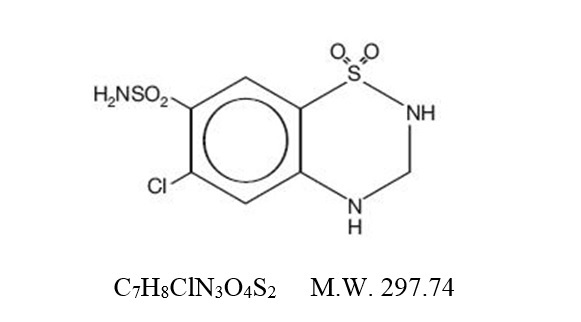
Hydrochlorothiazide, USP is a white, or practically white, crystalline powder which is slightly soluble in water, freely soluble in sodium hydroxide solution, in n -butylamine, and in dimethylformamide; sparingly soluble in methanol; insoluble in ether, in chloroform, and in dilute mineral acids. Each tablet for oral administration contains 25 mg or 50 mg hydrochlorothiazide USP. In addition, each tablet contains the following inactive ingredients: corn starch, FD&C Yellow #6, dibasic calcium phosphate, pregelatinized starch, colloidal silicon dioxide, lactose monohydrate and magnesium stearate.
CLINICAL PHARMACOLOGY
The mechanism of the antihypertensive effect of thiazides is unknown. Hydrochlorothiazide does not usually affect normal blood pressure.
Hydrochlorothiazide affects the distal renal tubular mechanism of electrolyte reabsorption. At maximal therapeutic dosage all thiazides are approximately equal in their diuretic efficacy.
Hydrochlorothiazide increases excretion of sodium and chloride in approximately equivalent amounts. Natriuresis may be accompanied by some loss of potassium and bicarbonate.
After oral use diuresis begins within 2 hours, peaks in about 4 hours and lasts about 6 to 12 hours.
Pharmacokinetics and Metabolism
Hydrochlorothiazide is not metabolized but is eliminated rapidly by the kidney. When plasma levels have been followed for at least 24 hours, the plasma half-life has been observed to vary between 5.6 and 14.8 hours. At least 61 percent of the oral dose is eliminated unchanged within 24 hours. Hydrochlorothiazide crosses the placental but not the blood-brain barrier and is excreted in breast milk.
HOW SUPPLIED
Hydrochlorothiazide Tablets USP are available as light orange, circular, flat, beveled, uncoated tablets, with score line having "T" and "154" debossed across the score line on one side and plain on other side containing 25 mg of hydrochlorothiazide USP.
Bottles of 90 : NDC 76282-154-90 Bottles of 100 : NDC 76282-154-01 Bottles of 500 : NDC 76282-154-05 Bottles of 1000 : NDC 76282-154-10
Hydrochlorothiazide Tablets USP are available as light orange, circular, flat, beveled, uncoated tablets, with score line having "T" and "155" debossed across the score line on one side and plain on other side containing 50 mg of hydrochlorothiazide USP.
Bottles of 90 : NDC 76282-155-90 Bottles of 100 : NDC 76282-155-01 Bottles of 500 : NDC 76282-155-05 Bottles of 1000 : NDC 76282-155-10
PHARMACIST: Dispense in a well-closed container as defined in the USP. Use child-resistant closure (as required) Store at 20° - 25° C (68°-77° F) [see USP Controlled Room Temperature]. Please address medical inquiries to Exelan Pharmaceuticals Inc’s toll free # 1-855-295-7455
