Get your patient on Methocarbamol - Methocarbamol tablet (Methocarbamol)
Methocarbamol - Methocarbamol tablet prescribing information

INDICATIONS AND USAGE
Methocarbamol tablets, USP are indicated as an adjunct to rest, physical therapy, and other measures for the relief of discomfort associated with acute, painful musculoskeletal conditions. The mode of action of methocarbamol has not been clearly identified, but may be related to its sedative properties. Methocarbamol does not directly relax tense skeletal muscles in man.
DOSAGE AND ADMINISTRATION
Methocarbamol tablets USP, 500 mg – Adults:
Initial dosage: 3 tablets q.i.d.
Maintenance dosage: 2 tablets q.i.d.
Methocarbamol tablets USP, 750 mg – Adults:
Initial dosage: 2 tablets q.i.d.
Maintenance dosage: 1 tablet q.4h. or 2 tablets t.i.d.
Six grams a day are recommended for the first 48 to 72 hours of treatment. (For severe conditions 8 grams a day may be administered). Thereafter, the dosage can usually be reduced to approximately 4 grams a day.
CONTRAINDICATIONS
Methocarbamol tablets, USP are contraindicated in patients hypersensitive to methocarbamol or to any of the tablet components.
ADVERSE REACTIONS
Adverse reactions reported coincident with the administration of methocarbamol include:
Body as a whole:
Anaphylactic reaction, angioneurotic edema, fever, headache
Cardiovascular system:
Bradycardia, flushing, hypotension, syncope, thrombophlebitis
Digestive system:
Dyspepsia, jaundice (including cholestatic jaundice), nausea and vomiting
Hemic and lymphatic system:
Leukopenia
Immune system:
Hypersensitivity reactions
Nervous system:
Amnesia, confusion, diplopia, dizziness or lightheadedness, drowsiness, insomnia, mild muscular incoordination, nystagmus, sedation, seizures (including grand mal), vertigo
Skin and special senses:
Blurred vision, conjunctivitis, nasal congestion, metallic taste, pruritus, rash, urticaria
Drug interactions
See WARNINGS and PRECAUTIONS for interaction with CNS drugs and alcohol.
Methocarbamol may inhibit the effect of pyridostigmine bromide. Therefore, methocarbamol should be used with caution in patients with myasthenia gravis receiving anticholinesterase agents.
DESCRIPTION
Methocarbamol tablets, USP, a carbamate derivative of guaifenesin, are a central nervous system (CNS) depressant with sedative and musculoskeletal relaxant properties.
The chemical name of methocarbamol is 3-(2-meth-oxyphenoxy)-1,2-propanediol 1-carbamate and has the empirical formula C 11 H 15 NO 5 . Its molecular weight is 241.24. The structural formula is shown below.
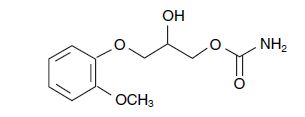
Methocarbamol, USP is a white powder, sparingly soluble in water and chloroform, soluble in alcohol (only with heating) and propylene glycol, and insoluble in benzene and n -hexane.
Methocarbamol tablets, USP are available as 500 mg and 750 mg tablets for oral administration. Methocarbamol tablets USP, 500 mg and 750 mg contain the following inactive ingredients: magnesium stearate, povidone, and sodium starch glycolate.
CLINICAL PHARMACOLOGY
The mechanism of action of methocarbamol in humans has not been established, but may be due to general central nervous system (CNS) depression. It has no direct action on the contractile mechanism of striated muscle, the motor end plate or the nerve fiber.
HOW SUPPLIED
Methocarbamol tablets, USP
500 mg tablets are round standard convex, scored, white to off-white tablet, debossed “S” above the bisect and “225” below on one side and plain on the reverse side.
They are supplied as follows:
Bottles of 100 NDC 43547-405-10 Bottles of 500 NDC 43547-405-50
Methocarbamol tablets, USP 750 mg tablets are capsule shape, white to off-white tablet, debossed “S226” on one side and plain on the reverse side.
They are supplied as follows:
Bottles of 100 NDC 43547-226-10 Bottles of 500 NDC 43547-226-50
Store at controlled room temperature, between 20°C and 25°C (68°F and 77°F). [see USP Controlled Room Temperature]. Dispense in tight container.
