Get your patient on Metyrosine - Metyrosine capsule (Metyrosine)
Metyrosine - Metyrosine capsule prescribing information

INDICATIONS AND USAGE
Metyrosine is indicated in the treatment of patients with pheochromocytoma for:
1. Preoperative preparation of patients for surgery
2. Management of patients when surgery is contraindicated
3. Chronic treatment of patients with malignant pheochromocytoma
Metyrosine is not recommended for the control of essential hypertension.
DOSAGE AND ADMINISTRATION
The recommended initial dosage of Metyrosine for adults and children 12 years of age and older is 250 mg orally four times daily. This may be increased by 250 mg to 500 mg every day to a maximum of 4 g/day in divided doses. When used for preoperative preparation, the optimally effective dosage of Metyrosine should be given for at least five to seven days.
Optimally effective dosages of Metyrosine usually are between 2 and 3 g/day, and the dose should be titrated by monitoring clinical symptoms and catecholamine excretion. In patients who are hypertensive, dosage should be titrated to achieve normalization of blood pressure and control of clinical symptoms. In patients who are usually normotensive, dosage should be titrated to the amount that will reduce urinary metanephrines and/or vanillylmandelic acid by 50% or more.
If patients are not adequately controlled by the use of Metyrosine, an alpha-adrenergic blocking agent (phenoxybenzamine) should be added.
Use of Metyrosine in children under 12 years of age has been limited and a dosage schedule for this age group cannot be given.
CONTRAINDICATIONS
Metyrosine is contraindicated in persons known to be hypersensitive to this compound.
ADVERSE REACTIONS
Central Nervous System
Sedation: The most common adverse reaction to Metyrosine is moderate to severe sedation, which has been observed in almost all patients. It occurs at both low and high dosages. Sedative effects begin within the first 24 hours of therapy, are maximal after two to three days, and tend to wane during the next few days.
Sedation usually is not obvious after one week unless the dosage is increased, but at dosages greater than 2000 mg/day some degree of sedation or fatigue may persist.
In most patients who experience sedation, temporary changes in sleep pattern occur following withdrawal of the drug. Changes consist of insomnia that may last for two or three days and feelings of increased alertness and ambition. Even patients who do not experience sedation while on Metyrosine may report symptoms of psychic stimulation when the drug is discontinued.
Extrapyramidal Signs: Extrapyramidal signs such as drooling, speech difficulty, and tremor have been reported in approximately 10% of patients. These occasionally have been accompanied by trismus and frank parkinsonism.
Anxiety and Psychic Disturbances: Anxiety and psychic disturbances such as depression, hallucinations, disorientation, and confusion may occur. These effects seem to be dose-dependent and may disappear with reduction of dosage.
Diarrhea
Diarrhea occurs in about 10% of patients and may be severe. Anti-diarrheal agents may be required if continuation of Metyrosine is necessary.
Miscellaneous
Infrequently, slight swelling of the breast, galactorrhea, nasal stuffiness, decreased salivation, dry mouth, headache, nausea, vomiting, abdominal pain, and impotence or failure of ejaculation may occur. Crystalluria (see PRECAUTIONS ) and transient dysuria and hematuria have been observed in a few patients. Hematologic disorders (including eosinophilia, anemia, thrombocytopenia, and thrombocytosis), increased SGOT levels, peripheral edema, and hypersensitivity reactions such as urticaria and pharyngeal edema have been reported rarely.
To report SUSPECTED ADVERSE REACTIONS, contact Oceanside Pharmaceuticals at 1-800-321-4576 or FDA at 1-800-FDA-1088 or www.fda.gov/medwatch.
DESCRIPTION
Metyrosine is (–)-α-methyl- L -tyrosine or (α-MPT). It has the following structural formula:
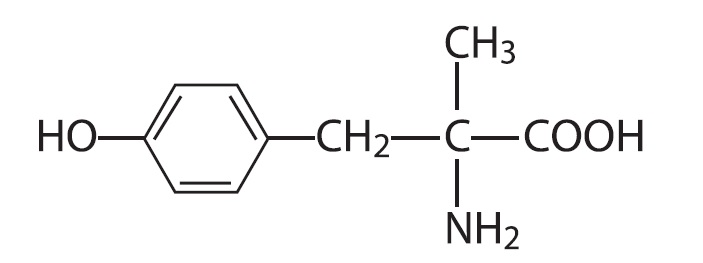
Metyrosine is a white to off-white, crystalline compound of molecular weight 195.22. It is very slightly soluble in water, acetone, and methanol, and insoluble in chloroform and benzene. It is soluble in acidic aqueous solutions. It is also soluble in alkaline aqueous solutions, but is subject to oxidative degradation under these conditions.
Metyrosine is supplied as capsules for oral administration. Each capsule contains 250 mg metyrosine.
Inactive ingredients are colloidal silicon dioxide, gelatin, hydroxypropyl cellulose, magnesium stearate, titanium dioxide, FD&C Blue 2 and edible black ink.
CLINICAL PHARMACOLOGY
Metyrosine inhibits tyrosine hydroxylase, which catalyzes the first transformation in catecholamine biosynthesis, i.e., the conversion of tyrosine to dihydroxyphenylalanine (DOPA). Because the first step is also the rate-limiting step, blockade of tyrosine hydroxylase activity results in decreased endogenous levels of catecholamines, usually measured as decreased urinary excretion of catecholamines and their metabolites.
In patients with pheochromocytoma, who produce excessive amounts of norepinephrine and epinephrine, administration of 1 to 4 grams of Metyrosine per day has reduced catecholamine biosynthesis from about 35% to 80% as measured by the total excretion of catecholamines and their metabolites (metanephrine and vanillylmandelic acid). The maximum biochemical effect usually occurs within two to three days, and the urinary concentration of catecholamines and their metabolites usually returns to pretreatment levels within three to four days after Metyrosine is discontinued. In some patients the total excretion of catecholamines and catecholamine metabolites may be lowered to normal or near normal levels (less than 10 mg/24 hours). In most patients, the duration of treatment has been two to eight weeks, but several patients have received Metyrosine for periods of 1 to 10 years.
Most patients with pheochromocytoma treated with Metyrosine experience decreased frequency and severity of hypertensive attacks with their associated headache, nausea, sweating, and tachycardia. In patients who respond, blood pressure decreases progressively during the first two days of therapy with Metyrosine; after withdrawal, blood pressure usually increases gradually to pretreatment values within two to three days.
Metyrosine is well absorbed from the gastrointestinal tract. From 53% to 88% (mean 69%) was recovered in the urine as unchanged drug following maintenance oral doses of 600 to 4000 mg/24 hours in patients with pheochromocytoma or essential hypertension. Less than 1% of the dose was recovered as catechol metabolites. These metabolites are probably not present in sufficient amounts to contribute to the biochemical effects of metyrosine. The quantities excreted, however, are sufficient to interfere with accurate determination of urinary catecholamines determined by routine techniques.
Plasma half-life of metyrosine determined over an 8-hour period after single oral doses was 3-3.7 hours in three patients.
For further information, refer to: Sjoerdsma A, Engelman K, Waldman TA, Cooperman LH, Hammond WG. Pheochromocytoma: Current Concepts of Diagnosis and Treatment: Combined Clinical Staff Conference at the National Institutes of Health. Ann Intern Med . 1966;65:1302-1326.
HOW SUPPLIED
Metyrosine Capsules 250 mg are blue opaque capsules imprinted with “ATON/305” on body, and “DEMSER” on cap, filled with white to off-white granular free-flowing powder. They are supplied as follows:
- NDC 68682-310-01 bottles of 100
Storage: Store at 20° to 25°C (68° to 77°F) [see USP Controlled Room Temperature].
Dispense in a well-closed container.
Distributed by:
Oceanside Pharmaceuticals, a division of Bausch Health US, LLC
Bridgewater, NJ 08807 USA
Manufactured by:
Bausch Health Companies Inc.
Steinbach, MB R5G 1Z7, Canada
DEMSER is a trademark of Bausch Health Companies Inc. or its affiliates.
© 2021 Bausch Health Companies Inc. or its affiliates
Rev. 07/2021 9744301 20003161
