Get your patient on Minocin - Minocycline Hydrochloride injection (Minocycline Hydrochloride)
Minocin - Minocycline Hydrochloride injection prescribing information

INDICATIONS AND USAGE
MINOCIN ® Intravenous is indicated in the treatment of the following infections due to susceptible isolates of the designated bacteria:
Rocky Mountain spotted fever, typhus fever and the typhus group, Q fever, rickettsialpox and tick fevers caused by rickettsiae. Respiratory tract infections caused by Mycoplasma pneumoniae . Lymphogranuloma venereum caused by Chlamydia trachomatis . Psittacosis (Ornithosis) due to Chlamydophila psittaci . Trachoma caused by Chlamydia trachomatis , although the infectious agent is not always eliminated, as judged by immunofluorescence. Inclusion conjunctivitis caused by Chlamydia trachomatis . Nongonococcal urethritis, endocervical, or rectal infections in adults caused by Ureaplasma urealyticum or Chlamydia trachomatis. Relapsing fever due to Borrelia recurrentis . Plague due to Yersinia pestis . Tularemia due to Francisella tularensis . Cholera caused by Vibrio cholerae . Campylobacter fetus infections caused by Campylobacter fetus . Brucellosis due to Brucella species (in conjunction with streptomycin). Bartonellosis due to Bartonella bacilliformis . Granuloma inguinale caused by Klebsiella granulomatis .
Minocycline is indicated for the treatment of infections caused by the following Gram-negative bacteria when bacteriologic testing indicates appropriate susceptibility to the drug:
Escherichia coli . Enterobacter aerogenes . Shigella species . Acinetobacter species . Respiratory tract infections caused by Haemophilus influenzae . Respiratory tract and urinary tract infections caused by Klebsiella species .
MINOCIN ® Intravenous is indicated for the treatment of infections caused by the following Gram-positive bacteria when bacteriologic testing indicates appropriate susceptibility to the drug:
Upper respiratory tract infections caused by Streptococcus pneumoniae. Skin and skin structure infections caused by Staphylococcus aureus (Note: Minocycline is not the drug of choice in the treatment of any type of staphylococcal infection.)
When penicillin is contraindicated, minocycline is an alternative drug in the treatment of the following infections:
Meningitis due to Neisseria meningitidis . Syphilis caused by Treponema pallidum subspecies pallidum . Yaws caused by Treponema pallidum subspecies pertenue . Listeriosis due to Listeria monocytogenes . Anthrax due to Bacillus anthracis . Vincent's infection caused by Fusobacterium fusiforme. Actinomycosis caused by Actinomyces israelii . Infections caused by Clostridium species .
In acute intestinal amebiasis , minocycline may be a useful adjunct to amebicides.
In severe acne , minocycline may be useful adjunctive therapy.
To reduce the development of drug-resistant bacteria and maintain the effectiveness of MINOCIN ® (minocycline) for Injection and other antibacterial drugs, MINOCIN ® (minocycline) for Injection should be used only to treat or prevent infections that are proven or strongly suspected to be caused by susceptible bacteria. When culture and susceptibility information are available, they should be considered in selecting or modifying antibacterial therapy. In the absence of such data, local epidemiology and susceptibility patterns may contribute to the empiric selection of therapy.
DOSAGE AND ADMINISTRATION
THE USUAL DOSAGE AND FREQUENCY OF ADMINISTRATION OF MINOCYCLINE DIFFERS FROM THAT OF THE OTHER TETRACYCLINES. EXCEEDING THE RECOMMENDED DOSAGE MAY RESULT IN AN INCREASED INCIDENCE OF SIDE EFFECTS.
Note: Rapid administration is to be avoided. Parenteral therapy is indicated only when oral therapy is not adequate or tolerated. Oral therapy should be instituted as soon as possible. If intravenous therapy is given over prolonged periods of time, thrombophlebitis may result.
For Pediatric Patients above 8 years of Age
Usual pediatric dose: Initial dose of 4 mg/kg, then 2 mg/kg administered over 60 minutes every 12 hours, not to exceed the usual adult dose.
Adults
Usual adult dose: Initial dose of 200 mg, then 100 mg administered over 60 minutes every 12 hours and should not exceed 400 mg in 24 hours.
The lyophilized powder should be reconstituted with 5 mL Sterile Water for Injection USP and immediately further diluted in 100 mL to 1,000 mL with Sodium Chloride Injection USP, Dextrose Injection USP, or Dextrose and Sodium Chloride Injection USP, or in 250 mL to 1000 mL Lactated Ringer's Injection USP, but not with other solutions containing calcium because a precipitate may form especially in neutral and alkaline solutions.
When diluted in compatible solutions, the pH usually ranges from 4.5 to 6.0.
Once diluted into an intravenous bag, MINOCIN ® for Injection may be stored either at room temperature for up to 4 hours or refrigerated at 2 to 8°C (36 to 46°F) for up to 24 hours. Any unused portions must be discarded after that period.
The pharmacokinetics of minocycline in patients with renal impairment (CL CR <80 mL/min) have not been fully characterized. Current data are insufficient to determine if a dosage adjustment is warranted. The total daily dosage should not exceed 200 mg in 24 hours in patients with renal impairment. However, due to the anti-anabolic effect of tetracyclines, BUN and creatinine should be monitored (See WARNINGS ). Because MINOCIN (minocycline) for Injection contains magnesium sulfate heptahydrate, serum levels of magnesium should be monitored in patients with renal impairment (See DESCRIPTION , PRECAUTIONS ).
Parenteral drug products should be inspected visually for particulate matter and discoloration prior to administration, whenever solution and container permit.
Incompatibilities
Additives or other medications should not be added to MINOCIN single-dose vials or infused simultaneously through the same intravenous line including Y-connectors. If the same intravenous line is used for sequential infusion of additional medications, the line should be flushed before and after infusion of MINOCIN with Sodium Chloride Injection USP, Dextrose Injection USP, Dextrose and Sodium Chloride Injection USP, or Lactated Ringer's Injection USP.
CONTRAINDICATIONS
This drug is contraindicated in persons who have shown hypersensitivity to any of the tetracyclines or to any of the components of the product formulation.
ADVERSE REACTIONS
The following adverse reactions have been observed in patients receiving tetracyclines.
Body as a whole: Fever, and discoloration of secretions.
Gastrointestinal: Anorexia, nausea, vomiting, diarrhea, dyspepsia, stomatitis, glossitis, dysphagia, enamel hypoplasia, enterocolitis, pseudomembranous colitis, pancreatitis, inflammatory lesions (with monilial overgrowth) in the oral and anogenital regions. These reactions have been caused by both the oral and parenteral administration of tetracyclines.
Genitourinary: Vulvovaginitis.
Hepatic toxicity: Hyperbilirubinemia, hepatic cholestasis, increases in liver enzymes, fatal hepatic failure, and jaundice. Hepatitis, including autoimmune hepatitis, and liver failure have been reported (See PRECAUTIONS ).
Skin: Alopecia, erythema nodosum, hyperpigmentation of nails, pruritus, toxic epidermal necrolysis, and vasculitis, maculopapular and erythematous rashes. Exfoliative dermatitis has been reported. Fixed drug eruptions have been reported. Lesions occurring on the glans penis have caused balanitis. Erythema multiforme and Stevens-Johnson syndrome have been reported. Photosensitivity is discussed above (See WARNINGS ). Pigmentation of the skin and mucous membranes has been reported.
Local Reactions: Injection site erythema and injection site pain.
Respiratory: Cough, dyspnea, bronchospasm, exacerbation of asthma, and pneumonitis.
Renal toxicity: Interstitial nephritis. Elevations in BUN have been reported and are apparently dose related (See WARNINGS ). Acute renal failure has been reported.
Musculoskeletal: Arthralgia, arthritis, bone discoloration, myalgia, joint stiffness, and joint swelling.
Hypersensitivity reactions: Urticaria, angioneurotic edema, polyarthralgia, anaphylaxis/anaphylactoid reaction (including shock and fatalities), anaphylactoid purpura, myocarditis, pericarditis, exacerbation of systemic lupus erythematosus, and pulmonary infiltrates with eosinophilia have been reported. A lupus-like syndrome and serum sickness-like reactions also have been reported.
Blood: Agranulocytosis, hemolytic anemia, thrombocytopenia, leukopenia, neutropenia, pancytopenia, and eosinophilia have been reported.
Central Nervous System: Convulsions, dizziness, hypesthesia, paresthesia, sedation, and vertigo. Pseudotumor cerebri (benign intracranial hypertension) in adults and bulging fontanels in infants (See PRECAUTIONS - General ). Headache has also been reported.
Other: Thyroid cancer has been reported in the post-marketing setting in association with minocycline products. When minocycline therapy is given over prolonged periods, monitoring for signs of thyroid cancer should be considered. When given over prolonged periods, tetracyclines have been reported to produce brown-black microscopic discoloration of the thyroid gland. Cases of abnormal thyroid function have been reported.
Tooth discoloration in pediatric patients less than 8 years of age (See WARNINGS ) and in adults has been reported.
Oral cavity discoloration (including tongue, lip, and gum) have been reported.
Tinnitus and decreased hearing have been reported in patients on MINOCIN ® (minocycline for injection).
The following syndromes have been reported. In some cases involving these syndromes, death has been reported. As with other serious adverse reactions, if any of these syndromes are recognized, the drug should be discontinued immediately:
Hypersensitivity syndrome consisting of cutaneous reaction (such as rash or exfoliative dermatitis), eosinophilia, and one or more of the following: hepatitis, pneumonitis, nephritis, myocarditis, and pericarditis. Fever and lymphadenopathy may be present.
Lupus-like syndrome consisting of positive antinuclear antibody; arthralgia, arthritis, joint stiffness, or joint swelling; and one or more of the following: fever, myalgia, hepatitis, rash, and vasculitis.
Serum sickness-like syndrome consisting of fever; urticaria or rash; and arthralgia, arthritis, joint stiffness, or joint swelling. Eosinophilia may be present.
MINOCIN ® (minocycline) for Injection contains magnesium sulfate heptahydrate (See DESCRIPTION ). Adverse effects that may be associated with magnesium intoxication include flushing, sweating, hypotension, depressed reflexes, flaccid paralysis, hypothermia, circulatory collapse, cardiac and CNS depression proceeding to respiratory paralysis (See PRECAUTIONS ).
Drug Interactions
Because tetracyclines have been shown to depress plasma prothrombin activity, patients who are on anticoagulant therapy may require downward adjustment of their anticoagulant dosage.
Since bacteriostatic drugs may interfere with the bactericidal action of penicillin, it is advisable to avoid giving tetracyclines in conjunction with penicillin.
Concurrent use of tetracyclines with oral contraceptives may render oral contraceptives less effective.
Administration of isotretinoin should be avoided shortly before, during, and shortly after minocycline therapy. Each drug alone has been associated with pseudotumor cerebri (See PRECAUTIONS ).
Increased risk of ergotism when ergot alkaloids or their derivatives are given with tetracyclines.
MINOCIN ® (minocycline) for Injection contains magnesium sulfate heptahydrate (See DESCRIPTION ). Potentially serious drug interactions may occur when intravenous magnesium sulfate heptahydrate is given concomitantly with CNS depressants, neuromuscular blocking agents and cardiac glycosides.
DESCRIPTION
MINOCIN (minocycline) for Injection, is a sterile formulation of a semisynthetic derivative of tetracycline. The chemical name of minocycline is 4,7-Bis(dimethylamino)- 1,4,4a,5,5a,6,11,12a-octahydro-3,10,12,12a- tetrahydroxy-1,11-dioxo-2- naphthacenecarboxamide monohydrochloride.
Its structural formula is:
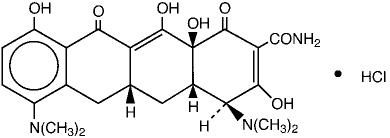 | ||
| C 23 H 27 N 3 O 7 ∙HCl | M.W. 493.94 | |
MINOCIN is supplied as a sterile yellow to amber lyophilized powder for intravenous infusion. Each vial contains minocycline HCl equivalent to 100 mg minocycline, 269 mg magnesium sulfate heptahydrate (2.2 mEq of magnesium) (an inactive ingredient) and sodium hydroxide (to adjust pH). When reconstituted with 5 mL of Sterile Water for Injection USP the pH ranges from 4.5 to 5.0.
CLINICAL PHARMACOLOGY
Following a single dose of Minocin 200 mg administered intravenously to 10 healthy male subjects, serum concentrations of minocycline ranged from 2.52 to 6.63 mcg/mL (average 4.18 mcg/mL) at the end of infusion and 0.82 to 2.64 mcg/mL (average 1.38 mcg/mL) after 12 hours. In a group of 5 healthy male subjects, serum concentrations of minocycline ranged from 1.4 to1.8 mcg/mL at the end of the dosing interval following administration of Minocin 100 mg every 12 hours for three days. When Minocin 200 mg once daily was administered for three days, serum concentrations of minocycline were approximately 1 mcg/mL at 24 hours. The serum elimination half-life of minocycline following administration of either Minocin 100 mg every 12 hours or 200 mg once daily was not significantly different and ranged from 15 to 23 hours. The serum elimination half-life of minocycline ranged from 11 to 16 hours in subjects with hepatic impairment (n=7) and 18 to 69 hours in subjects with renal impairment (n=5). In comparison, the serum elimination half-life of minocycline ranged from 11 to 17 hours following a single dose of oral minocycline 200 mg in healthy subjects (n=12).
Microbiology
Mechanism of Action
The tetracyclines are primarily bacteriostatic and are thought to exert their antimicrobial effect by the inhibition of protein synthesis. The tetracyclines, including minocycline, have a similar antimicrobial spectrum of activity against a wide range of Gram-positive and Gram-negative bacteria. Cross-resistance of these bacteria to tetracyclines is common.
List of Microorganisms
Minocycline has been shown to be active against most isolates of the following bacteria, both in vitro and in clinical infections as described in the INDICATIONS AND USAGE section:
Gram-positive Bacteria Bacillus anthracis Listeria monocytogenes Staphylococcus aureus Streptococcus pneumoniae
Gram-negative Bacteria Bartonella bacilliformis Brucella species Klebsiella granulomatis Campylobacter fetus Francisella tularensis Vibrio cholerae Yersinia pestis Acinetobacter species Enterobacter aerogenes Escherichia coli Haemophilus influenzae Klebsiella species Neisseria meningitidis Shigella species
Other Microorganisms Actinomyces species Borrelia recurrentis Chlamydophila psittaci Chlamydia trachomatis Clostridium species Entamoeba species Fusobacterium nucleatum subspecies fusiforme Mycobacterium marinum Mycoplasma pneumoniae Propionibacterium acnes Rickettsiae Treponema pallidum subspecies pallidum Treponema pallidum subspecies pertenue Ureaplasma urealyticum
Susceptibility Test Methods
For specific information regarding susceptibility test interpretive criteria and associated test methods and quality control standards recognized by FDA for this drug, please see: https://www.fda.gov/STIC .
HOW SUPPLIED
MINOCIN ® (minocycline) for Injection is supplied as 100 mg single-dose vials of sterile lyophilized powder.
NDC 70842-160-01: 100 mg single-dose vial NDC 70842-160-10: units of 10 × 1 single-dose 100 mg vials
Store at Controlled Room Temperature 20° to 25°C (68° to 77°F).
