Get your patient on Na - Lidocaine Hydrochloride injection, Solution (Lidocaine Hydrochloride)
Na - Lidocaine Hydrochloride injection, Solution prescribing information

INDICATIONS AND USAGE
Lidocaine Hydrochloride Injection is indicated for production of local or regional anesthesia by infiltration techniques such as percutaneous injection, by peripheral nerve block techniques such as brachial plexus and intercostal and by central neural techniques such as lumbar and caudal epidural blocks, when the accepted procedures for these techniques as described in standard textbooks are observed.
DOSAGE AND ADMINISTRATION
Table 1 (Recommended Dosages) summarizes the recommended volumes and concentrations of Lidocaine Hydrochloride Injection for various types of anesthetic procedures. The dosages suggested in this table are for normal healthy adults and refer to the use of epinephrine-free solutions. When larger volumes are required, only solutions containing epinephrine should be used except in those cases where vasopressor drugs may be contraindicated.There have been adverse event reports of chondrolysis in patients receiving intra-articular infusions of local anesthetics following arthroscopic and other surgical procedures. Lidocaine Hydrochloride Injection is not approved for this use (see WARNINGS and DOSAGE AND ADMINISTRATION ).These recommended doses serve only as a guide to the amount of anesthetic required for most routine procedures. The actual volumes and concentrations to be used depend on a number of factors such as type and extent of surgical procedure, depth of anesthesia and degree of muscular relaxation required, duration of anesthesia required, and the physical condition of the patient. In all cases the lowest concentration and smallest dose that will produce the desired result should be given. Dosages should be reduced for children and for the elderly and debilitated patients and patients with cardiac and/or liver disease.The onset of anesthesia, the duration of anesthesia and the degree of muscular relaxation are proportional to the volume and concentration (i.e., total dose) of local anesthetic used. Thus, an increase in volume and concentration of Lidocaine Hydrochloride Injection will decrease the onset of anesthesia, prolong the duration of anesthesia, provide a greater degree of muscular relaxation and increase the segmental spread of anesthesia. However, increasing the volume and concentration of Lidocaine Hydrochloride Injection may result in a more profound fall in blood pressure when used in epidural anesthesia. Although the incidence of side effects with lidocaine HCl is quite low, caution should be exercised when employing large volumes and concentrations, since the incidence of side effects is directly proportional to the total dose of local anesthetic agent injected.
Epidural Anesthesia
For epidural anesthesia, only the following dosage form of lidocaine hydrochloride injection is recommended:1%, 10 mL Glass Ampule2%, 10 mL Glass AmpuleAlthough this solution is intended specifically for epidural anesthesia, it may also be used for infiltration and peripheral nerve block, provided it is employed as a single-dose unit. This solution contains no bacteriostatic agent.In epidural anesthesia, the dosage varies with the number of dermatomes to be anesthetized (generally 2 to 3 mL of the indicated concentration per dermatome).
Caudal and Lumbar Epidural Block
As a precaution against the adverse experience sometimes observed following unintentional penetration of the subarachnoid space, a test dose such as 2 to 3 mL of 1.5% lidocaine HCl should be administered at least 5 minutes prior to injecting the total volume required for a lumbar or caudal epidural block. The test dose should be repeated if the patient is moved in a manner that may have displaced the catheter. Epinephrine, if contained in the test dose (10 to 15 mcg have been suggested), may serve as a warning of unintentional intravascular injection. If injected into a blood vessel, this amount of epinephrine is likely to produce a transient “epinephrine response” within 45 seconds, consisting of an increase in heart rate and systolic blood pressure, circumoral pallor, palpitations and nervousness in the unsedated patient.The sedated patient may exhibit only a pulse rate increase of 20 or more beats per minute for 15 or more seconds. Patients on beta blockers may not manifest changes in heart rate, but blood pressure monitoring can detect an evanescent rise in systolic blood pressure. Adequate time should be allowed for onset of anesthesia after administration of each test dose. The rapid injection of a large volume of Lidocaine Hydrochloride Injection through the catheter should be avoided, and, when feasible, fractional doses should be administered.In the event of the known injection of a large volume of local anesthetic solution into the subarachnoid space, after suitable resuscitation and if the catheter is in place, consider attempting the recovery of drug by draining a moderate amount of cerebrospinal fluid (such as 10 mL) through the epidural catheter.
CONTRAINDICATIONS
Lidocaine HCl is contraindicated in patients with a known history of hypersensitivity to local anesthetics of the amide type.
ADVERSE REACTIONS
Systemic
Adverse experiences following the administration of lidocaine HCl are similar in nature to those observed with other amide local anesthetic agents. These adverse experiences are, in general, dose- related and may result from high plasma levels caused by excessive dosage, rapid absorption or inadvertent intravascular injection, or may result from a hypersensitivity, idiosyncrasy or diminished tolerance on the part of the patient. Serious adverse experiences are generally systemic in nature. The following types are those most commonly reported:
Central Nervous System
CNS manifestations are excitatory and/or depressant and may be characterized by lightheadedness, nervousness, apprehension, euphoria, confusion, dizziness, drowsiness, tinnitus, blurred or double vision, vomiting, sensations of heat, cold or numbness, twitching, tremors, convulsions, unconsciousness, respiratory depression and arrest. The excitatory manifestations may be very brief or may not occur at all, in which case the first manifestation of toxicity may be drowsiness merging into unconsciousness and respiratory arrest.Drowsiness following the administration of lidocaine HCl is usually an early sign of a high blood level of the drug and may occur as a consequence of rapid absorption.
Cardiovascular System
Cardiovascular manifestations are usually depressant and are characterized by bradycardia, hypotension, and cardiovascular collapse, which may lead to cardiac arrest.
Allergic
Allergic reactions are characterized by cutaneous lesions, urticaria, edema or anaphylactoid reactions. Allergic reactions may occur as a result of sensitivity either to local anesthetic agents. Allergic reactions, including anaphylactic reactions, may occur as a result of sensitivity to lidocaine, but are infrequent. If allergic reactions do occur, they should be managed by conventional means. The detection of sensitivity by skin testing is of doubtful value.There have been no reports of cross sensitivity between lidocaine hydrochloride and procainamide or between lidocaine hydrochloride and quinidine.
Neurologic
The incidences of adverse reactions associated with the use of local anesthetics may be related to the total dose of local anesthetic administered and are also dependent upon the particular drug used, the route of administration and the physical status of the patient. In a prospective review of 10,440 patients who received lidocaine HCl for spinal anesthesia, the incidences of adverse reactions were reported to be about 3 percent each for positional headaches, hypotension and backache; 2 percent for shivering; and less than 1 percent each for peripheral nerve symptoms, nausea, respiratory inadequacy and double vision. Many of these observations may be related to local anesthetic techniques, with or without a contribution from the local anesthetic.In the practice of caudal or lumbar epidural block, occasional unintentional penetration of the subarachnoid space by the catheter may occur. Subsequent adverse effects may depend partially on the amount of drug administered subdurally. These may include spinal block of varying magnitude (including total spinal block), hypotension secondary to spinal block, loss of bladder and bowel control, and loss of perineal sensation and sexual function. Persistent motor, sensory and/or autonomic (sphincter control) deficit of some lower spinal segments with slow recovery (several months) or incomplete recovery have been reported in rare instances when caudal or lumbar epidural block has been attempted. Backache and headache have also been noted following use of these anesthetic procedures.There have been reported cases of permanent injury to extraocular muscles requiring surgical repair following retrobulbar administration.
Hematologic
Methemoglobinemia.
DESCRIPTION
Lidocaine Hydrochloride Injection, USP is a sterile, nonpyrogenic, aqueous solution that contains a local anesthetic agent and is administered parenterally by injection. See INDICATIONS AND USAGE section for specific uses.Lidocaine Hydrochloride Injection, USP solution contains lidocaine HCl, which is chemically designated as acetamide, 2-(diethylamino)-N-(2,6- dimethylphenyl)-, monohydrochloride and has the molecular wt. 270.8. Lidocaine HCl (C14H22N2O • HCl) has the following structural formula:
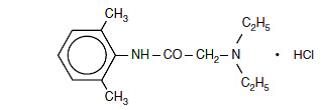
Lidocaine Hydrochloride Injection, USP solution is for single dose usage, and is Methyl Paraben Free (Preservative-Free).Lidocaine Hydrochloride Injection, USP solution is a sterile, nonpyrogenic, isotonic solution containing sodium chloride. The pH of this solution is adjusted to approximately 6.5 (5.0 to 7.0) with sodium hydroxide and/or hydrochloric acid.
CLINICAL PHARMACOLOGY
Mechanism of Action
Lidocaine HCl stabilizes the neuronal membrane by inhibiting the ionic fluxes required for the initiation and conduction of impulses thereby effecting local anesthetic action.
Hemodynamics
Excessive blood levels may cause changes in cardiac output, total peripheral resistance, and mean arterial pressure. With central neural blockade these changes may be attributable to block of autonomic fibers, a direct depressant effect of the local anesthetic agent on various components of the cardiovascular system, and/or the beta-adrenergic receptor stimulating action of epinephrine when present. The net effect is normally a modest hypotension when the recommended dosages are not exceeded.
Pharmacokinetics and Metabolism
Information derived from diverse formulations, concentrations and usages reveals that lidocaine HCl is completely absorbed following parenteral administration, its rate of absorption depending, for example, upon various factors such as the site of administration and the presence or absence of a vasoconstrictor agent. Except for intravascular administration, the highest blood levels are obtained following intercostal nerve block and the lowest after subcutaneous administration.The plasma binding of lidocaine HCl is dependent on drug concentration, and the fraction bound decreases with increasing concentration. At concentrations of 1 to 4 mcg of free base per mL 60 to 80 percent of lidocaine HCl is protein bound. Binding is also dependent on the plasma concentration of the alpha-1-acid glycoprotein.Lidocaine HCl crosses the blood-brain and placental barriers, presumably by passive diffusion.Lidocaine HCl is metabolized rapidly by the liver, and metabolites and unchanged drug are excreted by the kidneys. Biotransformation includes oxidative N-dealkylation, ring hydroxylation, cleavage of the amide linkage, and conjugation. N-dealkylation, a major pathway of biotransformation, yields the metabolites monoethylglycinexylidide and glycinexylidide. The pharmacological/toxicological actions of these metabolites are similar to, but less potent than, those of lidocaine HCl. Approximately 90% of lidocaine HCl administered is excreted in the form of various metabolites, and less than 10% is excreted unchanged. The primary metabolite in urine is a conjugate of 4-hydroxy-2,6-dimethylaniline.The elimination half-life of lidocaine HCl following an intravenous bolus injection is typically 1.5 to 2 hours. Because of the rapid rate at which lidocaine HCl is metabolized, any condition that affects liver function may alter lidocaine HCl kinetics. The half-life may be prolonged two-fold or more in patients with liver dysfunction. Renal dysfunction does not affect lidocaine HCl kinetics but may increase the accumulation of metabolites.Factors such as acidosis and the use of CNS stimulants and depressants affect the CNS levels of lidocaine HCl required to produce overt systemic effects. Objective adverse manifestations become increasingly apparent with increasing venous plasma levels above 6 mcg free base per mL. In the rhesus monkey arterial blood levels of 18 to 21 mcg/mL have been shown to be threshold for convulsive activity.
HOW SUPPLIED
Lidocaine Hydrochloride Injection, USP is supplied as sterile, clear colorless solution free from visible particles as follows:
Lidocaine Hydrochloride Injection, 1% (10 mg per mL)
Unit of sale | Strength | Each |
NDC 83090-001-10 Unit of 10 | 1% ( 20 mg per 2 mL ) (10 mg per mL) | 2 mL Single-Dose Ampule |
NDC 83090-002-10 Unit of 10 | 1% ( 50 mg per 5 mL ) (10 mg per mL) | 5 mL Single-Dose Ampule |
NDC 83090-003-10 Unit of 10 | 1% ( 100 mg per 10 mL ) (10 mg/mL) | 10 mL Single Dose Ampule |
Lidocaine Hydrochloride Injection, 2% (20 mg per mL)
Unit of sale | Strength | Each |
NDC 83090-004-10 Unit of 10 | 2% ( 40 mg per 2 mL ) (20 mg per mL) | 2 mL Single-Dose Ampule |
NDC 83090-005-10 Unit of 10 | 2% ( 100 mg per 5 mL ) (20 mg per mL) | 5 mL Single-Dose Ampule |
NDC 83090-006-10 Unit of 10 | 2% ( 200 mg per 10 mL ) (20 mg per mL) | 10 mL Single Dose Ampule |
Sterile, Nonpyrogenic
Discard unused portion
Store at 20° to 25°C (68° to 77°F). [See USP Controlled Room Temperature.]
Manufactured by: Sintetica S.A. Mendrisio Switzerland
Manufactured for: Sintetica US LLC 301 Carnegie Center Suite 101 Princeton, New Jersey 08540 USA
Revised: 11/2022
