Nalbuphine Hydrochloride - Nalbuphine Hydrochloride injection, Solution prescribing information

WARNING: SERIOUS AND LIFE-THREATENING RISKS FROM USE OF NALBUPHINE HYDROCHLORIDE INJECTION
Addiction, Abuse, and Misuse
Because the use of Nalbuphine Hydrochloride Injection exposes patients and other users to the risks of opioid addiction, abuse, and misuse, which can lead to overdose and death, assess each patient's risk prior to prescribing and reassess all patients regularly for the development of these behaviors and conditions [see WARNINGS ].
Life-Threatening Respiratory Depression
Serious, life-threatening, or fatal respiratory depression may occur with use of Nalbuphine Hydrochloride Injection, especially during initiation or following a dosage increase. To reduce the risk of respiratory depression, proper dosing, and titration of Nalbuphine Hydrochloride Injection are essential [see WARNINGS ].
Risks From Concomitant Use With Benzodiazepines Or Other CNS Depressants
Concomitant use of opioids with benzodiazepines or other central nervous system (CNS) depressants, including alcohol, may result in profound sedation, respiratory depression, coma, and death. Reserve concomitant prescribing of Nalbuphine Hydrochloride Injection and benzodiazepines or other CNS depressants for use in patients for whom alternative treatment options are inadequate [see WARNINGS , PRECAUTIONS; Drug Interactions ].
INDICATIONS AND USAGE
Nalbuphine Hydrochloride Injection is indicated for the management of pain severe enough to require an opioid analgesic and for which alternative treatments are inadequate. Nalbuphine Hydrochloride Injection can also be used as a supplement to balanced anesthesia, for preoperative and postoperative analgesia, and for obstetrical analgesia during labor and delivery.
Limitations of Use:
Because of the risks of addiction, abuse, misuse, overdose, and death, which can occur at any dosage or duration and persist over the course of therapy [see WARNINGS ], reserve opioid analgesics, including Nalbuphine Hydrochloride Injection, for use in patients for whom alternative treatment options are ineffective, not tolerated, or would be otherwise inadequate to provide sufficient management of pain.
DOSAGE AND ADMINISTRATION
Important Dosage and Administration Instructions
Nalbuphine Hydrochloride Injection should be administered as a supplement to general anesthesia only by persons specifically trained in the use of intravenous anesthetics and management of the respiratory effects of potent opioids.
An overdose reversal agent (e.g. naloxone, nalmefene), resuscitative and intubation equipment and oxygen should be readily available.
Use the lowest effective dosage for the shortest duration of time consistent with individual patient treatment goals [see WARNINGS ]. Because the risk of overdose increases as opioid doses increase, reserve titration to higher doses of Nalbuphine Hydrochloride Injection for patients in whom lower doses are insufficiently effective and in whom the expected benefits of using a higher dose opioid clearly outweigh the substantial risks.
There is variability in the opioid analgesic dose and duration needed to adequately manage pain due both to the cause of pain and to individual patient factors. Initiate the dosing regimen for each patient individually, taking into account the patient's underlying cause and severity of pain, prior analgesic treatment and response, and risk factors for addiction, abuse, and misuse [see WARNINGS ].
Respiratory depression can occur at any time during opioid therapy, especially when initiating and following dosage increases with Nalbuphine Hydrochloride Injection. Consider this risk when selecting an initial dose and when making dose adjustments [see WARNINGS ].
Parenteral drug products should be inspected visually for particulate matter and discoloration prior to administration whenever solution and container permit.
Initial Dosage
The usual recommended adult dose is 10 mg for a 70 kg individual administered subcutaneously, intramuscularly, or intravenously; this dose may be repeated every 3 to 6 hours as necessary. Use the lowest dose necessary to achieve adequate analgesia. Dosage should be adjusted according to the severity of the pain, physical status of the patient, and other medications which the patient may be receiving [see WARNINGS ]. In nontolerant individuals, the recommended single maximum dose is 20 mg with a maximum total daily dose of 160 mg.
The use of Nalbuphine Hydrochloride Injection as a supplement to balanced anesthesia requires larger doses than those recommended for analgesia. Induction doses of nalbuphine hydrochloride range from 0.3 mg/kg to 3 mg/kg intravenously to be administered over a 10-to-15-minute period with maintenance doses of 0.25 to 0.5 mg/kg in single intravenous administrations as required. The use of Nalbuphine Hydrochloride Injection may be followed by respiratory depression which can be reversed with the opioid antagonist naloxone hydrochloride.
Titration and Maintenance of Therapy
Titrate the dose based upon the individual patient’s response to their initial dose of Nalbuphine Hydrochloride Injection. Individually titrate Nalbuphine Hydrochloride Injection to a dose that provides adequate analgesia and minimizes adverse reactions. Continually reevaluate patients receiving nalbuphine hydrochloride to assess the maintenance of pain control, signs and symptoms of opioid withdrawal, and other adverse reactions, as well as to reassess for the development of addiction, abuse, or misuse [see WARNINGS ]. Frequent communication is important among the prescriber, other members of the healthcare team, the patient, and the caregiver/family during periods of changing analgesic requirements, including initial titration.
If the level of pain increases after dosage stabilization, attempt to identify the source of increased pain before increasing the Nalbuphine Hydrochloride Injection dosage. If after increasing the dosage, unacceptable opioid-related adverse reactions are observed (including an increase in pain after a dosage increase), consider reducing the dosage [see WARNINGS ]. Adjust the dosage to obtain an appropriate balance between management of pain and opioid-related adverse events.
Safe Reduction and Discontinuation of Nalbuphine Hydrochloride Injection
When a patient who has been taking Nalbuphine Hydrochloride Injection regularly and may be physically‑dependent no longer requires therapy with Nalbuphine Hydrochloride Injection, taper the dose gradually, by 25% to 50% every 2 to 4 days, while regularly evaluating for signs and symptoms of withdrawal. If the patient develops these signs or symptoms, raise the dose to the previous level and taper more slowly, either by increasing the interval between decreases, decreasing the amount of change in dose, or both. Do not rapidly reduce or abruptly discontinue Nalbuphine Hydrochloride Injection in a physically-dependent patient [see WARNINGS , DRUG ABUSE AND DEPENDENCE ].
CONTRAINDICATIONS
Nalbuphine Hydrochloride Injection is contraindicated in patients with:
- Significant respiratory depression [see WARNINGS ]
- Acute or severe bronchial asthma in an unmonitored setting or in the absence of resuscitative equipment [see WARNINGS ]
- Known or suspected gastrointestinal obstruction, including paralytic ileus [see WARNINGS ]
- Hypersensitivity to nalbuphine or any of the other ingredients in Nalbuphine Hydrochloride Injection.
ADVERSE REACTIONS
The most frequent adverse reaction in 1066 patients treated in clinical studies with Nalbuphine Hydrochloride Injection was sedation 381 (36%).
Less frequent reactions were: sweaty/clammy 99 (9%), nausea/vomiting 68 (6%), dizziness/vertigo 58 (5%), dry mouth 44 (4%), and headache 27 (3%).
Other adverse reactions which occurred (reported incidence of 1% or less) were:
CNS Effects: Nervousness, depression, restlessness, crying, euphoria, floating, hostility, unusual dreams, confusion, faintness, hallucinations, dysphoria, feeling of heaviness, numbness, tingling, unreality. The incidence of psychotomimetic effects, such as unreality, depersonalization, delusions, dysphoria and hallucinations has been shown to be less than that which occurs with pentazocine.
Cardiovascular: Hypertension, hypotension, bradycardia, tachycardia.
Gastrointestinal: Cramps, dyspepsia, bitter taste.
Respiratory: Depression, dyspnea, asthma.
Dermatologic: Itching, burning, urticaria.
Miscellaneous: Speech difficulty, urinary urgency, blurred vision, flushing and warmth.
Allergic Reactions: Anaphylactic/anaphylactoid and other serious hypersensitivity reactions have been reported following the use of nalbuphine and may require immediate, supportive medical treatment. These reactions may include shock, respiratory distress, respiratory arrest, bradycardia, cardiac arrest, hypotension, or laryngeal edema. Some of these allergic reactions may be life-threatening. Other allergic‑type reactions reported include stridor, bronchospasm, wheezing, edema, rash, pruritus, nausea, vomiting, diaphoresis, weakness, and shakiness.
Postmarketing Experience
The following adverse reactions have been identified during post approval use of nalbuphine. Because these reactions are reported voluntarily from a population of uncertain size, it is not always possible to reliably estimate their frequency or establish a causal relationship to drug exposure.
Abdominal pain, pyrexia, depressed level or loss of consciousness, somnolence, tremor, anxiety, pulmonary edema, agitation, seizures, and injection site reactions such as pain, swelling, redness, burning, and hot sensations. Death has been reported from severe allergic reactions to Nalbuphine Hydrochloride Injection treatment. Fetal death has been reported where mothers received Nalbuphine Hydrochloride Injection during labor and delivery.
Serotonin Syndrome : Cases of serotonin syndrome, a potentially life-threatening condition, have been reported during concomitant use of opioids with serotonergic drugs.
Adrenal Insufficiency : Cases of adrenal insufficiency have been reported with opioid use, more often following greater than one month of use.
Hyperalgesia and Allodynia : Cases of hyperalgesia and allodynia have been reported with opioid therapy of any duration [see WARNINGS ].
Hypoglycemia : Cases of hypoglycemia have been reported in patients taking opioids. Most reports were in patients with at least one predisposing risk factor (e.g., diabetes).
Opioid-induced esophageal dysfunction (OIED) : Cases of OIED have been reported in patients taking opioids and may occur more frequently in patients taking higher doses of opioids, and/or in patients taking opioids longer term [see WARNINGS ].
Adverse Reactions from Observational Studies
A prospective, observational cohort study estimated the risks of addiction, abuse, and misuse in patients initiating long-term use of Schedule II opioid analgesics between 2017 and 2021. Study participants included in one or more analyses had been enrolled in selected insurance plans or health systems for at least one year, were free of at least one outcome at baseline, completed a minimum number of follow-up assessments, and either: 1) filled multiple extended-release/long-acting opioid analgesic prescriptions during a 90‑day period (n=978); or 2) filled any Schedule II opioid analgesic prescriptions covering at least 70 of 90 days (n=1,244). Those included also had no dispensing of the qualifying opioids in the previous 6 months.
Over 12 months:
- approximately 1% to 6% of participants across the two cohorts newly met criteria for addiction, as assessed with two validated interview-based measures of moderate-to-severe opioid use disorder based on Diagnostic and Statistical Manual of Mental Disorders, Fifth Edition (DSM-5) criteria, and
- approximately 9% and 22% of participants across the two cohorts newly met criteria for prescription opioid abuse and misuse [defined in DRUG ABUSE AND DEPENDENCE ], respectively, as measured with a validated self-reported instrument.
A retrospective, observational cohort study estimated the risk of opioid-involved overdose or opioid overdose-related death in patients with new long-term use of Schedule II opioid analgesics from 2006 through 2016 (n=220,249). Included patients had been enrolled in either one of two commercial insurance programs, one managed care program, or one Medicaid program for at least 9 months. New long-term use was defined as having Schedule II opioid analgesic prescriptions covering at least 70 days’ supply over the 3 months prior to study entry and none during the preceding 6 months. Patients were excluded if they had an opioid-involved overdose in the 9 months prior to study entry. Overdose was measured using a validated medical code-based algorithm with linkage to the National Death Index database. The 5-year cumulative incidence estimates for opioid-involved overdose or opioid overdose-related death ranged from approximately 1.5% to 4% across study sites, counting only the first event during follow-up. Approximately 17% of first opioid overdoses observed over the entire study period (5-11 years, depending on the study site) were fatal. Higher baseline opioid dose was the strongest and most consistent predictor of opioid-involved overdose or opioid overdose-related death. Study exclusion criteria may have selected patients at lower risk of overdose, and substantial loss to follow-up (approximately 80%) also may have biased estimates.
The risk estimates from the studies described above may not be generalizable to all patients receiving opioid analgesics, such as those with exposures shorter or longer than the duration evaluated in the studies.
Drug Interactions
Benzodiazepines and other Central Nervous System (CNS) Depressants
Although Nalbuphine Hydrochloride Injection possesses opioid antagonist activity, there is evidence that in nondependent patients it will not antagonize an opioid analgesic administered just before, concurrently, or just after an injection of Nalbuphine Hydrochloride Injection. Therefore, due to additive pharmacologic effects, the concomitant use of other opioid analgesics, benzodiazepines or other CNS depressants such as alcohol, non-benzodiazepine sedatives/hypnotics, anxiolytics, tranquilizers, muscle relaxants, general anesthetics, antipsychotics, gabapentinoids (gabapentin or pregabalin), and other opioids, can increase the risk of respiratory depression, profound sedation, coma, and death.
Reserve concomitant prescribing of these drugs for use in patients for whom alternative treatment options are inadequate. Limit dosages and durations to the minimum required. Monitor closely for signs of respiratory depression and sedation [see WARNINGS ].
Serotonergic Drugs
The concomitant use of opioids with other drugs that affect the serotonergic neurotransmitter system, such as selective serotonin reuptake inhibitors (SSRIs), serotonin and norepinephrine reuptake inhibitors (SNRIs), tricyclic antidepressants (TCAs), triptans, 5-HT3 receptor antagonists, drugs that effect the serotonin neurotransmitter system (e.g., mirtazapine, trazodone, tramadol), certain muscle relaxants (i.e., cyclobenzaprine, metaxalone), and monoamine oxidase (MAO) inhibitors (those intended to treat psychiatric disorders and also others, such as linezolid and intravenous methylene blue), has resulted in serotonin syndrome [see PRECAUTIONS; Information for Patients ].
If concomitant use is warranted, carefully observe the patient, particularly during treatment initiation and dose adjustment. Discontinue Nalbuphine Hydrochloride Injection if serotonin syndrome is suspected.
Monoamine Oxidase Inhibitors (MAOIs)
MAOI (e.g., phenelzine, tranylcypromine, linezolid) interactions with opioids may manifest as serotonin syndrome [see PRECAUTIONS; Drug Interactions ] or opioid toxicity (e.g., respiratory depression, coma [see WARNINGS ]). The use of Nalbuphine Hydrochloride Injection is not recommended for patients taking MAOIs or within 14 days of stopping such treatment.
If urgent use of an opioid is necessary, use test doses and frequent titration of small doses to treat pain while closely monitoring blood pressure and signs and symptoms of CNS and respiratory depression.
Muscle Relaxants
Nalbuphine may enhance the neuromuscular blocking action of skeletal muscle relaxants (e.g., cyclobenzaprine, metaxalone) and produce an increased degree of respiratory depression.
Monitor patients for signs of respiratory depression that may be greater than otherwise expected and decrease the dosage of Nalbuphine Hydrochloride Injection and/or the muscle relaxant as necessary.
Diuretics
Opioids can reduce the efficacy of diuretics by inducing the release of antidiuretic hormone.
Monitor patients for signs of diminished diuresis and/or effects on blood pressure and increase the dosage of the diuretic as needed.
Anticholinergic Drugs
The concomitant use of anticholinergic drugs may increase risk of urinary retention and/or severe constipation, which may lead to paralytic ileus.
Monitor patients for signs of urinary retention or reduced gastric motility when Nalbuphine Hydrochloride Injection is used concomitantly with anticholinergic drugs.
DESCRIPTION
Nalbuphine hydrochloride is a synthetic opioid agonist-antagonist analgesic of the phenanthrene series. It is chemically related to both the widely used opioid antagonist, naloxone, and the potent opioid analgesic, oxymorphone. Chemically nalbuphine hydrochloride is 17-(cyclobutylmethyl)-4,5α-epoxymorphinan-3,6α,14-triol hydrochloride. Nalbuphine hydrochloride molecular weight is 393.91 and is soluble in H 2 O (35.5 mg/mL at 25ºC) and ethanol (0.8%); insoluble in CHCl 3 and ether. Nalbuphine hydrochloride has pKa values of 8.71 and 9.96. The molecular formula is C 21 H 27 NO 4 ∙ HCl. The structural formula is:
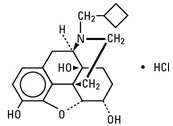
Nalbuphine Hydrochloride Injection is a sterile, nonpyrogenic solution of nalbuphine hydrochloride in water for injection. This product may be administered by subcutaneous, intramuscular, or intravenous injection.
Each milliliter (mL) contains nalbuphine hydrochloride 10 mg or 20 mg; sodium citrate, dihydrate 0.47 mg and citric acid, anhydrous 0.63 mg added as buffers and may contain sodium hydroxide and/or hydrochloric acid for pH adjustment; pH 3.7 (3.0 to 4.5). Contains sodium chloride for tonicity adjustment.
Multiple-dose vials contain 1.8 mg/mL methylparaben and 0.2 mg/mL propylparaben added as preservatives. Single-dose products contain no bacteriostat or antimicrobial agent and unused portions must be discarded.
CLINICAL PHARMACOLOGY
Mechanism of Action
Nalbuphine is an agonist at kappa opioid receptors and an antagonist at mu opioid receptors.
Pharmacodynamics
Nalbuphine Hydrochloride Injection is a potent analgesic. Its analgesic potency is essentially equivalent to that of morphine on a milligram basis up to a dosage of approximately 30 mg.
The opioid antagonist activity of Nalbuphine Hydrochloride Injection is one-fourth as potent as nalorphine and 10 times that of pentazocine.
Nalbuphine Hydrochloride Injection may produce the same degree of respiratory depression as equianalgesic doses of morphine. However, Nalbuphine Hydrochloride Injection exhibits a ceiling effect such that increases in dose greater than 30 mg do not produce further respiratory depression in the absence of other CNS active medications affecting respiration.
Nalbuphine Hydrochloride Injection by itself has potent opioid antagonist activity at doses equal to or lower than its analgesic dose. When administered following or concurrent with mu agonist opioid analgesics (e.g., morphine, oxymorphone, fentanyl), nalbuphine hydrochloride may partially reverse or block opioid-induced respiratory depression from the mu agonist analgesic. Nalbuphine Hydrochloride Injection may precipitate withdrawal in patients dependent on opioid drugs. Nalbuphine Hydrochloride Injection should be used with caution in patients who have been receiving mu opioid analgesics on a regular basis.
Effects on the Central Nervous System
Nalbuphine produces respiratory depression by direct action on brain stem respiratory centers. The respiratory depression involves a reduction in the responsiveness of the brain stem respiratory centers to both increases in carbon dioxide tension and electrical stimulation. However, there may be a ceiling effect for the respiratory depression caused by nalbuphine. Although a mixed agonist/antagonist, the respiratory depressant effects of nalbuphine can be reversed by naloxone.
Nalbuphine causes miosis, even in total darkness. Pinpoint pupils are a sign of opioid overdose but are not pathognomonic (e.g., pontine lesions of hemorrhagic or ischemic origins may produce similar findings). Marked mydriasis rather than miosis may be seen due to hypoxia in overdose situations.
Effects on the Gastrointestinal Tract and Other Smooth Muscle
Nalbuphine causes a reduction in motility associated with an increase in smooth muscle tone in the antrum of the stomach and duodenum. Digestion of food in the small intestine is delayed and propulsive contractions are decreased. Propulsive peristaltic waves in the colon are decreased, while tone may be increased to the point of spasm, resulting in constipation. Other opioid-induced effects may include a reduction in biliary and pancreatic secretions, spasm of sphincter of Oddi, transient elevations in serum amylase, and opioid-induced esophageal dysfunction (OIED).
Effects on the Cardiovascular System
During use of nalbuphine during anesthesia, a higher incidence of bradycardia has been reported in patients who did not receive atropine pre-operatively.
Opioids produce peripheral vasodilation, which may result in orthostatic hypotension or syncope. Manifestations of histamine release and/or peripheral vasodilation may include pruritus, flushing, red eyes, sweating, and/or orthostatic hypotension.
Effects on the Endocrine System
Opioids inhibit the secretion of adrenocorticotropic hormone (ACTH), cortisol, and luteinizing hormone (LH) in humans [see ADVERSE REACTIONS ]. They also stimulate prolactin, growth hormone (GH) secretion, and pancreatic secretion of insulin and glucagon.
Use of opioids for an extended period of time may influence the hypothalamic-pituitary-gonadal axis, leading to androgen deficiency that may manifest as low libido, impotence, erectile dysfunction, amenorrhea, or infertility.
The causal role of opioids in the clinical syndrome of hypogonadism is unknown because the various medical, physical, lifestyle, and psychological stressors that may influence gonadal hormone levels have not been adequately controlled for in studies conducted to date [see ADVERSE REACTIONS ].
Effects on the Immune System
Opioids have been shown to have a variety of effects on components of the immune system in in vitro and animal models. The clinical significance of these findings is unknown. Overall, the effects of opioids appear to be modestly immunosuppressive.
Concentration–Efficacy Relationships
The minimum effective analgesic concentration will vary widely among patients, especially among patients who have been previously treated with extended-release opioid agonists. The minimum effective analgesic concentration of nalbuphine for any individual patient may increase over time due to an increase in pain, the development of a new pain syndrome, and/or the development of analgesic tolerance [see DOSAGE AND ADMINISTRATION ].
Pharmacokinetics
The onset of action of Nalbuphine Hydrochloride Injection occurs within 2 to 3 minutes after intravenous administration, and in less than 15 minutes following subcutaneous or intramuscular injection. The plasma half-life of nalbuphine is 5 hours, and in clinical studies the duration of analgesic activity has been reported to range from 3 to 6 hours.
The metabolic pathway for nalbuphine has not been defined but is likely hepatic.
HOW SUPPLIED
Nalbuphine Hydrochloride Injection is supplied as a sterile solution in single-dose ampuls and multiple‑dose fliptop vials for intramuscular, subcutaneous, or intravenous administration, and available as follows:
| Unit of Sale | Concentration |
|---|---|
NDC 0409-1463-01 | 10 mg/mL |
Tray of 10 – 1 mL Single-dose Ampuls | |
NDC 0409-1465-01 | 20 mg/mL |
Tray of 10 – 1 mL Single-dose Ampuls | |
NDC 0409-1464-01 | 100 mg/10 mL |
Case of 25 – 10 mL Multiple-dose Fliptop Vials | (10 mg/mL) |
NDC 0409-1467-01 | 200 mg/10 mL |
Case of 25 – 10 mL Multiple-dose Fliptop Vials | (20 mg/mL) |
Store at 20℃ to 25°C (68℉ to 77°F). [See USP Controlled Room Temperature.]
Protect from excessive light. Store in carton until contents have been used.
Mechanism of Action
Nalbuphine is an agonist at kappa opioid receptors and an antagonist at mu opioid receptors.
