Naltrexone Hydrochloride - Naltrexone Hydrochloride tablet, Film Coated prescribing information

INDICATIONS AND USAGE
Naltrexone hydrochloride tablets are indicated in the treatment of alcohol dependence and for the blockade of the effects of exogenously administered opioids.
Naltrexone hydrochloride has not been shown to provide any therapeutic benefit except as part of an appropriate plan of management for the addictions.
DOSAGE AND ADMINISTRATION
To reduce the risk of precipitated withdrawal in patients dependent on opioids, or exacerbation of a preexisting subclinical withdrawal syndrome, opioid-dependent patients, including those being treated for alcohol dependence, should be opioid-free (including tramadol) before starting naltrexone hydrochloride treatment. An opioid-free interval of a minimum of 7 to 10 days is recommended for patients previously dependent on short-acting opioids.
Switching from Buprenorphine, Buprenorphine/Naloxone, or Methadone
There are no systematically collected data that specifically address the switch from buprenorphine or methadone to naltrexone hydrochloride; however, review of postmarketing case reports have indicated that some patients may experience severe manifestations of precipitated withdrawal when being switched from opioid agonist therapy to opioid antagonist therapy (see WARNINGS ). Patients transitioning from buprenorphine or methadone may be vulnerable to precipitation of withdrawal symptoms for as long as 2 weeks. Healthcare providers should be prepared to manage withdrawal symptomatically with non-opioid medications.
Treatment of Alcoholism
A dose of 50 mg once daily is recommended for most patients. The placebo-controlled studies that demonstrated the efficacy of naltrexone hydrochloride as an adjunctive treatment of alcoholism used a dose regimen of naltrexone hydrochloride 50 mg once daily for up to 12 weeks. Other dose regimens or durations of therapy were not evaluated in these trials.
Naltrexone hydrochloride should be considered as only one of many factors determining the success of treatment of alcoholism. Factors associated with a good outcome in the clinical trials with naltrexone hydrochloride were the type, intensity, and duration of treatment; appropriate management of comorbid conditions; use of community-based support groups; and good medication compliance. To achieve the best possible treatment outcome, appropriate compliance-enhancing techniques should be implemented for all components of the treatment program, especially medication compliance.
Treatment of Opioid Dependence
Treatment should be initiated with an initial dose of 25 mg of naltrexone hydrochloride. If no withdrawal signs occur, the patient may be started on 50 mg a day thereafter. A dose of 50 mg once a day will produce adequate clinical blockade of the actions of parenterally administered opioids. As with many non-agonist treatments for addiction, naltrexone hydrochloride is of proven value only when given as part of a comprehensive plan of management that includes some measure to ensure the patient takes the medication.
Naloxone Challenge Test
Clinicians are reminded that there is no completely reliable method for determining whether a patient has had an adequate opioid-free period. A naloxone challenge test may be helpful if there is any question of occult opioid dependence. If signs of opioid withdrawal are still observed following naloxone challenge, treatment with naltrexone hydrochlorideshould not be attempted. The naloxone challenge can be repeated in 24 hours. The naloxone challenge test should not be performed in a patient showing clinical signs or symptoms of opioid withdrawal, or in a patient whose urine contains opioids. The naloxone challenge test may be administered by either the intravenous or subcutaneous routes. Intravenous:
Inject 0.2 mg naloxone.
Observe for 30 seconds for signs or symptoms of withdrawal.
If no evidence of withdrawal, inject 0.6 mg of naloxone.
Observe for an additional 20 minutes. Subcutaneous:
Administer 0.8 mg naloxone.
Observe for 20 minutes for signs or symptoms of withdrawal.
Note: Individual patients, especially those with opioid dependence, may respond to lower doses of naloxone. In some cases, 0.1 mg IV naloxone has produced a diagnostic response.
Interpretation of the Challenge
Monitor vital signs and observe the patient for signs and symptoms of opioid withdrawal. These may include, but are not limited to: nausea, vomiting, dysphoria, yawning, sweating, tearing, rhinorrhea, stuffy nose, craving for opioids, poor appetite, abdominal cramps, sense of fear, skin erythema, disrupted sleep patterns, fidgeting, uneasiness, poor ability to focus, mental lapses, muscle aches or cramps, pupillary dilation, piloerection, fever, changes in blood pressure, pulse or temperature, anxiety, depression, irritability, backache, bone or joint pains, tremors, sensations of skin crawling or fasciculations. If signs or symptoms of withdrawal appear, the test is positive and no additional naloxone should be administered.
Warning: If the test is positive, do NOT initiate naltrexone hydrochloride therapy. Repeat the challenge in 24 hours. If the test is negative, naltrexone hydrochloride therapy may be started if no other contraindications are present. If there is any doubt about the result of the test, hold naltrexone hydrochloride and repeat the challenge in 24 hours.
Alternative Dosing Schedules
A flexible approach to a dosing regimen may need to be employed in cases of supervised administration. Thus, patients may receive 50 mg of naltrexone hydrochloride every weekday with a 100 mg dose on Saturday, 100 mg every other day, or 150 mg every third day. The degree of blockade produced by naltrexone hydrochloride may be reduced by these extended dosing intervals.
There may be a higher risk of hepatocellular injury with single doses above 50 mg, and use of higher doses and extended dosing intervals should balance the possible risks against the probable benefits (see WARNINGS ).
Patient Compliance
Naltrexone hydrochloride should be considered as only one of many factors determining the success of treatment. To achieve the best possible treatment outcome, appropriate compliance-enhancing techniques should be implemented for all components of the treatment program, including medication compliance.
CONTRAINDICATIONS
Naltrexone hydrochloride is contraindicated in:
- Patients receiving opioid analgesics.
- Patients currently dependent on opioids, including those currently maintained on opiate agonists [e.g., methadone) or partial agonists (e.g., buprenorphine).
- Patients in acute opioid withdrawal (see WARNINGS ).
- Any individual who has failed the naloxone challenge test or who has a positive urine screen for opioids.
- Any individual with a history of sensitivity to naltrexone hydrochloride or any other components of this product. It is not known if there is any cross-sensitivity with naloxone or the phenanthrene containing opioids.
ADVERSE REACTIONS
During two randomized, double-blind, placebo-controlled 12 week trials to evaluate the efficacy of naltrexone hydrochloride as an adjunctive treatment of alcohol dependence, most patients tolerated naltrexone hydrochloride well. In these studies, a total of 93 patients received naltrexone hydrochloride at a dose of 50 mg once daily. Five of these patients discontinued naltrexone hydrochloride because of nausea. No serious adverse events were reported during these two trials.
While extensive clinical studies evaluating the use of naltrexone hydrochloride in detoxified, formerly opioid-dependent individuals failed to identify any single, serious untoward risk of naltrexone hydrochloride use, placebo-controlled studies employing up to fivefold higher doses of naltrexone hydrochloride (up to 300 mg per day) than that recommended for use in opiate receptor blockade have shown that naltrexone hydrochloride causes hepatocellular injury in a substantial proportion of patients exposed at higher doses (see WARNINGS and PRECAUTIONS: Laboratory Tests ).
Aside from this finding, and the risk of precipitated opioid withdrawal, available evidence does not incriminate naltrexone hydrochloride, used at any dose, as a cause of any other serious adverse reaction for the patient who is “opioid-free.” It is critical to recognize that naltrexone hydrochloride can precipitate or exacerbate abstinence signs and symptoms in any individual who is not completely free of exogenous opioids.
Patients with addictive disorders, especially opioid addiction, are at risk for multiple numerous adverse events and abnormal laboratory findings, including liver function abnormalities . Data from both controlled and observational studies suggest that these abnormalities, other than the dose-related hepatotoxicity described above, are not related to the use of naltrexone hydrochloride.
Among opioid-free individuals, naltrexone hydrochloride administration at the recommended dose has not been associated with a predictable profile of serious adverse or untoward events. However, as mentioned above, among individuals using opioids, naltrexone hydrochloride may cause serious withdrawal reactions (see CONTRAINDICATIONS , WARNINGS , DOSAGE AND ADMINISTRATION ).
Reported Adverse Events
Naltrexone hydrochloride has not been shown to cause significant increases in complaints in placebo-controlled trials in patients known to be free of opioids for more than 7 to 10 days. Studies in alcoholic populations and in volunteers in clinical pharmacology studies have suggested that a small fraction of patients may experience an opioid withdrawal-like symptom complex consisting of tearfulness, mild nausea, abdominal cramps, restlessness, bone or joint pain, myalgia, and nasal symptoms. This may represent the unmasking of occult opioid use, or it may represent symptoms attributable to naltrexone. A number of alternative dosing patterns have been recommended to try to reduce the frequency of these complaints.
Alcoholism
In an open label safety study with approximately 570 individuals with alcoholism receiving naltrexone hydrochloride, the following new-onset adverse reactions occurred in 2% or more of the patients: nausea (10%), headache (7%), dizziness (4%), nervousness (4%), fatigue (4%), insomnia (3%), vomiting (3%), anxiety (2%) and somnolence (2%).
Depression, suicidal ideation, and suicidal attempts have been reported in all groups when comparing naltrexone, placebo, or controls undergoing treatment for alcoholism.
| RATE RANGES OF NEW ONSET EVENTS | ||
| Naltrexone | Placebo | |
| Depression | 0 to 15% | 0 to 17% |
| Suicide Attempt/Ideation | 0 to 1% | 0 to 3% |
Although no causal relationship with naltrexone hydrochloride is suspected, physicians should be aware that treatment with naltrexone hydrochloride does not reduce the risk of suicide in these patients (see PRECAUTIONS ).
Opioid Addiction
The following adverse reactions have been reported both at baseline and during the naltrexone hydrochloride clinical trials in opioid addiction at an incidence rate of more than 10%: Difficulty sleeping, anxiety, nervousness, abdominal pain/cramps, nausea and/or vomiting, low energy, joint and muscle pain, and headache. The incidence was less than 10% for: Loss of appetite, diarrhea, constipation, increased thirst, increased energy, feeling down, irritability, dizziness, skin rash, delayed ejaculation, decreased potency, and chills. The following events occurred in less than 1% of subjects: Respiratory: Nasal congestion, itching, rhinorrhea, sneezing, sore throat, excess mucus or phlegm, sinus trouble, heavy breathing, hoarseness, cough, shortness of breath. Cardiovascular: Nose bleeds, phlebitis, edema, increased blood pressure, non-specific ECG changes, palpitations, tachycardia. Gastrointestinal: Excessive gas, hemorrhoids, diarrhea, ulcer. Musculoskeletal: Painful shoulders, legs or knees; tremors, twitching. Genitourinary: Increased frequency of, or discomfort during, urination; increased or decreased sexual interest. Dermatologic: Oily skin, pruritus, acne, athlete’s foot, cold sores, alopecia. Psychiatric: Depression, paranoia, fatigue, restlessness, confusion, disorientation, hallucinations, nightmares, bad dreams. Special senses: Eyes-blurred, burning, light sensitive, swollen, aching, strained; ears-“clogged”, aching, tinnitus. General: Increased appetite, weight loss, weight gain, yawning, somnolence, fever, dry mouth, head “pounding”, inguinal pain, swollen glands, “side” pains, cold feet, “hot spells.” Postmarketing Experience: Data collected from postmarketing use of naltrexone hydrochloride show that most events usually occur early in the course of drug therapy and are transient. It is not always possible to distinguish these occurrences from those signs and symptoms that may result from a withdrawal syndrome. Events that have been reported include anorexia, asthenia, chest pain, fatigue, headache, hot flushes, malaise, changes in blood pressure, agitation, dizziness, hyperkinesia, nausea, vomiting, tremor, abdominal pain, diarrhea, palpitations, myalgia, anxiety, confusion, euphoria, hallucinations, insomnia, nervousness, somnolence, abnormal thinking, dyspnea, rash, increased sweating, vision abnormalities, and idiopathic thrombocytopenic purpura. In some individuals the use of opioid antagonists has been associated with a change in baseline levels of some hypothalamic, pituitary, adrenal, or gonadal hormones. The clinical significance of such changes is not fully understood. Adverse events, including withdrawal symptoms and death, have been reported with the use of naltrexone hydrochloride in ultra rapid opiate detoxification programs. The cause of death in these cases is not known (see WARNINGS ). Laboratory Tests: In a placebo controlled study in which naltrexone hydrochloride was administered to obese subjects at a dose approximately five-fold that recommended for the blockade of opiate receptors (300 mg per day), 19% (5/26) of naltrexone hydrochloride recipients and 0% (0/24) of placebo-treated patients developed elevations of serum transaminases (i.e., peak ALT values ranging from 121 to 532; or 3 to 19 times their baseline values) after three to eight weeks of treatment. The patients involved were generally clinically asymptomatic, and the transaminase levels of all patients on whom follow-up was obtained returned to (or toward) baseline values in a matter of weeks. Transaminase elevations were also observed in other placebo controlled studies in which exposure to naltrexone hydrochloride at doses above the amount recommended for the treatment of alcoholism or opioid blockade consistently produced more numerous and more significant elevations of serum transaminases than did placebo. Transaminase elevations occurred in 3 of 9 patients with Alzheimer's Disease who received naltrexone hydrochloride (at doses up to 300 mg/day) for 5 to 8 weeks in an open clinical trial.
Drug Interactions
Studies to evaluate possible interactions between naltrexone hydrochloride and drugs other than opiates have not been performed. Consequently, caution is advised if the concomitant administration of naltrexone hydrochloride and other drugs is required.
The safety and efficacy of concomitant use of naltrexone hydrochloride and disulfiram is unknown, and the concomitant use of two potentially hepatotoxic medications is not ordinarily recommended unless the probable benefits outweigh the known risks.
Lethargy and somnolence have been reported following doses of naltrexone hydrochloride and thioridazine.
Patients taking naltrexone hydrochloride may not benefit from opioid containing medicines, such as cough and cold preparations, antidiarrheal preparations, and opioid analgesics. In an emergency situation when opioid analgesia must be administered to a patient receiving naltrexone hydrochloride, the amount of opioid required may be greater than usual, and the resulting respiratory depression may be deeper and more prolonged (see PRECAUTIONS ).
DESCRIPTION
Naltrexone hydrochloride, an opioid antagonist, is a synthetic congener of oxymorphone with no opioid agonist properties. Naltrexone hydrochloride differs in structure from oxymorphone in that the methyl group on the nitrogen atom is replaced by a cyclopropylmethyl group. Naltrexone hydrochloride is also related to the potent opioid antagonist, naloxone, or n-allylnoroxymorphone. The chemical name for naltrexone hydrochloride is Morphinan-6-one, 17-(cyclopropylmethyl)-4,5-epoxy-3,14-dihydroxy-, hydrochloride, (5⛙)-. The structural formula is as follows:
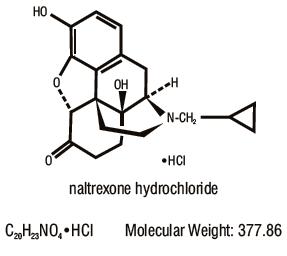
Naltrexone hydrochloride is a white, crystalline compound. The hydrochloride salt is soluble in water to the extent of about 100 mg/mL. Naltrexone hydrochloride is available in scored film-coated tablets containing 50 mg of naltrexone hydrochloride, USP. Naltrexone hydrochloride tablets, USP also contain: lactose monohydrate, microcrystalline cellulose, colloidal silicon dioxide, crospovidone, magnesium stearate, hypromellose, titanium dioxide, polyethylene glycol, iron oxide yellow, polysorbate 80 and iron oxide red. test
CLINICAL PHARMACOLOGY
Pharmacodynamic Actions
Naltrexone hydrochloride is a pure opioid antagonist. It markedly attenuates or completely blocks, reversibly, the subjective effects of intravenously administered opioids.
When coadministered with morphine, on a chronic basis, naltrexone hydrochloride blocks the physical dependence to morphine, heroin and other opioids.
Naltrexone hydrochloride has few, if any, intrinsic actions besides its opioid blocking properties. However, it does produce some pupillary constriction, by an unknown mechanism.
The administration of naltrexone hydrochloride is not associated with the development of tolerance or dependence. In subjects physically dependent on opioids, naltrexone hydrochloride will precipitate withdrawal symptomatology.
Clinical studies indicate that 50 mg of naltrexone hydrochloride will block the pharmacologic effects of 25 mg of intravenously administered heroin for periods as long as 24 hours. Other data suggest that doubling the dose of naltrexone hydrochloride provides blockade for 48 hours, and tripling the dose of naltrexone hydrochloride provides blockade for about 72 hours.
Naltrexone hydrochloride blocks the effects of opioids by competitive binding (i.e., analogous to competitive inhibition of enzymes) at opioid receptors. This makes the blockade produced potentially surmountable, but overcoming full naltrexone blockade by administration of very high doses of opiates has resulted in excessive symptoms of histamine release in experimental subjects.
The mechanism of action of naltrexone hydrochloride in alcoholism is not understood; however, involvement of the endogenous opioid system is suggested by preclinical data. Naltrexone hydrochloride, an opioid receptor antagonist, competitively binds to such receptors and may block the effects of endogenous opioids. Opioid antagonists have been shown to reduce alcohol consumption by animals, and naltrexone hydrochloride has been shown to reduce alcohol consumption in clinical studies.
Naltrexone hydrochloride is not aversive therapy and does not cause a disulfiram-like reaction either as a result of opiate use or ethanol ingestion.
Pharmacokinetics
Naltrexone hydrochloride is a pure opioid receptor antagonist. Although well absorbed orally, naltrexone is subject to significant first pass metabolism with oral bioavailability estimates ranging from 5 to 40%. The activity of naltrexone is believed to be due to both parent and the 6-ß-naltrexol metabolite. Both parent drug and metabolites are excreted primarily by the kidney (53% to 79% of the dose), however, urinary excretion of unchanged naltrexone accounts for less than 2% of an oral dose and fecal excretion is a minor elimination pathway. The mean elimination half-life (T-1/2) values for naltrexone and 6-ß-naltrexol are 4 hours and 13 hours, respectively. Naltrexone and 6-ß-naltrexol are dose proportional in terms of AUC and C max over the range of 50 to 200 mg and do not accumulate after 100 mg daily doses.
Absorption:
Following oral administration, naltrexone undergoes rapid and nearly complete absorption with approximately 96% of the dose absorbed from the gastrointestinal tract. Peak plasma levels of both naltrexone and 6-ß-naltrexol occur within one hour of dosing.
Distribution:
The volume of distribution for naltrexone following intravenous administration is estimated to be 1350 liters. In vitro tests with human plasma show naltrexone to be 21% bound to plasma proteins over the therapeutic dose range.
Metabolism:
The systemic clearance (after intravenous administration) of naltrexone is ~ 3.5 L/min, which exceeds liver blood flow (~ 1.2 L/min). This suggests both that naltrexone is a highly extracted drug (>98% metabolized) and that extrahepatic sites of drug metabolism exist. The major metabolite of naltrexone is 6-ß-naltrexol. Two other minor metabolites are 2-hydroxy-3-methoxy-6-ß-naltrexol and 2-hydroxy-3-methyl-naltrexone. Naltrexone and its metabolites are also conjugated to form additional metabolic products.
Elimination:
The renal clearance for naltrexone ranges from 30 to 127 mL/min and suggests that renal elimination is primarily by glomerular filtration. In comparison the renal clearance for 6-ß-naltrexol ranges from 230 to 369 mL/min, suggesting an additional renal tubular secretory mechanism. The urinary excretion of unchanged naltrexone accounts for less than 2% of an oral dose; urinary excretion of unchanged and conjugated 6-ß-naltrexol accounts for 43% of an oral dose. The pharmacokinetic profile of naltrexone suggests that naltrexone and its metabolites may undergo enterohepatic recycling.
Hepatic and Renal Impairment:
Naltrexone appears to have extra-hepatic sites of drug metabolism and its major metabolite undergoes active tubular secretion (see Metabolism above). Adequate studies of naltrexone in patients with severe hepatic or renal impairment have not been conducted (see PRECAUTIONS: Special Risk Patients ).
Clinical Trials
Alcoholism:
The efficacy of naltrexone hydrochloride as an aid to the treatment of alcoholism was tested in placebo-controlled, outpatient, double blind trials. These studies used a dose of naltrexone hydrochloride 50 mg once daily for 12 weeks as an adjunct to social and psychotherapeutic methods when given under conditions that enhanced patient compliance. Patients with psychosis, dementia, and secondary psychiatric diagnoses were excluded from these studies. In one of these studies, 104 alcohol-dependent patients were randomized to receive either naltrexone hydrochloride 50 mg once daily or placebo. In this study, naltrexone
hydrochloride proved superior to placebo in measures of drinking including abstention rates (51% vs. 23%), number of drinking days, and relapse (31% vs. 60%). In a second study with 82 alcohol-dependent patients, the group of patients receiving naltrexone hydrochloride were shown to have lower relapse rates (21% vs. 41%), less alcohol craving, and fewer drinking days compared with patients who received placebo, but these results depended on the specific analysis used.
The clinical use of naltrexone hydrochloride as adjunctive pharmacotherapy for the treatment of alcoholism was also evaluated in a multicenter safety study. This study of 865 individuals with alcoholism included patients with comorbid psychiatric conditions, concomitant medications, polysubstance abuse and HIV disease. Results of this study demonstrated that the side effect profile of naltrexone hydrochloride appears to be similar in both alcoholic and opioid dependent populations, and that serious side effects are uncommon.
In the clinical studies, treatment with naltrexone hydrochloride supported abstinence, prevented relapse and decreased alcohol consumption. In the uncontrolled study, the patterns of abstinence and relapse were similar to those observed in the controlled studies. Naltrexone hydrochloride was not uniformly helpful to all patients, and the expected effect of the drug is a modest improvement in the outcome of conventional treatment.
Treatment of Opioid Addiction:
Naltrexone hydrochloride has been shown to produce complete blockade of the euphoric effects of opioids in both volunteer and addict populations. When administered by means that enforce compliance, it will produce an effective opioid blockade, but has not been shown to affect the use of cocaine or other non-opioid drugs of abuse.
There are no data that demonstrate an unequivocally beneficial effect of naltrexone hydrochloride on rates of recidivism among detoxified, formerly opioid-dependent individuals who self-administer the drug. The failure of the drug in this setting appears to be due to poor medication compliance.
The drug is reported to be of greatest use in good prognosis opioid addicts who take the drug as part of a comprehensive occupational rehabilitative program, behavioral contract, or other compliance-enhancing protocol. Naltrexone hydrochloride, unlike methadone or LAAM (levo-alpha-acetyl-methadol), does not reinforce medication compliance and is expected to have a therapeutic effect only when given under external conditions that support continued use of the medication.
HOW SUPPLIED
Naltrexone Hydrochloride Tablets, USP are available as follows: 50 mg: Yellow, round, biconvex, film-coated tablets debossed with “326” on one side and scored on other side.
Bottles of 30’s with Child Resistant Cap……………..NDC 47335-326-83
Bottles of 100’s with Child Resistant Cap…................NDC 47335-326-88
Bottles of 100’s with Non Child Resistant Cap…........NDC 47335-326-08
Bottles of 1000’s with Non Child Resistant Cap……..NDC 47335-326-18
Store at 20° to 25°C (68° to 77°F); excursions permitted between 15° and 30°C (59° and 86°F) [see USP Controlled Room Temperature]. Dispense in a tight container.
