Get your patient on Nardil - Phenelzine Sulfate tablet, Film Coated (Phenelzine Sulfate)
Nardil - Phenelzine Sulfate tablet, Film Coated prescribing information

Suicidality and Antidepressant Drugs
Antidepressants increased the risk compared to placebo of suicidal thinking and behavior (suicidality) in children, adolescents, and young adults in short-term studies of major depressive disorder (MDD) and other psychiatric disorders. Anyone considering the use of Nardil or any other antidepressant in a child, adolescent, or young adult must balance this risk with the clinical need. Short-term studies did not show an increase in the risk of suicidality with antidepressants compared to placebo in adults beyond age 24; there was a reduction in risk with antidepressants compared to placebo in adults aged 65 and older. Depression and certain other psychiatric disorders are themselves associated with increases in the risk of suicide. Patients of all ages who are started on antidepressant therapy should be monitored appropriately and observed closely for clinical worsening, suicidality, or unusual changes in behavior. Families and caregivers should be advised of the need for close observation and communication with the prescriber. Nardil is not approved for use in pediatric patients. (See Warnings: Clinical Worsening and Suicide Risk , Precautions: Information for Patients , and Precautions: Pediatric Use )
INDICATIONS AND USAGE
NARDIL has been found to be effective in depressed patients clinically characterized as "atypical," "nonendogenous," or "neurotic." These patients often have mixed anxiety and depression and phobic or hypochondriacal features. There is less conclusive evidence of its usefulness with severely depressed patients with endogenous features.
NARDIL should rarely be the first antidepressant drug used. Rather, it is more suitable for use with patients who have failed to respond to the drugs more commonly used for these conditions.
DOSAGE AND ADMINISTRATION
Initial dose
The usual starting dose of NARDIL is one tablet (15 mg) three times a day.
Early phase treatment
Dosage should be increased to at least 60 mg per day at a fairly rapid pace consistent with patient tolerance. It may be necessary to increase dosage up to 90 mg per day to obtain sufficient MAO inhibition. Many patients do not show a clinical response until treatment at 60 mg has been continued for at least 4 weeks.
Maintenance dose
After maximum benefit from NARDIL is achieved, dosage should be reduced slowly over several weeks. Maintenance dose may be as low as one tablet, 15 mg, a day or every other day, and should be continued for as long as is required.
CONTRAINDICATIONS
NARDIL should not be used in patients who are hypersensitive to the drug or its ingredients, with pheochromocytoma, congestive heart failure, severe renal impairment or renal disease, a history of liver disease, or abnormal liver function tests.
The potentiation of sympathomimetic substances and related compounds by MAO inhibitors may result in hypertensive crises (see WARNINGS ). Therefore, patients being treated with NARDIL should not take sympathomimetic drugs (including amphetamines, cocaine, methylphenidate, dopamine, epinephrine, and norepinephrine) or related compounds (including methyldopa, L-dopa, L-tryptophan, L-tyrosine, and phenylalanine). Hypertensive crises during NARDIL therapy may also be caused by the ingestion of foods with a high concentration of tyramine or dopamine. Therefore, patients being treated with NARDIL should avoid high protein food that has undergone protein breakdown by aging, fermentation, pickling, smoking, or bacterial contamination. Patients should also avoid cheeses (especially aged varieties), pickled herring, beer, wine, liver, yeast extract (including brewer's yeast in large quantities), dry sausage (including Genoa salami, hard salami, pepperoni, and Lebanon bologna), pods of broad beans (fava beans), and yogurt. Excessive amounts of caffeine and chocolate may also cause hypertensive reactions.
NARDIL should not be used in combination with dextromethorphan or with CNS depressants such as alcohol and certain narcotics. Excitation, seizures, delirium, hyperpyrexia, circulatory collapse, coma, and death have been reported in patients receiving MAOI therapy who have been given a single dose of meperidine. NARDIL should not be administered together with or in rapid succession to other MAO inhibitors because HYPERTENSIVE CRISES and convulsive seizures, fever, marked sweating, excitation, delirium, tremor, coma, and circulatory collapse may occur.
Concomitant use with meperidine is contraindicated (see WARNINGS ).
A List of MAO Inhibitors by Generic Name Follows:
pargyline hydrochloride pargyline hydrochloride and methylclothiazide furazolidone isocarboxazid procarbazine tranylcypromine
NARDIL should also not be used in combination with buspirone HCl, since several cases of elevated blood pressure have been reported in patients taking MAO inhibitors who were then given buspirone HCl. At least 14 days should elapse between the discontinuation of NARDIL and the institution of another antidepressant or buspirone HCl, or the discontinuation of another MAO inhibitor and the institution of NARDIL.
There have been reports of serious reactions (including hyperthermia, rigidity, myoclonic movements and death) when serotoninergic drugs (e.g., dexfenfluramine, fluoxetine, fluvoxamine, paroxetine, sertraline, citalopram, venlafaxine) have been combined with an MAO inhibitor. Therefore, the concomitant use of NARDIL with serotoninergic agents is contraindicated (see PRECAUTIONS-Drug Interactions ). At least 14 days should elapse between the discontinuation of an MAO inhibitor and the start of a serotonin re-uptake inhibitor or vice-versa, with the exception of fluoxetine. Allow at least five weeks between discontinuation of fluoxetine and initiation of NARDIL and at least 14 days between discontinuation of NARDIL and initiation of fluoxetine, or other serotoninergic agents. Before initiating NARDIL after using other serotoninergic agents, a sufficient amount of time must be allowed for clearance of the serotoninergic agent and its active metabolites.
The combination of MAO inhibitors and tryptophan has been reported to cause behavioral and neurologic syndromes including disorientation, confusion, amnesia, delirium, agitation, hypomanic signs, ataxia, myoclonus, hyperreflexia, shivering, ocular oscillations, and Babinski signs.
The concurrent administration of an MAO inhibitor and bupropion hydrochloride (Wellbutrin®) is contraindicated. At least 14 days should elapse between discontinuation of an MAO inhibitor and initiation of treatment with bupropion hydrochloride.
Patients taking NARDIL should not undergo elective surgery requiring general anesthesia. Also, they should not be given cocaine or local anesthesia containing sympathomimetic vasoconstrictors. The possible combined hypotensive effects of NARDIL and spinal anesthesia should be kept in mind. NARDIL should be discontinued at least 10 days prior to elective surgery.
MAO inhibitors, including NARDIL, are contraindicated in patients receiving guanethidine.
ADVERSE REACTIONS
NARDIL is a potent inhibitor of monoamine oxidase. Because this enzyme is widely distributed throughout the body, diverse pharmacologic effects can be expected to occur. When they occur, such effects tend to be mild or moderate in severity (see below), often subside as treatment continues, and can be minimized by adjusting dosage; rarely is it necessary to institute counteracting measures or to discontinue NARDIL.
Common side effects include:
Nervous System —Dizziness, headache, drowsiness, sleep disturbances (including insomnia and hypersomnia), fatigue, weakness, tremors, twitching, myoclonic movements, hyperreflexia.
Gastrointestin al—Constipation, dry mouth, gastrointestinal disturbances, elevated serum transaminases (without accompanying signs and symptoms).
Metabolic —Weight gain.
Cardiovascular —Postural hypotension, edema.
Genitourinary —Sexual disturbances, eg, anorgasmia and ejaculatory disturbances and impotence.
Less common mild to moderate side effects (some of which have been reported in a single patient or by a single physician) include:
Nervous System —Jitteriness, palilalia, euphoria, nystagmus, paresthesias.
Genitourinary —Urinary retention.
Metabolic —Hypernatremia.
Dermatologic —Pruritus, skin rash, sweating.
Special Senses —Blurred vision, glaucoma.
Although reported less frequently, and sometimes only once, additional severe side effects include:
Nervous System —Ataxia, shock-like coma, toxic delirium, manic reaction, convulsions, acute anxiety reaction, precipitation of schizophrenia, transient respiratory and cardiovascular depression following ECT.
Gastrointestinal —To date, fatal progressive necrotizing hepatocellular damage has been reported in very few patients. Reversible jaundice.
Hematologic —Leukopenia.
Immunologic —Lupus-like syndrome
Metabolic —Hypermetabolic syndrome (which may include, but is not limited to, hyperpyrexia, tachycardia, tachypnea, muscular rigidity, elevated CK levels, metabolic acidosis, hypoxia, coma and may resemble an overdose).
Respiratory —Edema of the glottis.
General —Fever associated with increased muscle tone.
Withdrawal may be associated with nausea, vomiting, and malaise.
An uncommon withdrawal syndrome following abrupt withdrawal of NARDIL has been infrequently reported. Signs and symptoms of this syndrome generally commence 24 to 72 hours after drug discontinuation and may range from vivid nightmares with agitation to frank psychosis and convulsions. This syndrome generally responds to reinstitution of low-dose NARDIL therapy followed by cautious downward titration and discontinuation.
Drug Interactions
In patients receiving nonselective monoamine oxidase (MAO) inhibitors in combination with serotoninergic agents (e.g., dexfenfluramine, fluoxetine, fluvoxamine, paroxetine, sertraline, citalopram, venlafaxine) there have been reports of serious, sometimes fatal, reactions. Because NARDIL is a monoamine oxidase (MAO) inhibitor, NARDIL should not be used concomitantly with a serotoninergic agent (See CONTRAINDICATIONS ).
Administration of guanethidine to patients receiving an MAO inhibitor can produce moderate to severe hypertension due to release of catecholamines. At least two weeks should elapse between withdrawal of the MAO inhibitor and the initiation of guanethidine. (see CONTRAINDICATIONS )
DESCRIPTION
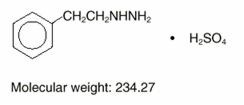
NARDIL ® (phenelzine sulfate) is a potent inhibitor of monoamine oxidase (MAO). Phenelzine sulfate is a hydrazine derivative. It has a molecular weight of 234.27 and is chemically described as C 8 H 12 N 2 • H 2 SO 4 . Its chemical structure is shown below:
Each NARDIL film-coated tablet for oral administration contains phenelzine sulfate equivalent to 15 mg of phenelzine base and the following inactive ingredients: mannitol, USP; croscarmellose sodium, NF; povidone, USP; edetate disodium, USP; magnesium stearate, NF; isopropyl alcohol, USP; purified water, USP; opadry orange Y30-13242A.
CLINICAL PHARMACOLOGY
Monoamine oxidase is a complex enzyme system, widely distributed throughout the body. Drugs that inhibit monoamine oxidase in the laboratory are associated with a number of clinical effects. Thus, it is unknown whether MAO inhibition per se, other pharmacologic actions, or an interaction of both is responsible for the clinical effects observed. Therefore, the physician should become familiar with all the effects produced by drugs of this class.
Pharmacokinetics
Absorption
Following a single 30 mg dose of NARDIL ® (2 × 15 mg tablets), a mean peak plasma concentration (Cmax) of 19.8 ng/mL occurred at a time (Tmax) of 43 minutes postdose.
Metabolism
NARDIL ® is extensively metabolized, primarily by oxidation via monoamine oxidase. After oral administration of 13 C 6 -phenelzine, 73% of the administered dose was recovered in urine as phenylacetic acid and parahydroxyphenylacetic acid within 96 hours. Acetylation to N 2 -acetylphenelzine is a minor pathway.
Elimination
The mean elimination half-life after a single 30 mg dose is 11.6 hours. Multiple dose pharmacokinetics have not been studied in man.
HOW SUPPLIED
Each NARDIL tablet is orange, biconvex, film-coated, and engraved with "P-D 270" and contains phenelzine sulfate equivalent to 15 mg of phenelzine base.
NDC 0071-0350-60. Bottle of 60
Storage
Store between 15° – 30°C (59° – 86°F).
