Get your patient on Omlonti - Omidenepag Isopropyl solution/ Drops (Omidenepag Isopropyl)
Omlonti - Omidenepag Isopropyl solution/ Drops prescribing information

INDICATIONS AND USAGE
Omlonti (omidenepag isopropyl ophthalmic solution) 0.002%, is indicated for the reduction of elevated intraocular pressure (IOP) in patients with open-angle glaucoma or ocular hypertension.
DOSAGE AND ADMINISTRATION
The recommended dosage is one drop in the affected eye(s) once daily in the evening. (2.1 )
Recommended Dosage
The recommended dosage is one drop in the affected eye(s) once daily in the evening.
Administration Instructions
Gently shake the bottle prior to administration. If more than one topical ophthalmic drug is being used, the drugs should be administered at least five (5) minutes apart. Contact lenses should be removed prior to the administration of Omlonti, and may be reinserted 15 minutes after administration [see Patient Counseling Information (17) ].
DOSAGE FORMS AND STRENGTHS
Omidenepag isopropyl ophthalmic solution: 0.002% (0.02 mg/mL)
USE IN SPECIFIC POPULATIONS
Pregnancy
Risk Summary
There are no available data on the use of Omlonti in pregnant women. In animal reproduction studies, subcutaneous administration of omidenepag isopropyl to pregnant rabbits throughout the period of organogenesis produced fetal skeletal anomalies at a dose of 24 times the clinical dose, based on estimated plasma C max . Omidenepag isopropyl was not teratogenic in rats when administered subcutaneously at 1 mg/kg/day, 2,452 times the clinical dose, based on estimated plasma C max (see Data ) .
Data
Animal Data
An embryofetal development study was conducted in pregnant rabbits administered omidenepag isopropyl once daily by subcutaneous injection at 0.008, 0.08, or 0.8 mg/kg/day from gestation Day 6 to 18, a period which covers implantation and the period of organogenesis in rabbits. Fetal skeletal anomalies (thoracic misaligned centrum and hemivertebra, fused sternebra, absent rib) were observed at 0.008 mg/kg/day (24 times the maximum recommended human ocular dose [MRHOD], based on estimated plasma C max ). Additional fetal skeletal anomalies were observed at 0.08 mg/kg (absent thoracic arch, fused rib) and 0.8 mg/kg (misaligned and misshapen cervical vertebrae), corresponding to 256 times and 3,696 times the MRHOD based on estimated plasma C max , respectively. Increases in preimplantation loss and post-implantation loss were observed at 0.8 mg/kg/day. The rabbit maternal, No Observed Adverse Effect Level [NOAEL] was 0.8 mg/kg/day.
An embryofetal development study was conducted in pregnant rats administered omidenepag isopropyl once daily by subcutaneous injection at 0.01, 0.1, or 1 mg/kg/day from gestation Day 6 to 17, to target the period of organogenesis. Omidenepag isopropyl was not found to have any effect on embryo-fetal development in rats at up to 1 mg/kg/day (2,452 times the MRHOD based on estimated plasma C max ). The rat maternal NOAEL was 1 mg/kg/day. In a pre/postnatal development study, treatment of pregnant rats with omidenepag isopropyl subcutaneously from gestation day 6 to lactation day 20 at 0.01, 0.1, or 1 mg/kg/day resulted in no adverse effects. The NOAEL for pre- and postnatal development was 1 mg/kg/day (2,452 times the MRHOD based on estimated plasma C max ).
Lactation
Risk Summary
There are no data on the presence of Omlonti in human milk, the effects on the breastfed infant, or the effects on milk production. However, systemic exposure to omidenepag following topical ocular administration is low [see Clinical Pharmacology (12.3) ], and it is not known whether measurable levels of omidenepag would be present in maternal milk following topical ocular administration. The developmental and health benefits of breastfeeding should be considered along with the mother's clinical need for Omlonti and any unknown potential adverse effects on the breast-fed child from Omlonti.
Females and Males of Reproductive Potential
Infertility
There are no data on the effects of Omlonti on human fertility. No impairment of fertility has been reported in animals receiving omidenepag isopropyl subcutaneously at doses up to 2,452 times the clinical dose based on estimated plasma C max [see Nonclinical Toxicology (13.1) ] .
Pediatric Use
The safety and effectiveness of Omlonti have not been established in pediatric patients.
Geriatric Use
No overall differences in safety or effectiveness have been observed between elderly and other adult patients.
CONTRAINDICATIONS
None.
WARNINGS AND PRECAUTIONS
Pigmentation
Omlonti (omidenepag isopropyl ophthalmic solution) 0.002%, is a prodrug of omidenepag, a relatively selective EP2 receptor agonist. Pigmentation is expected to increase as long as omidenepag isopropyl ophthalmic solution is administered. The pigmentation change is due to increased melanin content in the melanocytes rather than to an increase in the number of melanocytes. After discontinuation of Omlonti, pigmentation of the iris is likely to be permanent, while pigmentation of the periorbital tissue and eyelash changes are likely to be reversible in most patients. Patients who receive prostaglandin analogs, including Omlonti, should be informed of the possibility of increased pigmentation, including permanent changes. The long-term effects of increased pigmentation are not known.
Iris color change may not be noticeable for several months to years. Typically, the brown pigmentation around the pupil spreads concentrically towards the periphery of the iris and the entire iris or parts of the iris become more brownish. Neither nevi nor freckles of the iris appear to be affected by treatment. While treatment with Omlonti (omidenepag isopropyl ophthalmic solution), 0.002% can be continued in patients who develop noticeably increased iris pigmentation, these patients should be examined regularly [see Patient Counseling Information (17) ] .
Eyelash Changes
Omlonti may gradually change eyelashes and vellus hair in the treated eye. These changes include increased length, thickness, and the number of lashes or hairs. Eyelash changes are usually reversible upon discontinuation of treatment.
Ocular Inflammation
Ocular inflammation has been reported in patients taking Omlonti. Omlonti should be used with caution in patients with active ocular inflammation, including iritis/uveitis.
Macular Edema
Macular edema, including cystoid macular edema, has been reported during clinical trials in patients with pseudophakia receiving Omlonti. Omlonti should be used with caution in aphakic patients, in pseudophakic patients, or in patients with known risk factors for macular edema.
Risk of Contamination and Potential Injury to the Eye
Advise patients to avoid touching the tip of the bottle to the eye or any surface, as this may contaminate the solution. Advise patients to not touch the tip to their eye to avoid the potential for injury to the eye.
ADVERSE REACTIONS
The following clinically significant adverse reactions are described elsewhere in the labeling:
- Pigmentation [see Warnings and Precautions (5.1) ]
- Eyelash Changes [see Warnings and Precautions (5.2) ]
- Ocular Inflammation [see Warnings and Precautions (5.3) ]
- Macular Edema [see Warnings and Precautions (5.4) ]
Clinical Trials Experience
Because clinical trials are conducted under widely varying conditions, adverse reaction rates observed in the clinical trials of a drug cannot be directly compared to rates in the clinical trials of another drug and may not reflect the rates observed in practice.
The data described below reflect exposure to Omlonti in 600 patients for up to 3 months . The most common adverse reactions with incidence ≥ 1% are conjunctival hyperemia (9%), photophobia (5%), vision blurred (4%), dry eye (3%), instillation site pain (3%), eye pain (2%), ocular hyperemia (2%), punctate keratitis (2%), headache (2%), eye irritation (1%), and visual impairment (1%).
DESCRIPTION
Omlonti (omidenepag isopropyl ophthalmic solution) 0.002%, contains the prodrug form of the active omidenepag, a relatively selective prostaglandin EP2 receptor agonist with ocular hypotensive activity. Omidenepag isopropyl is a white to light brown crystal or crystalline powder and practically insoluble in water. Omidenepag isopropyl's chemical name is Glycine, N-[6-[[[[4-(1H-pyrazol-1-yl)phenyl]methyl](3-pyridinylsulfonyl)amino]methyl]-2-pyridinyl]-, 1-methylethyl ester and has the following structure:
Structural Formula
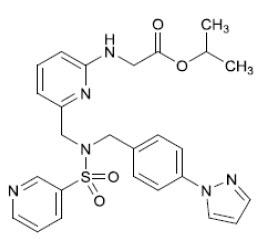
Formula of the free base: C 26 H 28 N 6 O 4 S. Molecular weight: 520.61
Omlonti appears as a clear, colorless solution. It is supplied as a sterile, isotonic, buffered aqueous solution of omidenepag isopropyl with a target pH of 5.8 and an osmolality of approximately 285 mOsmol/kg.
Each mL of Omlonti contains: Active: 0.02 mg of omidenepag isopropyl.
Preservative: 0.005% benzalkonium chloride.
Inactive ingredients: glycerin, polyoxyl 35 castor oil, sodium citrate, citric acid monohydrate, edetate disodium, sodium hydroxide and/or hydrochloric acid (to adjust pH), and water for injection.
CLINICAL PHARMACOLOGY
Mechanism of Action
Omidenepag is a relatively selective EP2 receptor agonist which decreases intraocular pressure (IOP). The exact mechanism of action is unknown at this time. Elevated IOP represents a major risk factor for glaucomatous field loss. The higher the level of IOP, the greater the likelihood of optic nerve damage and visual field loss.
Pharmacokinetics
Absorption
Omlonti is absorbed through the cornea where prodrug omidenepag isopropyl is hydrolyzed to become biologically active metabolite, omidenepag. After once daily ocular administration of one drop of omidenepag isopropyl 0.0025% eye drops to both eyes in humans for 7 days, plasma concentrations of omidenepag reached C max at 10-15 minutes. Systemic exposure was similar between days 1 and 7, indicating no systemic accumulation.
Elimination
Metabolism
After topical ocular administration, omidenepag isopropyl is rapidly metabolized in the eye to omidenepag (active moiety) by carboxylesterase-1. The pharmacologically active form, omidenepag is further metabolized by liver through oxidation, N -dealkylation, glucuronidation, sulfate conjugation or taurine conjugation.
Excretion
In rats, 0.03% 14 C-Omlonti was instilled in both eyes as a single dose (5 mcL/eye, 3 mcg/animal). By 168 hours after ocular instillation, 89% of the administered radioactive dose had been excreted. Specifically, 83% and 4% of the administered radioactive dose were excreted in the feces and urine, respectively, and radioactivity in expired air was below the lower limit of quantitation.
NONCLINICAL TOXICOLOGY
Carcinogenesis, Mutagenesis, Impairment of Fertility
Carcinogenesis
Lifetime rodent studies have not been performed to evaluate the carcinogenic potential of omidenepag isopropyl or omidenepag.
In rats dosed by subcutaneous injection daily for 26 weeks, nephroblastoma and a spermatic cord tumor were found at 0.003 mg/kg/day (33 times the RHOD based on the estimated area under the curve [AUC]). Mammary adenocarcinoma and pituitary pars distalis adenomas were observed at 0.03 mg/kg/day (319 fold the RHOD based on the estimated AUC).
Mutagenesis
Omidenepag was not mutagenic in the bacterial reverse mutation (Ames) test and the in vivo mouse micronucleus test. Omidenepag isopropyl was positive (mutagenic and clastogenic) without metabolic activation in the in vitro mouse lymphoma forward mutation assay. [see Clinical Pharmacology (12.3) ] .
Impairment of Fertility
In a rat fertility and early embryonic development study, daily subcutaneous doses of omidenepag isopropyl did not affect male or female fertility at doses up to 1 mg/kg/day (2,452 times the MRHOD based on estimated plasma C max ).
The rabbit embryofetal development study administered omidenepag isopropyl to pregnant rabbits beginning on gestation day 6, covering the period of implantation [see Use in Specific Populations (8.1) ] . Preimplantation losses were observed at 0.8 mg/kg/day (3,696 times the MRHOD based on estimated plasma C max ). The NOAEL for rabbit preimplantation loss was 0.08 mg/kg/day (256 times the MHROD based on estimated plasma C max ) [see Use in Specific Populations (8.1) ] .
Animal Toxicology and/or Pharmacology
Nasal cavity respiratory epithelium metaplasia was observed in cynomolgus monkeys receiving unilateral topical ocular instillations of omidenepag isopropyl at 0.003% (0.9 mcg/eye) [1.07 fold the MRHOD, based on ocular dose comparison]. In a 13-week monkey study, the 0.9 mcg/eye dose was associated with nasal cavity respiratory epithelial metaplasia, and increased nasal cavity goblet cell respiratory epithelium mucosa. In a 39-week monkey study, the 0.9 mcg/eye dose was associated with increased incidence and severity of nasal cavity respiratory epithelium metaplasia. These findings were present in both the treated side and untreated contralateral side, and they were also observed in the vehicle group [see Adverse Reactions (6) ] .
CLINICAL STUDIES
Omlonti was evaluated in three randomized and controlled clinical trials in subjects with open-angle glaucoma or ocular hypertension with average baseline IOP of 24-26 mm Hg. The double-masked treatment duration was 3 months in all 3 studies. The third study included a 9-month open-label treatment period following the 3-month double-masked treatment period.
In the three studies, IOP reductions were observed for all treatment arms. In the Omlonti arm, the reduction in IOP ranged from 5-7 mm Hg across all three studies. The corresponding reductions for the timolol and latanoprost arms were 5-7 mm Hg and 6-8 mm Hg, respectively.
HOW SUPPLIED/STORAGE AND HANDLING
Omlonti (omidenepag isopropyl ophthalmic solution) 0.002%, is supplied as a 2.5 mL sterile solution in 5 mL white low density polyethylene bottles with linear low density polyethylene dropper tips, high density polyethylene screw caps and tamper-evident low density polyethylene overcaps.
Package of 1 bottle, NDC 84826-002-01
Multi-pack of 3 bottles, NDC 84826-002-03
Storage: Store unopened bottle (s) in the refrigerator at 2°C to 8°C (36°F to 46°F). Once a bottle is opened for use, it can be stored for up to 31 days at up to 30°C (86°F).
Mechanism of Action
Omidenepag is a relatively selective EP2 receptor agonist which decreases intraocular pressure (IOP). The exact mechanism of action is unknown at this time. Elevated IOP represents a major risk factor for glaucomatous field loss. The higher the level of IOP, the greater the likelihood of optic nerve damage and visual field loss.