Get your patient on Ovidrel - Choriogonadotropin Alfa injection, Solution (Choriogonadotropin Alfa)
Ovidrel - Choriogonadotropin Alfa injection, Solution prescribing information

INDICATIONS AND USAGE
Ovidrel ® PreFilled Syringe (choriogonadotropin alfa injection) is indicated for the induction of final follicular maturation and early luteinization in infertile women who have undergone pituitary desensitization and who have been appropriately pretreated with follicle stimulating hormones as part of an Assisted Reproductive Technology (ART) program such as in vitro fertilization and embryo transfer. Ovidrel ® PreFilled Syringe is also indicated for the induction of ovulation (OI) and pregnancy in anovulatory infertile patients in whom the cause of infertility is functional and not due to primary ovarian failure.
Selection of Patients
- Before treatment with gonadotropins is instituted, a thorough gynecologic and endocrinologic evaluation must be performed. This should include an assessment of pelvic anatomy. Patients with tubal obstruction should receive Ovidrel ® PreFilled Syringe only if enrolled in an in vitro fertilization program.
- Primary ovarian failure should be excluded by the determination of gonadotropin levels.
- Appropriate evaluation should be performed to exclude pregnancy.
- Patients in later reproductive life have a greater predisposition to endometrial carcinoma as well as a higher incidence of anovulatory disorders. A thorough diagnostic evaluation should always be performed in patients who demonstrate abnormal uterine bleeding or other signs of endometrial abnormalities before starting FSH and Ovidrel ® PreFilled Syringe therapy.
- Evaluation of the partner's fertility potential should be included in the initial evaluation.
DOSAGE AND ADMINISTRATION
For Subcutaneous Use Only
Infertile Women Undergoing Assisted Reproductive Technologies (ART)
Ovidrel ® PreFilled Syringe 250 µg should be administered one day following the last dose of the follicle stimulating agent. Ovidrel ® PreFilled Syringe should not be administered until adequate follicular development is indicated by serum estradiol and vaginal ultrasonography. Administration should be withheld in situations where there is an excessive ovarian response, as evidenced by clinically significant ovarian enlargement or excessive estradiol production.
Infertile Women Undergoing Ovulation Induction (OI)
Ovidrel ® PreFilled Syringe should not be administered until adequate follicular development is indicated by serum estradiol and vaginal ultrasonography.
Ovidrel ® PreFilled Syringe 250 µg should be administered one day following the last dose of the follicle stimulating agent.
Ovidrel ® PreFilled Syringe administration should be withheld in situations where there is an excessive ovarian response, as evidenced by multiple follicular development, clinically significant ovarian enlargement or excessive estradiol production.
Directions for Administration of Ovidrel ® Prefilled Syringe
Ovidrel ® PreFilled Syringe is intended for a single subcutaneous injection. Any unused material should be discarded.
Ovidrel ® PreFilled Syringe may be self-administered by the patient. Follow the directions below for injecting Ovidrel ® PreFilled Syringe.
Step 1: Wash your hands thoroughly with soap and water.
Step 2: Carefully clean the injection site.
Make yourself comfortable by sitting or lying down. Carefully clean the injection site on the stomach with an alcohol wipe and allow it to air-dry.
Step 3: Administer your injection.
Carefully remove the needle cap from the syringe. Do not touch the needle or allow the needle to touch any surface. Inject the prescribed dose as directed by your doctor, nurse or pharmacist.
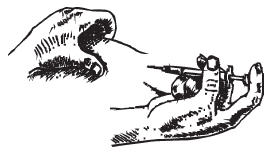
Step 4: Gently withdraw the needle.
Discard the needle and syringe into your safety container. Place gauze over the injection site. If any bleeding occurs, apply gentle pressure. If bleeding does not stop within a few minutes, place a clean piece of gauze over the injection site and cover it with an adhesive bandage.

Step 5: Storage and clean up.
Remember that your injection materials must be kept sterile and cannot be reused.
CONTRAINDICATIONS
Ovidrel ® PreFilled Syringe (choriogonadotropin alfa injection) is contraindicated in women who exhibit:
- Prior hypersensitivity to hCG preparations or one of their excipients.
- Primary ovarian failure.
- Uncontrolled thyroid or adrenal dysfunction.
- An uncontrolled organic intracranial lesion such as a pituitary tumor.
- Abnormal uterine bleeding of undetermined origin (see " Selection of Patients " ).
- Ovarian cyst or enlargement of undetermined origin (see " Selection of Patients " ).
- Sex hormone dependent tumors of the reproductive tract and accessory organs.
- Pregnancy.
ADVERSE REACTIONS
(see WARNINGS )
The safety of Ovidrel ® was examined in four clinical studies that treated 752 patients of whom 335 received Ovidrel ® 250 µg following follicular recruitment with gonadotropins. When patients enrolled in four clinical studies (3 in ART and one in OI) were injected subcutaneously with either Ovidrel ® or an approved urinary-derived hCG, 14.6 % (49 of 335 patients) in the Ovidrel ® 250 µg group experienced application site disorders compared to 28% (92 of 328 patients) in the approved u-hCG group. Adverse events reported for Ovidrel ® 250 µg occurring in at least 2% of patients (regardless of causality) are listed in Table 9 for the 3 ART studies and in Table 10 for the single OI study.
| Body System | Ovidrel ® 250 µg (n=236) |
|---|---|
| Preferred Term | Incidence Rate % (n) |
| At Least One Adverse Event | 33.1% (78) |
| Application Site Disorders | 14.0% (33) |
| Injection Site Pain | 7.6% (18) |
| Injection Site Bruising | 4.7% (11) |
| Gastro-Intestinal System Disorders | 8.5% (20) |
| Abdominal Pain | 4.2% (10) |
| Nausea | 3.4% ( 8) |
| Vomiting | 2.5% ( 6) |
| Secondary Terms (Post-Operative Pain) | 4.7% (11) |
| Post-Operative Pain | 4.7% (11) |
Adverse events not listed in Table 9 that occurred in less than 2% of patients treated with Ovidrel ® 250 µg whether or not considered causally related to Ovidrel ® , included: injection site inflammation and reaction, flatulence, diarrhea, hiccup, ectopic pregnancy, breast pain, intermenstrual bleeding, vaginal hemorrhage, cervical lesion, leukorrhea, ovarian hyperstimulation, uterine disorders, vaginitis, vaginal discomfort, body pain, back pain, fever, dizziness, headache, hot flashes, malaise, paraesthesias, rash, emotional lability, insomnia, upper respiratory tract infection, cough, dysuria, urinary tract infection, urinary incontinence, albuminuria, cardiac arrhythmia, genital moniliasis, genital herpes, leukocytosis, heart murmur and cervical carcinoma.
| Body System | Ovidrel ® 250 µg (n=99) |
|---|---|
| Preferred Term | Incidence Rate % (n) |
| At Least One Adverse Event | 26.2% (26) |
| Application Site Disorders | 16.2% (16) |
| Injection site pain | 8.1% (8) |
| Injection site inflammation | 2.0% (2) |
| Injection site bruising | 3.0% (3) |
| Injection site reaction | 3.0% (3) |
| Reproductive Disorders, Female | 7.1% (7) |
| Ovarian cyst | 3.0% (3) |
| Ovarian hyperstimulation | 3.0% (3) |
| Gastro-Intestinal System Disorders | 4.0% (4) |
| Abdominal pain | 3.0% (3) |
Additional adverse events not listed in Table 10 that occurred in less than 2% of patients treated with Ovidrel ® 250 µg, whether or not considered causally related to Ovidrel ® , included: breast pain, flatulence, abdominal enlargement, pharyngitis, upper respiratory tract infection, hyperglycemia and pruritis.
The following medical events have been reported subsequent to pregnancies resulting from hCG therapy in controlled clinical studies:
- Spontaneous Abortion
- Ectopic Pregnancy
- Premature Labor
- Postpartum Fever
- Congenital Abnormalities
Of 125 clinical pregnancies reported following treatment with FSH and Ovidrel ® 250 µg or 500 µg, three were associated with a congenital anomaly of the fetus or newborn. Among patients receiving Ovidrel ® 250 µg, cranial malformation was detected in the fetus of one woman and a chromosomal abnormality (47, XXX) in another. These events were judged by the investigators to be of unlikely or unknown relation to treatment. These three events represent an incidence of major congenital malformations of 2.4%, which is consistent with the reported rate for pregnancies resulting from natural or assisted conception. In a woman who received Ovidrel ® 500 µg, one birth in a set of triplets was associated with Down's syndrome and atrial septal defect. This event was considered to be unrelated to the study drug.
The following adverse reactions have been previously reported during menotropin therapy:
- Pulmonary and vascular complications (see " Warnings " )
- Adnexal torsion (as a complication of ovarian enlargement)
- Mild to moderate ovarian enlargement
- Hemoperitoneum
There have been infrequent reports of ovarian neoplasms, both benign and malignant, in women who have undergone multiple drug regimens for ovulation induction; however, a causal relationship has not been established.
Post-Marketing Experience
In addition to adverse events reported from clinical trials, the following events have been reported during post-marketing use of Ovidrel ® . Therefore, these events were reported from a population of uncertain size, the frequency or causal relationship to Ovidrel ® cannot be reliably determined.
- Cases of allergic reactions, including anaphylactic reactions and mild reversible skin rashes have been reported in patients treated with Ovidrel ® since market introduction. The causal relationship is unknown.
- Thromboembolic events both in association with, and separate from, the Ovarian Hyperstimulation Syndrome (see " WARNINGS ")
DESCRIPTION
Ovidrel ® PreFilled Syringe (choriogonadotropin alfa injection) is a sterile liquid preparation of choriogonadotropin alfa (recombinant human Chorionic Gonadotropin, r-hCG). Choriogonadotropin alfa is a water soluble glycoprotein consisting of two non-covalently linked subunits - designated α and β - consisting of 92 and 145 amino acid residues, respectively, with carbohydrate moieties linked to ASN-52 and ASN-78 (on alpha subunit) and ASN-13, ASN-30, SER-121, SER-127, SER-132 and SER-138 (on beta subunit). The primary structure of the α - chain of r-hCG is identical to that of the α - chain of hCG, FSH and LH. The glycoform pattern of the α - subunit of r-hCG is closely comparable to urinary derived hCG (u-hCG), the differences mainly being due to the branching and sialylation extent of the oligosaccharides. The β - chain has both O- and N-glycosylation sites and its structure and glycosylation pattern are also very similar to that of u-hCG.
The production process involves expansion of genetically modified Chinese Hamster Ovary (CHO) cells from an extensively characterized cell bank into large scale cell culture processing. Choriogonadotropin alfa is secreted by the CHO cells directly into the cell culture medium that is then purified using a series of chromatographic steps. This process yields a product with a high level of purity and consistent product characteristics including glycoforms and biological activity. The biological activity of choriogonadotropin alfa is determined using the seminal vesicle weight gain test in male rats described in the "Chorionic Gonadotrophins" monograph of the European Pharmacopoeia. The in vivo biological activity of choriogonadotropin alfa has been calibrated against the third international reference preparation IS75/587 for chorionic gonadotropin.
Ovidrel ® PreFilled Syringe is a sterile, liquid intended for subcutaneous (SC) injection. Each Ovidrel ® PreFilled Syringe is filled with 0.515 mL containing 257.5 µg of choriogonadotropin alfa, 28.1 mg mannitol, 505 µg 85% O-phosphoric acid, 103 µg L-methionine, 51.5 µg Poloxamer 188, Sodium Hydroxide (for pH adjustment), and Water for Injection to deliver 250 µg of choriogonadotropin alfa in 0.5 mL. The pH of the solution is 6.5 to 7.5.
Therapeutic Class: Infertility
CLINICAL PHARMACOLOGY
The physicochemical, immunological, and biological activities of recombinant hCG are comparable to those of placental and human pregnancy urine-derived hCG. Choriogonadotropin alfa stimulates late follicular maturation and resumption of oocyte meiosis, and initiates rupture of the pre-ovulatory ovarian follicle. Choriogonadotropin alfa, the active component of Ovidrel ® PreFilled Syringe , is an analogue of Luteinizing Hormone (LH) and binds to the LH/hCG receptor of the granulosa and theca cells of the ovary to effect these changes in the absence of an endogenous LH surge. In pregnancy, hCG, secreted by the placenta, maintains the viability of the corpus luteum to provide the continued secretion of estrogen and progesterone necessary to support the first trimester of pregnancy. Ovidrel ® PreFilled Syringe is administered when monitoring of the patient indicates that sufficient follicular development has occurred in response to FSH treatment for ovulation induction.
Pharmacokinetics
When given by intravenous administration, the pharmacokinetic profile of Ovidrel ® followed a biexponential model and was linear over a range of 25 µg to 1000 µg. Pharmacokinetic parameter estimates following SC administration of Ovidrel ® 250 µg to females are presented in Table 1.
| Ovidrel ® 250 µg SC | |
|---|---|
| C max : peak concentration (above baseline), t max : time of C max , AUC: total area under the curve, t ½ : elimination half-life, F: bioavailability | |
| C max (IU/L) | 121 ± 44 |
| t max (h) median (range) | 24 (12-24) |
| AUC (h∙IU/L) | 7701 ± 2101 |
| t ½ (h) | 29 ± 6 |
| F | 0.4 ± 0.1 |
Absorption
Following subcutaneous administration of Ovidrel ® 250 µg, maximum serum concentration (121 ± 44 IU/L) is reached after approximately 12 to 24 hours. The mean absolute bioavailability of Ovidrel ® following a single subcutaneous injection to healthy female volunteers is about 40%.
Distribution
Following intravenous administration of Ovidrel ® 250 µg to healthy down-regulated female volunteers, the serum profile of hCG is described by a two-compartment model with an initial half-life of 4.5 ± 0.5 hours. The volume of the central compartment is 3.0 ± 0.5 L and the steady state volume of distribution is 5.9 ± 1.0 L.
Metabolism/Excretion
Following subcutaneous administration of Ovidrel ® , hCG is eliminated from the body with a mean terminal half-life of about 29 ± 6 hours. After intravenous administration of Ovidrel ® 250 µg to healthy down-regulated females, the mean terminal half-life is 26.5 ± 2.5 hours and the total body clearance is 0.29 ± 0.04 L/h. One-tenth of the dose is excreted in the urine.
Pharmacodynamics
In female subjects on oral contraception after an initial latency period, Ovidrel ® induced a clear increase in androstenedione serum levels by 24 hours after dosing. Pharmacodynamic studies in females determined that the relationship of Ovidrel ® pharmacokinetics to pharmacologic effect of Ovidrel ® are complex and vary with the pharmacodynamic marker examined. In general pharmacologic effects are not proportional to exposure and in some cases appear to be near maximal at a 250 µg dose.
Population pharmacokinetics and pharmacodynamics
In patients undergoing in-vitro fertilization/embryo transfer given Ovidrel ® subcutaneously to trigger ovulation, the results of a population PK/PD analysis generally supported the data obtained in healthy subjects. Pharmacokinetic parameters for Ovidrel ® include a median elimination half-life of 29.2 hours, median apparent clearance (Cl/F) of 0.51 L/hr and median apparent volume of distribution (V/F) of 21.4 L.
Bioequivalence of Formulations
Ovidrel ® PreFilled Syringe (choriogonadotropin alfa injection) has been determined to be bioequivalent to Ovidrel ® (choriogonadotropin alfa for injection) based on the statistical evaluation of AUC and C max . A summary of the Ovidrel ® PreFilled Syringe pharmacokinetic parameters is presented in Table 2.
| Parameter | C max (mIU/mL) | AUCl ast (mIU∙h/mL) | AUC (mIU∙h/mL) | AUC extrapolated (%) | t max (h) |
|---|---|---|---|---|---|
| Abbreviations are: C max : peak concentration (above baseline); t max : time of C max | |||||
| Mean | 125 | 10050 | 10350 | 2.85 | 20.0 |
| (Min-Max) | (68.0-294) | (5646-14850) | (5800-15100) | (1.08-6.27) | (9.00-48.0) |
Special populations
Safety, efficacy, and pharmacokinetics of Ovidrel ® PreFilled Syringe in patients with renal or hepatic insufficiency have not been established.
Drug-Drug Interactions
No drug-drug interaction studies have been conducted. Administration of Ovidrel ® PreFilled Syringe may interfere with the interpretation of pregnancy tests. (see PRECAUTIONS .)
CLINICAL STUDIES
The safety and efficacy of Ovidrel ® have been examined in three well-controlled studies in women; two studies for assisted reproductive technologies (ART) and one study for ovulation induction (OI).
Assisted Reproductive Technologies (ART)
The safety and efficacy of Ovidrel ® 250 µg and Ovidrel ® 500 µg administered subcutaneously versus 10,000 USP Units of an approved urinary-derived hCG product administered intramuscularly were assessed in a randomized, open-label, multicenter study in infertile women undergoing in vitro fertilization and embryo transfer (Study 7927). The study was conducted in 20 U.S. centers.
The primary efficacy parameter in this single-cycle study was the number of oocytes retrieved. 297 patients entered the study, of whom 94 were randomized to receive Ovidrel ® 250 µg. The number of oocytes retrieved was similar for the Ovidrel ® and urinary-derived hCG (10,000 USP Units) treatment groups. The efficacy of Ovidrel ® 250 µg and Ovidrel ® 500 µg were both found to be clinically and statistically equivalent to that of the approved urinary-derived hCG product and to each other. The efficacy results for the patients who received Ovidrel ® 250 µg are summarized in Table 3.
| Parameter | Ovidrel ® 250 µg (n = 94) |
|---|---|
| Mean number of oocytes retrieved per patient | 13.60 |
| Mean number of mature oocytes retrieved per patient | 7.6 |
| Mean number of 2 PN fertilized oocytes per patient | 7.2 |
| Mean number of 2 PN or cleaved embryos per patient | 7.6 |
| Implantation rate per embryo transferred (%) | 18.7 |
| Mean mid-luteal serum progesterone levels (nmol/L nmol/L ÷ 3.18 = ng/mL ) | 423 |
| Clinical pregnancy rate per initiated treatment cycle (%) Clinical pregnancy was defined as a pregnancy during which a fetal sac (with or without heartbeat activity) was detected by ultrasound on day 35-42 after hCG administration) | 35.1 |
| Clinical pregnancy rate per transfer (%) | 36.3 |
For the 33 patients who achieved a clinical pregnancy with Ovidrel ® 250 µg, the outcomes of the pregnancies are presented in Table 4.
| Parameter | Ovidrel ® 250 µg (n = 33) |
|---|---|
| Clinical pregnancies not reaching term | 4 (12.1%) |
| Live births | 29 (87.9%) |
| Singleton | 20 (69.0%) |
| Multiple birth | 9 (31.0%) |
The safety and efficacy of Ovidrel ® 250 µg administered subcutaneously versus 5,000 IU of an approved urinary-derived hCG product administered subcutaneously were assessed in a second, randomized, multicenter study in infertile women undergoing in vitro fertilization and embryo transfer (Study 7648). This double-blinded study was conducted in nine centers in Europe and Israel.
The primary efficacy parameter in this single-cycle study was the number of oocytes retrieved per patient. 205 patients entered the study, of whom 97 received Ovidrel ® 250 µg. The efficacy of Ovidrel ® 250 µg was found to be clinically and statistically equivalent to that of the approved urinary-derived hCG product. The results for the 97 patients who received Ovidrel ® 250 µg are summarized in Table 5.
| Parameter | Ovidrel ® 250 µg (n = 97) |
|---|---|
| Mean number of oocytes retrieved per patient | 10.6 |
| Mean number of mature oocytes retrieved per patient | 10.1 |
| Mean number of 2 PN fertilized oocytes per patient | 5.7 |
| Mean number of 2 PN or cleaved embryos per patient | 5.1 |
| Implantation rate per embryo transferred (%) | 17.4 |
| Mean mid-luteal serum progesterone levels (nmol/L) nmol/L ÷ 3.18 = ng/mL | 394 |
| Clinical pregnancy rate per initiated treatment cycle (%) Clinical pregnancy was defined as a pregnancy during which a fetal sac (with or without heartbeat activity) was detected by ultrasound on day 35-42 after hCG administration) | 33 |
| Clinical pregnancy rate per transfer (%) | 37.6 |
For the 32 patients who achieved a clinical pregnancy with Ovidrel ® 250 µg, the outcomes of the pregnancies are presented in Table 6.
| Parameter | Ovidrel ® 250 µg (n = 32) |
|---|---|
| Clinical Pregnancies not reaching term | 6 (18.8%) |
| Live births | 26 (81.2%) |
| Singleton | 18 (69.2%) |
| Multiple birth | 8 (30.8%) |
Ovulation Induction (OI)
The safety and efficacy of Ovidrel ® 250 µg administered subcutaneously versus 5,000 IU of an approved urinary-derived hCG product administered intramuscularly were assessed in a double-blind, randomized, multicenter study in anovulatory infertile women (Study 8209) which was conducted in 19 centers in Australia, Canada, Europe and Israel.
The primary efficacy parameter in this single-cycle study was the patient ovulation rate. 242 patients entered the study, of whom 99 received Ovidrel ® 250 µg. The efficacy of Ovidrel ® 250 µg was found to be clinically and statistically equivalent to that of the approved urinary-derived hCG product. The results of those patients who received Ovidrel ® 250 µg are summarized in Table 7.
| Parameter | Ovidrel ® 250 µg (n = 99) |
|---|---|
| Ovulation Rate | 91 (91.9%) |
| Clinical Pregnancy Rate Clinical pregnancy was defined as a pregnancy during which a fetal sac (with or without heartbeat activity) was detected by ultrasound on day 35-42 after hCG administration. | 22 (22%) |
For the 22 patients who had a clinical pregnancy with Ovidrel ® 250 µg, the outcome of the pregnancy is presented in Table 8.
| Parameter | Ovidrel ® 250 µg (n = 22) |
|---|---|
| Clinical Pregnancies not reaching term | 7 (31.8%) |
| Live births | 15 (68.2%) |
| Singleton | 13 (86.7%) |
| Multiple birth | 2 (13.3%) |
HOW SUPPLIED
Ovidrel ® PreFilled Syringe (choriogonadotropin alfa injection) is supplied in a sterile, liquid single dose pre-filled 1 mL syringe. Each Ovidrel ® PreFilled Syringe is filled with 0.515 mL containing 257.5 µg of choriogonadotropin alfa, 28.1 mg mannitol, 505 µg 85% O-phosphoric acid, 103 µg L-methionine, 51.5 µg Poloxamer 188, Sodium Hydroxide (for pH adjustment), and Water for Injection to deliver 250 µg of choriogonadotropin alfa in 0.5 mL.
The following package combination is available:
- 1 pre-filled syringe containing 250 μg Ovidrel ® PreFilled Syringe NDC 44087-1150-1
Storage
The Ovidrel ® PreFilled Syringe must be stored refrigerated between 2-8°C (36-46°F) before being dispensed to the patient. Patients should store the pre-filled syringe refrigerated to allow the product to be used until the expiry date shown on the syringe or carton. The Ovidrel ® PreFilled Syringe may be stored by the patient for no more than 30 days at room temperature (up to 25°C (77°F) but must be used within those 30 days.
Protect from light.
Store in original package. Discard unused material.
