Get your patient on Penicillin G Potassium - Penicillin G Potassium injection, Powder, For Solution (Penicillin G Potassium)
Penicillin G Potassium - Penicillin G Potassium injection, Powder, For Solution prescribing information

INDICATIONS AND USAGE
Therapy
Penicillin G Potassium for Injection is indicated in the treatment of serious infections caused by susceptible strains of the designated microorganisms in the conditions listed below.
Appropriate culture and susceptibility tests should be done before treatment in order to isolate and identify organisms causing infection and to determine their susceptibility to penicillin G.
Therapy with Penicillin G Potassium for Injection may be initiated before results of such tests are known when there is reason to believe the infection may involve any of the organisms listed below; however, once these results become available, appropriate therapy should be continued.
| CLINICAL INDICATION | INFECTING ORGANISM |
| Septicemia, empyema, pneumonia, pericarditis, endocarditis, meningitis | Streptococcus pyogenes (group A β-hemolytic streptococcus), other β-hemolytic streptococci including groups C, H, G, L and M, Streptococcus pneumoniae and Staphylococcus species (non-penicillinase producing strains) |
| Anthrax | Bacillus anthracis |
| Actinomycosis (cervico-facial disease and thoracic and abdominal disease) | Actinomyces israelii |
| Botulism (adjunctive therapy to antitoxin), gas gangrene, and tetanus (adjunctive therapy to human tetanus immune globulin) | Clostridium species |
| Diphtheria (adjunctive therapy to antitoxin and prevention of the carrier state) | Corynebacterium diphtheriae |
| Erysipelothrix endocarditis | Erysipelothrix rhusiopathiae |
| Fusospirochetosis (severe infections of the oropharynx [Vincent's], lower respiratory tract and genital area) | Fusobacterium species and spirochetes |
| Listeria infections including meningitis and endocarditis | Listeria monocytogenes |
| Pasteurella infections including bacteremia and meningitis | Pasteurella multocida |
| Haverhill fever | Streptobacillus moniliformis |
| Rat bite fever | Spirillum minus or Streptobacillus moniliformis |
| Disseminated gonococcal infections | Neisseria gonorrhoeae (Penicillin-susceptible) |
| Syphilis (congenital and neurosyphilis) | Treponema pallidum |
| Meningococcal meningitis and/or septicemia | Neisseria meningitidis |
| Gram-negative bacillary infections (bacteremias) | Gram-negative bacillary organisms (i.e. Enterobacteriaceae ) |
| Penicillin G is not the drug of choice in the treatment of Gram-negative bacillary infections | |
To reduce the development of drug-resistant bacteria and maintain effectiveness of Penicillin G Potassium for Injection and other antibacterial drugs, Penicillin G Potassium for Injection should be used only to treat or prevent infections that are proven or strongly suspected to be caused by susceptible bacteria. When culture and susceptibility information are available, they should be considered in selecting or modifying antibacterial therapy. In the absence of such data, local epidemiology and susceptibility patterns may contribute to the empiric selection of therapy.
DOSAGE AND ADMINISTRATION
Buffered Penicillin G Potassium for Injection, USP may be given intravenously or intramuscularly. The usual dose recommendations are as follows:
Adult patients
• Because of its short half-life, Penicillin G is administered in divided doses, usually every 4 to 6 hours with the exception of meningococcal meningitis/septicemia, i.e., every 2 hours. | |
| CLINICAL INDICATION | DOSAGE |
Serious infections due to susceptible strains of streptococci (including S. pneumoniae )
| 12 to 24 million units/day depending on the infection and its severity administered in equally divided doses every 4 to 6 hours |
Serious infections due to susceptible strains of staphylococci
| 5 to 24 million units/day depending on the infection and its severity administered in equally divided doses every 4 to 6 hours |
| Anthrax | Minimum of 8 million units/day in divided doses every 6 hours. Higher doses may be required depending on susceptibility of organism |
| Actinomycosis Cervicofacial disease Thoracic and abdominal disease | 1 to 6 million units/day• 10 to 20 million units/day• |
Clostridial infections
| 20 million units/day• |
| Diphtheria (adjunctive therapy to antitoxin and for the prevention of the carrier state) | 2 to 3 million units/day in divided doses for 10 to 12 days• |
| Erysipelothrix endocarditis | 12 to 20 million units/day for 4 to 6 weeks• |
| Fusospirochetosis (severe infections of the oropharynx [Vincent's], lower respiratory tract and genital area) | 5 to 10 million units/day• |
| Listeria infections Meningitis Endocarditis | 15 to 20 million units/day for 2 weeks• 15 to 20 million units/day for 4 weeks• |
| Pasteurella infections including bacteremia and meningitis | 4 to 6 million units/day for 2 weeks• |
| Haverhill fever; Rat-bite fever | 12 to 20 million units/day for 3 to 4 weeks• |
| Disseminated gonococcal infections, such as meningitis, endocarditis, arthritis, etc., caused by penicillin-susceptible organisms | 10 million units/day•, duration depends on the type of infection |
| Syphilis (neurosyphilis) | 12 to 24 million units/day, as 2 to 4 MU every 4 hours for 10 to 14 days; many experts recommend additional therapy with Benzathine PCN G 2.4 MU IM weekly for 3 doses after completion of IV therapy |
| Meningococcal meningitis and/or septicemia | 24 million units/day as 2 million units every 2 hours |
Pediatric patients
This product should not be administered to patients requiring less than one million units per dose (see PRECAUTIONS, Pediatric Use ).
| CLINICAL INDICATION | DOSAGE |
| Serious infections, such as pneumonia and endocarditis, due to susceptible strains of streptococci (including S. pneumoniae ) and meningococcus | 150,000 to 300,000 units/kg/day divided in equal doses every 4 to 6 hours, duration depends on infecting organism and type of infection |
| Meningitis caused by susceptible strains of pneumococcus and meningococcus | 250,000 units/kg/day divided in equal doses every 4 hours for 7 to 14 days depending on the infecting organism (maximum dose of 12 to 20 million units/day) |
| Disseminated Gonococcal Infections (penicillin-susceptible strains) | Weight less than 45 kg: |
| Arthritis | 100,000 units/kg/day in 4 equally divided doses for 7 to 10 days |
| Meningitis | 250,000 units/kg/day in equal doses every 4 hours for 10 to 14 days |
| Endocarditis | 250,000 units/kg/day in equal doses every 4 hours for 4 weeks |
| Arthritis, meningitis, endocarditis | Weight 45 kg or greater: 10 million units/day in equally divided doses with the duration of therapy depending on the type of infection |
| Syphilis (congenital and neurosyphilis) after the newborn period | 200,000 to 300,000 units/kg/day (administered as 50,000 units/kg every 4 to 6 hours) for 10 to 14 days |
| Diphtheria (adjunctive therapy to antitoxin and for prevention of the carrier state) | 150,000 to 250,000 units/kg/day in equal doses every 6 hours for 7 to 10 days |
| Rat-bite fever; Haverhill fever (with endocarditis caused by S. moniliformis ) | 150,000 to 250,000 units/kg/day in equal doses every 4 hours for 4 weeks |
Renal Impairment
Penicillin G is relatively nontoxic, and dosage adjustments are generally required only in cases of severe renal impairment. The recommended dosage regimens are as follows:
Creatinine clearance less than 10 mL/min/1.73 m 2 ; administer a full loading dose (see recommended dosages in the tables above) followed by one-half of the loading dose every 8 to 10 hours.
Uremic patients with a creatinine clearance greater than 10 mL/min/1.73 m 2 ; administer a full loading dose (see recommended dosages in the tables above) followed by one-half of the loading dose every 4 to 5 hours. Additional dosage modification should be made in patients with hepatic disease and renal impairment.
For most acute infections, treatment should be continued for at least 48 to 72 hours after the patient becomes asymptomatic. Antibiotic therapy for Group A β-hemolytic streptococcal infections should be maintained for at least 10 days to reduce the risk of rheumatic fever.
Parenteral drug products should be inspected visually for particulate matter and discoloration prior to administration whenever solution and container permit.
Reconstitution
The following table shows the amount of solvent required for solution of various concentrations:
| Approx. Desired Concentration (units/mL) | Volume (mL) Solvent for Vial of 5,000,000 units | Infusion Only Volume (mL) Solvent for Vial of 20,000,000 units |
| 50,000 | - | - |
| 100,000 | - | - |
| 250,000 | 18.2 | 75.0 |
| 500,000 | 8.2 | 33.0 |
| 1,000,000 | 3.2 | 11.5 |
When the required volume of solvent is greater than the capacity of the vial, the penicillin can be dissolved by first injecting only a portion of the solvent into the vial, then withdrawing the resultant solution and combining it with the remainder of the solvent in a larger sterile container.
Buffered Penicillin G Potassium for Injection is highly water soluble. It may be dissolved in small amounts of Water for Injection, or Sterile Isotonic Sodium Chloride Solution for Parenteral Use. All solutions should be stored in a refrigerator. When refrigerated, penicillin solutions may be stored for seven days without significant loss of potency.
Buffered Penicillin G Potassium for Injection may be given intramuscularly or by continuous intravenous infusion for dosages of 500,000, 1,000,000, or 5,000,000 units. It is also suitable for intrapleural, intraarticular, and other local instillations.
THE 20,000,000 UNIT DOSAGE MAY BE ADMINISTERED BY INTRAVENOUS INFUSION ONLY.
(1) Intramuscular Injection
Keep total volume of injection small. The intramuscular route is the preferred route of administration. Solutions containing up to 100,000 units of penicillin per mL of diluent may be used with a minimum of discomfort. Greater concentration of penicillin G per mL is physically possible and may be employed where therapy demands. When large dosages are required, it may be advisable to administer aqueous solutions of penicillin by means of continuous intravenous infusion.
(2) Continuous Intravenous Infusion
Determine the volume of fluid and rate of its administration required by the patient in a 24-hour period in the usual manner for fluid therapy, and add the appropriate daily dosage of penicillin to this fluid. For example, if an adult patient requires 2 liters of fluid in 24 hours and a daily dosage of 10 million units of penicillin, add 5 million units to 1 liter and adjust the rate of flow so the liter will be infused in 12 hours.
(3) Intrapleural or Other Local Infusion
If fluid is aspirated, give infusion in a volume equal to ¼ or ½ the amount of fluid aspirated, otherwise, prepare as for intramuscular injection.
(4) Intrathecal Use
The intrathecal use of penicillin in meningitis must be highly individualized. It should be employed only with full consideration of the possible irritating effects of penicillin when used by this route. The preferred route of therapy in bacterial meningitides is intravenous, supplemented by intramuscular injection.
Parenteral drug products should be inspected visually for particulate matter and discoloration prior to administration, whenever solution and container permit.
Sterile solution may be left in the refrigerator for one week without significant loss of potency.
CONTRAINDICATIONS
A history of a hypersensitivity (anaphylactic) reaction to any penicillin is a contraindication.
ADVERSE REACTIONS
Body as a whole
The Jarisch-Herxheimer reaction is a systemic reaction that may occur after the initiation of penicillin therapy in patients with syphilis or other spirochetal infections ( i.e. , Lyme disease and Relapsing fever). The reaction begins one or two hours after initiation of therapy and disappears within 12 to 24 hours. It is characterized by fever, chills, myalgias, headache, exacerbation of cutaneous lesions, tachycardia, hyperventilation, vasodilation with flushing and mild hypotension. The pathogenesis of the Herxheimer reaction may be due to the release from the spirochetes of heat-stable pyrogen.
Hypersensitivity reactions
The reported incidence of allergic reactions to all penicillins ranges from 0.7 to 10 percent in different studies (see WARNINGS ). Sensitization is usually the result of previous treatment with a penicillin, but some individuals have had immediate reactions when first treated. In such cases, it is postulated that prior exposure to penicillin may have occurred via trace amounts present in milk or vaccines.
Two types of allergic reactions to penicillin are noted clinically - immediate and delayed.
Immediate reactions usually occur within 20 minutes of administration and range in severity from urticaria and pruritus to angioneurotic edema, laryngospasm, bronchospasm, hypotension, vascular collapse and death (see WARNINGS ). Such immediate anaphylactic reactions are very rare and usually occur after parenteral therapy, but a few cases of anaphylaxis have been reported following oral therapy. Another type of immediate reaction, an accelerated reaction, may occur between 20 minutes and 48 hours after administration and may include urticaria, pruritus, fever and, occasionally, laryngeal edema.
Delayed reactions to penicillin therapy usually occur within 1 to 2 weeks after initiation of therapy. Manifestations include serum sickness-like symptoms, i.e., fever, malaise, urticaria, myalgia, arthralgia, abdominal pain and various skin rashes, ranging from maculopapular eruptions to exfoliative dermatitis.
Contact dermatitis has been observed in individuals who prepare penicillin solutions.
Gastrointestinal system
Pseudomembranous colitis has been reported with the onset occurring during or after penicillin G treatment. Nausea, vomiting, stomatitis, black or hairy tongue, and other symptoms of gastrointestinal irritation may occur, especially during oral therapy.
Hematologic system
Reactions include neutropenia, which resolves after penicillin therapy is discontinued; Coombs-positive hemolytic anemia, an uncommon reaction, occurs in patients treated with intravenous penicillin G in doses greater than 10 million units/day and who have previously received large doses of the drug; and with large doses of penicillin, a bleeding diathesis can occur secondary to platelet dysfunction.
Metabolic
Penicillin G Potassium for Injection (1 million units contains 1.68 mEq of potassium ion) may cause serious and even fatal electrolyte disturbances, i.e., hyperkalemia, when given intravenously in large doses.
Nervous system
Neurotoxic reactions including hyperreflexia, myoclonic twitches, seizures and coma have been reported following the administration of massive intravenous doses and are more likely in patients with impaired renal function.
Urogenital system
Renal tubular damage and interstitial nephritis have been associated with large intravenous doses of penicillin G. Manifestations of this reaction may include fever, rash, eosinophilia, proteinuria, eosinophiluria, hematuria and a rise in serum urea nitrogen.
Discontinuation of penicillin G results in resolution in the majority of patients.
Local reactions
Phlebitis and thrombophlebitis may occur, and pain at the injection site has been reported with intravenous administration.
Immune system disorders
Acute myocardial ischemia with or without myocardial infarction may occur as part of an allergic reaction.
To report SUSPECTED ADVERSE REACTIONS, contact Avenacy Inc. at 1-855-283-6229 or FDA at 1-800-FDA-1088 or www.fda.gov/medwatch .
Drug Interactions
Bacteriostatic antibacterials (i.e., chloramphenicol, erythromycins, sulfonamides or tetracyclines) may antagonize the bactericidal effect of penicillin, and concurrent use of these drugs should be avoided. This has been documented in vitro ; however, the clinical significance of this interaction is not well-documented.
Penicillin blood levels may be prolonged by concurrent administration of probenecid which blocks the renal tubular secretion of penicillins. Other drugs may compete with penicillin G for renal tubular secretion and thus prolong the serum half-life of penicillin. These drugs include: aspirin, phenylbutazone, sulfonamides, indomethacin, thiazide diuretics, furosemide and ethacrynic acid.
DESCRIPTION
Buffered Penicillin G Potassium for Injection, USP is a sterile, pyrogen-free powder for reconstitution. Buffered Penicillin G Potassium for Injection, USP is an antibacterial agent for intramuscular, continuous intravenous infusion, intrapleural or other local infusion, and intrathecal administration.
Each million units contains approximately 6.8 milligrams of sodium (0.3 mEq) and 65.6 milligrams of potassium (1.68 mEq). Buffered Penicillin G Potassium for Injection, USP is supplied in vials equivalent to 5,000,000 units (5 million units) or 20,000,000 units (20 million units) of penicillin G as the potassium salt.
Chemically, Penicillin G Potassium for Injection, USP is monopotassium 3,3-dimethyl-7-oxo-6-(2-phenylacetamido)-4-thia-1-azabicyclo (3.2.0) heptane-2-carboxylate. It has a molecular weight of 372.48 and the following chemical structure:
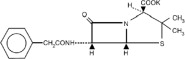 |
| Formula: C 16 H 17 KN 2 O 4 S |
Penicillin G potassium is a colorless or white crystal, or a white crystalline powder which is odorless, or practically so, and moderately hygroscopic. Penicillin G potassium is very soluble in water. The pH of the reconstituted product is between 6.0 to 8.5.
CLINICAL PHARMACOLOGY
Aqueous penicillin G is rapidly absorbed following both intramuscular and subcutaneous injection. Initial blood levels following parenteral administration are high but transient.
Penicillins bind to serum proteins, mainly albumin. Therapeutic levels of the penicillins are easily achieved under normal circumstances in extracellular fluid and most other body tissues. Penicillins are distributed in varying degrees into pleural, pericardial, peritoneal, ascitic, synovial, and interstitial fluids. Penicillins are excreted in breast milk. Penetration into the cerebrospinal fluid, eyes, and prostate is poor. Penicillins are rapidly excreted in the urine by glomerular filtration and active tubular secretion, primarily as unchanged drug. Approximately 60 percent of the total dose of 300,000 units is excreted in the urine within this 5-hour period. For this reason, high and frequent doses are required to maintain the elevated serum levels desirable in treating certain severe infections in individuals with normal kidney function. In neonates and young infants, and in individuals with impaired kidney function, excretion is considerably delayed.
After an intravenous infusion of penicillin G, peak serum concentrations are attained immediately after completion of the infusion. In a study of ten patients administered a single 5 million unit dose of penicillin G intravenously over 3 to 5 minutes, the mean serum concentrations were 400 mcg/mL, 273 mcg/mL and 3.0 mcg/mL at 5 to 6 minutes, 10 minutes and 4 hours after completion of the injection, respectively. In a separate study, five healthy adults were administered one million units of penicillin G intravenously, either as a bolus over 4 minutes or as an infusion over 60 minutes. The mean serum concentration eight minutes after completion of the bolus was 45 mcg/mL and eight minutes after completion of the infusion was 14.4 mcg/mL. The mean β-phase serum half-life of penicillin G administered by the intravenous route in ten patients with normal renal function was 42 minutes, with a range of 31 to 50 minutes.
The clearance of penicillin G in normal individuals is predominantly via the kidney. The renal clearance, which is extremely rapid, is the result of glomerular filtration and active tubular transport, with the latter route predominating. Urinary recovery is reported to be 58 to 85% of the administered dose. Renal clearance of penicillin is delayed in premature infants, neonates and in the elderly due to decreased renal function. The serum half-life of penicillin G correlates inversely with age and clearance of creatinine and ranges from 3.2 hours in infants 0 to 6 days of age to 1.4 hours in infants 14 days of age or older.
Nonrenal clearance includes hepatic metabolism and, to a lesser extent, biliary excretion. The latter routes become more important with renal impairment.
Probenecid blocks the renal tubular secretion of penicillin. Therefore, the concurrent administration of probenecid prolongs the elimination of penicillin G and, consequently, increases the serum concentrations.
Penicillin G is distributed to most areas of the body including lung, liver, kidney, muscle, bone and placenta. In the presence of inflammation, levels of penicillin in abscesses, middle ear, pleural, peritoneal and synovial fluids are sufficient to inhibit most susceptible bacteria. Penetration in the eye, brain, cerebrospinal fluid (CSF) or prostate is poor in the absence of inflammation. With inflamed meninges, the penetration of penicillin G into the CSF improves, such that the CSF/serum ratio is 2 to 6%. Inflammation also enhances its penetration into the pericardial fluid. Penicillin G is actively secreted into the bile resulting in levels at least 10 times those achieved simultaneously in serum. Penicillin G penetrates poorly into human polymorphonuclear leukocytes.
In the presence of impaired renal function, the β-phase serum half-life of penicillin G is prolonged. β-phase serum half-lives of one to two hours were observed in azotemic patients with serum creatinine concentrations <3 mg/100 mL and ranged as high as 20 hours in anuric patients. A linear relationship, including the lowest range of renal function, is found between the serum elimination rate constant and renal function as measured by creatinine clearance.
In patients with altered renal function, the presence of hepatic insufficiency further alters the elimination of penicillin G. In one study, the serum half-lives in two anuric patients (excreting <400 mL urine/day) were 7.2 and 10.1 hours. A totally anuric patient with terminal hepatic cirrhosis had a penicillin half-life of 30.5 hours, while another patient with anuria and liver disease had a serum half-life of 16.4 hours. The dosage of penicillin G should be reduced in patients with severe renal impairment, with additional modifications when hepatic disease accompanies the renal impairment. Hemodialysis has been shown to reduce penicillin G serum levels.
Microbiology
Penicillin G exerts a bactericidal action against penicillin-susceptible microorganisms during the stage of active multiplication. It acts through the inhibition of biosynthesis of cell wall peptidoglycan rendering the cell wall osmotically unstable. It is not active against the penicillinase-producing bacteria, which include many strains of staphylococci or against organisms resistant to beta-lactams because of alterations in the penicillin-binding proteins, such as methicillin-resistant staphylococci. Penicillin G is highly active in vitro against streptococci (groups A, B, C, G, H, L and M), and Neisseria meningitidis .
Other organisms susceptible to penicillin G are N. gonorrhoeae, Corynebacterium diphtheriae, Bacillus anthracis, Clostridium spp., Actinomyces species, “Spirillum minus”, Streptobacillus moniliformis, Listeria monocytogenes, and Leptospira spp.; Treponema pallidum is extremely sensitive to the bactericidal action of penicillin G.
Some species of gram-negative bacilli were previously considered susceptible to very high intravenous doses of penicillin G (up to 80 million units/day) including some strains of Escherichia coli, Proteus mirabilis , Salmonella spp. and Shigella spp.; Enterobacter aerogenes (formerly Aerobacter aerogenes ) and Alcaligenes faecalis . Penicillin G is no longer considered a drug of choice for infections caused by these organisms.
Susceptibility Testing
For specific information regarding susceptibility test interpretive criteria and associated test methods and quality control standards recognized by FDA for this drug, please see: https://www.fda.gov/STIC .
HOW SUPPLIED
Penicillin G Potassium for Injection, USP is available in vials; buffered with sodium citrate and citric acid to an optimum pH. Each million units contains approximately 6.8 milligrams of sodium (0.3 mEq) and 65.6 milligrams of potassium (1.68 mEq).
Penicillin G Potassium for Injection, USP is supplied as follows:
| NDC | Penicillin G Potassium for Injection, USP | Package Factor |
| 83634-102-20 | 5,000,000 units per vial | 10 vials per carton |
| 83634-103-51 | 20,000,000 units per vial | 1 vial per carton |
Storage Conditions
Store at or below 86ºF (30ºC).
STERILE SOLUTION MAY BE KEPT IN REFRIGERATOR FOR ONE (1) WEEK WITHOUT SIGNIFICANT LOSS OF POTENCY.
Sterile, Nonpyrogenic, Preservative-free. The container closure is not made with natural rubber latex.
Brands listed are the trademarks of their respective owners.
AVENACY Mfd. for Avenacy Schaumburg, IL 60173 (USA) Made in Italy ©2024 Avenacy Inc.
October 2024
