Get your patient on Triamterene And Hydrochlorothiazide - Triamterene And Hydrochlorothiazide capsule (Triamterene And Hydrochlorothiazide)
Triamterene And Hydrochlorothiazide - Triamterene And Hydrochlorothiazide capsule prescribing information

INDICATIONS AND USAGE
This fixed combination drug is not indicated for the initial therapy of edema or hypertension except in individuals in whom the development of hypokalemia cannot be risked.
Triamterene and hydrochlorothiazide capsules are indicated for the treatment of hypertension or edema in patients who develop hypokalemia on hydrochlorothiazide alone.
Triamterene and hydrochlorothiazide capsules are also indicated for those patients who require a thiazide diuretic and in whom the development of hypokalemia cannot be risked.
Triamterene and hydrochlorothiazide capsules may be used alone or as an adjunct to other antihypertensive drugs, such as beta-blockers. Since triamterene and hydrochlorothiazide capsules may enhance the action of these agents, dosage adjustments may be necessary.
Usage in Pregnancy: The routine use of diuretics in an otherwise healthy woman is inappropriate and exposes mother and fetus to unnecessary hazard. Diuretics do not prevent development of toxemia of pregnancy, and there is no satisfactory evidence that they are useful in the treatment of developed toxemia.
Edema during pregnancy may arise from pathological causes or from the physiologic and mechanical consequences of pregnancy. Diuretics are indicated in pregnancy when edema is due to pathologic causes, just as they are in the absence of pregnancy. Dependent edema in pregnancy resulting from restriction of venous return by the expanded uterus is properly treated through elevation of the lower extremities and use of support hose; use of diuretics to lower intravascular volume in this case is illogical and unnecessary. There is hypervolemia during normal pregnancy which is harmful to neither the fetus nor the mother (in the absence of cardiovascular disease), but which is associated with edema, including generalized edema in the majority of pregnant women. If this edema produces discomfort, increased recumbency will often provide relief. In rare instances this edema may cause extreme discomfort which is not relieved by rest. In these cases, a short course of diuretics may provide relief and may be appropriate.
DOSAGE AND ADMINISTRATION
The usual dose of triamterene and hydrochlorothiazide capsules is 1 or 2 capsules given once daily, with appropriate monitoring of serum potassium and of the clinical effect (see WARNINGS , Hyperkalemia) .
CONTRAINDICATIONS
Antikaliuretic Therapy and Potassium Supplementation: Triamterene and hydrochlorothiazide capsules should not be given to patients receiving other potassium-sparing agents such as spironolactone, amiloride, or other formulations containing triamterene. Concomitant potassium-containing salt substitutes should also not be used.
Potassium supplementation should not be used with triamterene and hydrochlorothiazide capsules except in severe cases of hypokalemia. Such concomitant therapy can be associated with rapid increases in serum potassium levels. If potassium supplementation is used, careful monitoring of the serum potassium level is necessary.
Impaired Renal Function: Triamterene and hydrochlorothiazide capsules are contraindicated in patients with anuria, acute and chronic renal insufficiency, or significant renal impairment.
Hypersensitivity: Hypersensitivity to either drug in the preparation or to other sulfonamide-derived drugs is a contraindication.
Hyperkalemia: Triamterene and hydrochlorothiazide capsules should not be used in patients with pre-existing elevated serum potassium.
ADVERSE REACTIONS
Adverse effects are listed in decreasing order of severity.
Hypersensitivity: Anaphylaxis, rash, urticaria, subacute cutaneous lupus erythematosus-like reactions, photosensitivity.
Cardiovascular: Arrhythmia, postural hypotension.
Metabolic: Diabetes mellitus, hyperkalemia, hypokalemia, hyponatremia, acidosis, hypercalcemia, hyperglycemia, glycosuria, hyperuricemia, hypochloremia.
Gastrointestinal: Jaundice and/or liver enzyme abnormalities, pancreatitis, nausea and vomiting, diarrhea, constipation, abdominal pain.
Renal: Acute renal failure (one case of irreversible renal failure has been reported), interstitial nephritis, renal stones composed primarily of triamterene, elevated BUN and serum creatinine, abnormal urinary sediment.
Hematologic: Leukopenia, thrombocytopenia and purpura, megaloblastic anemia.
Musculoskeletal: Muscle cramps.
Central Nervous System: Weakness, fatigue, dizziness, headache, dry mouth.
Miscellaneous: Impotence, sialadenitis.
Thiazides alone have been shown to cause the following additional adverse reactions:
Central Nervous System: Paresthesias, vertigo.
Ophthalmic: Xanthopsia, transient blurred vision.
Respiratory: Allergic pneumonitis, pulmonary edema, respiratory distress.
Other: Necrotizing vasculitis, exacerbation of lupus.
Hematologic: Aplastic anemia, agranulocytosis, hemolytic anemia.
Neonate and infancy: Thrombocytopenia and pancreatitis–rarely, in newborns whose mothers have received thiazides during pregnancy.
Skin: Erythema multiforme, including Stevens-Johnson syndrome; exfoliative dermatitis, including toxic epidermal necrolysis.
Postmarketing Experience: Non-Melanoma Skin Cancer: Hydrochlorothiazide is associated with an increased risk of non-melanoma skin cancer. In a study conducted in the Sentinel System, increased risk was predominantly for squamous cell carcinoma (SCC) and in white patients taking large cumulative doses. The increased risk for SCC in the overall population was approximately 1 additional case per 16,000 patients per year, and for white patients taking a cumulative dose of ≥50,000 mg the risk increase was approximately 1 additional SCC case for every 6,700 patients per year.
DESCRIPTION
Each triamterene and hydrochlorothiazide capsule, USP for oral use contains triamterene, USP 37.5 mg and hydrochlorothiazide, USP 25 mg. Hydrochlorothiazide, USP is a diuretic/antihypertensive agent and triamterene, USP is an antikaliuretic agent.
Hydrochlorothiazide, USP is slightly soluble in water. It is soluble in dilute ammonia, dilute aqueous sodium hydroxide, and dimethylformamide. It is sparingly soluble in methanol.
Hydrochlorothiazide, USP is 6-chloro-3,4-dihydro-2 H -1,2,4-benzothiadiazine-7-sulfonamide 1,1-dioxide, and its structural formula is:
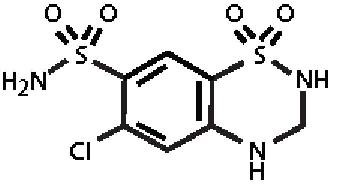
Molecular Formula: C 7 H 8 CIN 3 O 4 S 2 M.W. 297.74
At 50°C, triamterene, USP is practically insoluble in water (less than 0.1%). It is soluble in formic acid, sparingly soluble in methoxyethanol, and very slightly soluble in alcohol.
Triamterene, USP is 2,4,7-triamino-6-phenylpteridine and its structural formula is:
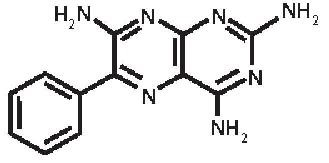
Molecular Formula: C 12 H 11 N 7 M.W. 253.26
Inactive ingredients consist of lactose monohydrate, pregelatinized starch, sodium starch glycolate, polysorbate 80, citric acid anhydrous, povidone, and magnesium stearate. The capsule shell consists of titanium dioxide and gelatin. The capsule imprinting ink consists of shellac glaze in ethanol, iron oxide black, n-butyl alcohol, propylene glycol, ethanol, methanol, FD&C Blue # 2 Aluminum Lake, FD&C Red # 40 Aluminum Lake, FD&C Blue # 1 Aluminum Lake, and D&C Yellow # 10 Aluminum Lake.
Triamterene and hydrochlorothiazide capsules, USP meet USP Dissolution Test 3 as published in the current USP monograph for Triamterene and Hydrochlorothiazide Capsules.
CLINICAL PHARMACOLOGY
The triamterene and hydrochlorothiazide capsule is a diuretic/antihypertensive drug product that combines natriuretic and antikaliuretic effects. Each component complements the action of the other. The hydrochlorothiazide component blocks the reabsorption of sodium and chloride ions, and thereby increases the quantity of sodium traversing the distal tubule and the volume of water excreted. A portion of the additional sodium presented to the distal tubule is exchanged there for potassium and hydrogen ions. With continued use of hydrochlorothiazide and depletion of sodium, compensatory mechanisms tend to increase this exchange and may produce excessive loss of potassium, hydrogen, and chloride ions. Hydrochlorothiazide also decreases the excretion of calcium and uric acid, may increase the excretion of iodide, and may reduce glomerular filtration rate. The exact mechanism of the antihypertensive effect of hydrochlorothiazide is not known.
The triamterene component of triamterene and hydrochlorothiazide capsules exerts its diuretic effect on the distal renal tubule to inhibit the reabsorption of sodium in exchange for potassium and hydrogen ions. Its natriuretic activity is limited by the amount of sodium reaching its site of action. Although it blocks the increase in this exchange that is stimulated by mineralocorticoids (chiefly aldosterone), it is not a competitive antagonist of aldosterone and its activity can be demonstrated in adrenalectomized rats and patients with Addison’s disease. As a result, the dose of triamterene required is not proportionally related to the level of mineralocorticoid activity but is dictated by the response of the individual patients and the kaliuretic effect of concomitantly administered drugs. By inhibiting the distal tubular exchange mechanism, triamterene maintains or increases the sodium excretion and reduces the excess loss of potassium, hydrogen, and chloride ions induced by hydrochlorothiazide. As with hydrochlorothiazide, triamterene may reduce glomerular filtration and renal plasma flow. Via this mechanism, it may reduce uric acid excretion although it has no tubular effect on uric acid reabsorption or secretion. Triamterene does not affect calcium excretion. No predictable antihypertensive effect has been demonstrated for triamterene.
Duration of diuretic activity and effective dosage range of the hydrochlorothiazide and triamterene components of triamterene and hydrochlorothiazide capsules are similar. Onset of diuresis with triamterene and hydrochlorothiazide capsules takes place within 1 hour, peaks at 2 to 3 hours, and tapers off during the subsequent 7 to 9 hours.
Triamterene and hydrochlorothiazide capsules are well absorbed.
Upon administration of a single oral dose to fasted normal male volunteers, mean pharmacokinetic parameters were determined (Table 1).
Table 1. Mean Pharmacokinetic Parameters after Single Oral Dose in Fasted Male Volunteers a
AUC (0-48) ng•h/mL (± SD) | C max ng/mL (± SD) | Median T max h | Ae Mg (± SD) | |
Triamterene | 148.7 (87.9) | 46.4 (29.4) | 1.1 | 2.7 (1.4) |
Hydroxytriamterene sulfate | 1,865 (471) | 720 (364) | 1.3 | 19.7 (6.1) |
Hydrochlorothiazide | 834 (177) | 135.1 (35.7) | 2.0 | 14.3 (3.8) |
a AUC (0-48) , C max , T max , and Ae represent area under the plasma concentration versus time plot, maximum plasma concentration, time to reach C max , and amount excreted in urine over 48 hours.
A capsule of triamterene and hydrochlorothiazide is bioequivalent to a single entity 25-mg hydrochlorothiazide tablet and 37.5-mg triamterene capsule used in the double-blind clinical trial below (see Clinical Trials ).
In a limited study involving 12 subjects, coadministration of triamterene and hydrochlorothiazide capsules with a high-fat meal resulted in: (1) an increase in the mean bioavailability of triamterene by about 67% (90% confidence interval = 0.99, 1.90), p-hydroxytriamterene sulfate by about 50% (90% confidence interval = 1.06, 1.77), hydrochlorothiazide by about 17% (90% confidence interval = 0.90, 1.34); (2) increases in the peak concentrations of triamterene and p-hydroxytriamterene; and (3) a delay of up to 2 hours in the absorption of the active constituents.
HOW SUPPLIED
Triamterene and Hydrochlorothiazide Capsules, USP contain 37.5 mg triamterene, USP and 25 mg hydrochlorothiazide, USP and are available in size # 4 white opaque/white opaque capsules imprinted with Logo “LANNETT” on the cap and “1632” on the body. They are supplied as follows:
Bottles of 90, NDC 62135-529-90
Store at 20° to 25°C (68° to 77°F) [see USP Controlled Room Temperature]. Protect from light. Dispense in a tight, light-resistant container as defined in the USP, with a child-resistant closure.
Manufactured for: Chartwell RX, LLC.
Congers, NY 10920
L71344
Revised 03/2023
