Get your patient on Trihexyphenidyl Hydrochloride - Trihexyphenidyl Hydrochloride syrup (Trihexyphenidyl Hydrochloride)
Trihexyphenidyl Hydrochloride - Trihexyphenidyl Hydrochloride syrup prescribing information

INDICATIONS AND USAGE
Trihexyphenidyl is indicated as an adjunct in the treatment of all forms of parkinsonism (postencephalitic, arteriosclerotic, and idiopathic). It is often useful as adjuvant therapy when treating these forms of parkinsonism with levodopa. Additionally, it is indicated for the control of extrapyramidal disorders caused by central nervous system drugs such as the dibenzoxazepines, phenothiazines, thioxanthenes, and butyrophenones.
DOSAGE AND ADMINISTRATION
Dosage should be individualized. The initial dose should be low and then increased gradually, especially in patients over 60 years of age.Whether trihexyphenidyl may best be given before or after meals should be determined by the way the patient reacts. Postencephalitic patients, who are usually more prone to excessive salivation, may prefer to take it after meals and may, in addition, require small amounts of atropine which, under such circumstances, is sometimes an effective adjuvant. If trihexyphenidyl tends to dry the mouth excessively, it may be better to take it before meals, unless it causes nausea. If taken after meals, the thirst sometimes induced can be allayed by mint candies, chewing gum or water.
Abrupt withdrawal of treatment for parkinsonism may result in acute exacerbation of parkinsonism symptoms; therefore, abrupt withdrawal should be avoided.
Abrupt withdrawal of treatment may result in neuroleptic malignant syndrome (NMS) (See WARNINGS ).
Idiopathic Parkinsonism
As initial therapy for parkinsonism, 1 mg of trihexyphenidyl hydrochloride may be administered the first day. The dose may then be increased by 2 mg increments at intervals of three to five days, until a total of 6 to 10 mg is given daily. The total daily dose will depend upon what is found to be the optimal level. Many patients derive maximum benefit from this daily total of 6 to 10 mg, but some patients, chiefly those in the postencephalitic group, may require a total daily dose of 12 to 15 mg.
Drug-Induced Parkinsonism
The size and frequency of the trihexyphenidyl dose needed to control extrapyramidal reactions to commonly employed tranquilizers, notably the phenothiazines, thioxanthenes, and butyrophenones, must be determined empirically. The total daily dosage usually ranges between 5 and 15 mg although, in some cases, these reactions have been satisfactorily controlled with as little as 1 mg daily. It may be advisable to commence therapy with a single 1 mg dose. If the extrapyramidal manifestations are not controlled in a few hours, the subsequent doses may be progressively increased until satisfactory control is achieved. Satisfactory control may sometimes be more rapidly achieved by temporarily reducing the dosage of the tranquilizer when instituting trihexyphenidyl therapy and then adjusting the dosage of both drugs until the desired ataractic effect is retained without onset of extrapyramidal reactions.
It is sometimes possible to maintain the patient on a reduced trihexyphenidyl dosage after the reactions have remained under control for several days. Instances have been reported in which these reactions have remained in remission for long periods after trihexyphenidyl therapy was discontinued.
Concomitant Use with Levodopa
When trihexyphenidyl is used concomitantly with levodopa, the usual dose of each may need to be reduced. Careful adjustment is necessary, depending on side effects and degree of symptom control. A trihexyphenidyl dosage of 3 to 6 mg daily, in divided doses, is usually adequate.
Concomitant Use with Other Parasympathetic Inhibitors
Trihexyphenidyl may be substituted, in whole or in part, for other parasympathetic inhibitors. The usual technique is partial substitution initially, with progressive reduction in the other medication as the dose of trihexyphenidyl is increased.
The total daily intake of trihexyphenidyl hydrochloride oral solution USP is tolerated best if divided into 3 doses and taken at mealtimes. High doses (>10 mg daily) may be divided into 4 parts, with 3 doses administered at mealtimes and the fourth at bedtime.
CONTRAINDICATIONS
Trihexyphenidyl is contraindicated in patients with hypersensitivity to trihexyphenidyl or to any of the other ingredients. Trihexyphenidyl is also contraindicated in patients with narrow angle glaucoma. Blindness after long-term use due to narrow angle glaucoma has been reported.
ADVERSE REACTIONS
Minor side effects, such as dryness of the mouth, blurred vision, dizziness, mild nausea or nervousness, will be experienced by 30 to 50 percent of all patients. These sensations, however, are much less troublesome with trihexyphenidyl than with belladonna alkaloids and are usually less disturbing than unalleviated parkinsonism. Such reactions tend to become less pronounced, and even to disappear, as treatment continues. Even before these reactions have remitted spontaneously, they may often be controlled by careful adjustment of dosage form, amount of drug, or interval between doses.
Isolated instances of suppurative parotitis secondary to excessive dryness of the mouth, skin rashes, dilatation of the colon, paralytic ileus, and certain psychiatric manifestations such as delusions, hallucinations, and paranoia, all of which may occur with any of the atropine-like drugs, have been reported rarely with trihexyphenidyl.
Potential side effects associated with the use of any atropine-like drugs, including trihexyphenidyl, include cognitive dysfunctions, including confusion and memory impairment; constipation, drowsiness, urinary hesitancy or retention, tachycardia, dilation of the pupil, increased intraocular pressure, choreiform movements, weakness, vomiting, and headache. Exacerbation of parkinsonism with abrupt treatment withdrawal has been reported. Neuroleptic malignant syndrome with abrupt treatment withdrawal has been reported (See WARNINGS, Neuroleptic Malignant Syndrome ).
The occurrence of angle-closure glaucoma in patients receiving trihexyphenidyl has been reported (blindness has been reported in some cases). Paradoxical sinus bradycardia, dry skin, and cycloplegia have been reported.
In addition to adverse events seen in adults, the following adverse events have been reported in the literature in pediatric patients: hyperkinesia, psychosis, forgetfulness, weight loss, restlessness, chorea, and sleep alterations.
Drug Interactions
Cannabinoids, barbiturates, opiates, and alcohol may have additive effects with trihexyphenidyl, and thus, an abuse potential exists.
Concurrent use of alcohol or other CNS depressants with trihexyphenidyl may cause increased sedative effects.
Monoamine oxidase inhibitors and tricyclic antidepressants possessing significant anticholinergic activity may intensify the anticholinergic effects of antidyskinetic agents because of the secondary anticholinergic activities of these medications.
Prophylactic administration of anticholinergic agents, such as trihexyphenidyl, as a prevention of drug-induced parkinsonism during neuroleptic therapy is not recommended. There may be an increased risk for the development of tardive dyskinesia during concomitant administration of anticholinergics and neuroleptics (See PRECAUTIONS, General ).
The usual dose of either trihexyphenidyl or levodopa may need to be reduced during concomitant therapy, since concomitant administration may increase drug-induced involuntary movements (See DOSAGE AND ADMINISTRATION ).
DESCRIPTION
Trihexyphenidyl Hydrochloride Oral Solution USP is a synthetic antispasmodic drug. It is designated chemically as α-Cyclohexyl-α-phenyl-1-piperidinepropanol hydrochloride and its structural formula is as follows:
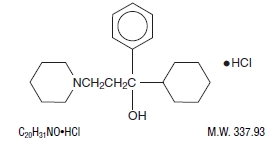
Trihexyphenidyl hydrochloride occurs as a white or creamy-white, almost odorless, crystalline powder. It is very slightly soluble in ether and benzene, slightly soluble in water and soluble in methanol.
Each 5 mL (teaspoonful) for oral administration contains 2 mg trihexyphenidyl hydrochloride and alcohol 5% in a clear, colorless, lime-mint flavored preparation. In addition, it contains the following inactive ingredients: citric acid, flavoring, methylparaben, propylparaben, purified water and sorbitol solution.
CLINICAL PHARMACOLOGY
Trihexyphenidyl exerts a direct inhibitory effect upon the parasympathetic nervous system. It also has a relaxing effect on smooth musculature; exerted both directly upon the muscle tissue itself and indirectly through an inhibitory effect upon the parasympathetic nervous system. Its therapeutic properties are similar to those of atropine although undesirable side effects are ordinarily less frequent and severe than with the latter.
HOW SUPPLIED
Trihexyphenidyl Hydrochloride Oral Solution, containing trihexyphenidyl hydrochloride 2 mg per 5 mL, is a clear, colorless lime-peppermint flavored liquid supplied in 473 mL (16 fl. oz) bottles, NDC 61748-054-16.
Dispense in a tight, light-resistant container with a child-resistant closure.
Store at 20° to 25°C (68° to 77°F) [See USP Controlled Room Temperature].
DO NOT FREEZE.
R x Only
Manufactured by: MIKART, INC. Atlanta, GA 30318
Marketed by: VersaPharm, Inc. – An Akorn Company Lake Forest, IL 60045
Code 734A00
Rev 03/17
