Get your patient on Zevaskyn - Prademagene Zamikeracel cellular Sheet (Prademagene Zamikeracel)
Zevaskyn - Prademagene Zamikeracel cellular Sheet prescribing information

1 INDICATIONS AND USAGE
ZEVASKYN is indicated for the treatment of wounds in adult and pediatric patients with recessive dystrophic epidermolysis bullosa (RDEB).
2 DOSAGE AND ADMINISTRATION
For autologous topical application on wounds only
- The recommended dose of ZEVASKYN is based on the surface area of the wound(s). One sheet of ZEVASKYN covers an area of 41.25 cm 2 . (2.1 )
- Up to twelve ZEVASKYN sheets may be manufactured from the patient biopsies and supplied for potential use. (2.1 )
- Verify the patient’s identity prior to ZEVASKYN application. (2.2 )
- See full prescribing information for ZEVASKYN preparation, and administration instructions. (2.2 , 2.3 )
2.1 Recommended Dose
For autologous topical application on wounds only.
- The recommended dose of ZEVASKYN is based on the surface area of the wound(s).
- One sheet of ZEVASKYN covers an area of 41.25 cm 2 .
- Up to twelve ZEVASKYN sheets may be manufactured from the patient biopsies and supplied for potential use.
2.2 Receipt and Preparation
Receipt of ZEVASKYN
- ZEVASKYN is shipped directly to the qualified treatment center sealed in transport packaging.
- If the patient is expected to be ready for same-day application, transport the packaging to the operating room. Hold at room temperature (15-25°C) until preparation to maintain cell viability.
- If the patient is not expected to be ready for same-day application, store the packaging containing ZEVASKYN in a secure onsite location at room temperature (15-25°C) until preparation to maintain cell viability.
Preparation
- ZEVASKYN is to be prepared by the manufacturer in an appropriate healthcare setting for surgical application by a qualified healthcare provider.
- Manufacturer will conduct Quality Control (QC) testing to release the product immediately prior to surgery in the operating room.
- Verify patient’s identity during preparation.
- Hold ZEVASKYN at room temperature (15-25°C) until application.
- Apply all selected sheets in a single surgical session.
2.3 Administration
Below is the list of standard surgical supplies needed for ZEVASKYN administration and not provided by the manufacturer:
- scalpel
- scissors
- forceps
- resorbable sutures
- non-adhesive dressings
- topical antibiotic ointment
1. Verify patient’s identity prior to ZEVASKYN application. Do not apply ZEVASKYN if the information on the patient-specific label(s) does not match the intended patient.
2. Prepare wound by debridement under general or other appropriate anesthesia to accommodate ZEVASKYN sheet(s).
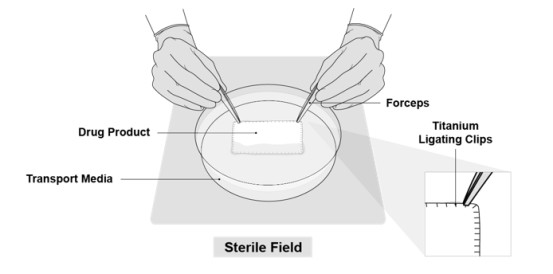
3. Before surgical application, pick up ZEVASKYN sheet with forceps by grasping the titanium ligating clips (Figure 1). Handle ZEVASKYN sheets only with forceps and only by the titanium ligating clips.
Figure 1. ZEVASKYN sheets removed with forceps for application
4. Do not trim ZEVASKYN sheets.
5. Apply unaltered ZEVASKYN sheets onto the wound bed only (nylon suture on the ZEVASKYN sheet facing away from wound) by affixing via resorbable sutures. Do not suture ZEVASKYN onto healthy intact skin. Do not overlap ZEVASKYN sheets on wounds.
6. Apply all selected sheets in a single surgical session.
7. Cover area of application of ZEVASKYN sheets with non-adhesive dressings and topical antibiotic ointment.
After ZEVASKYN application
8. Instruct patient to leave the treated area undisturbed for 5-10 days at the discretion of the physician based on individual needs for immobilization of treated areas and post-surgical recovery.
9. Instruct patient to keep dressings dry and not submerge the treated area in water until the gauze of the ZEVASKYN product falls off the treatment site. Gauze backing should fall off within 2-3 weeks of ZEVASKYN surgical application.
3 DOSAGE FORMS AND STRENGTHS
ZEVASKYN is supplied as single-dose cellular sheets each measuring 41.25 cm 2 (5.5 cm x 7.5 cm) and consisting of patient's own viable, gene-modified cells that contain functional copies of the COL7A1 gene, which express collagen 7 (C7) protein.
Up to twelve (12) C7-expressing cellular sheets are supplied for each surgical session (supplied as up to 3 containers containing up to 4 sheets).
8 USE IN SPECIFIC POPULATIONS
8.1 Pregnancy
Risk Summary
There are no available data with ZEVASKYN use in pregnant women. No animal reproductive and developmental toxicity studies have been conducted with ZEVASKYN.
The estimated background risk of major birth defects and miscarriage for the indicated population is unknown. In the U.S. general population, the estimated background risk of major birth defects and miscarriage in clinically recognized pregnancies is 2-4% and 15-20%, respectively.
Clinical Considerations
Women of childbearing potential should be advised to use an effective method of contraception to prevent pregnancy at the time of treatment with ZEVASKYN.
8.2 Lactation
Risk Summary
There is no information regarding the presence of ZEVASKYN in human milk, its effect on the breastfed infant, or its effects on milk production. Animal lactation studies have not been conducted with ZEVASKYN.
The developmental and health benefits of breastfeeding should be considered along with the mother’s clinical need for ZEVASKYN and any potential adverse effects on the breast-fed infant from ZEVASKYN or from the underlying maternal condition.
8.000000000000000e+00 3 Females and Males of Reproductive Potential
No studies were performed to evaluate the effect of ZEVASKYN on fertility.
8.000000000000000e+00 4 Pediatric Use
The safety and effectiveness of ZEVASKYN have been established in pediatric patients. The use of ZEVASKYN in pediatric patients was supported by evidence from one clinical study which included two pediatric patients aged 6 years and 16 years [ see Adverse Reactions (6 ) and Clinical Studies (14 ) ] .
8.5 Geriatric Use
The safety and effectiveness of ZEVASKYN have not been studied in geriatric patients ≥ 65 years of age.
4 CONTRAINDICATIONS
None.
5 WARNINGS AND PRECAUTIONS
- Hypersensitivity reactions to vancomycin, amikacin, or product excipients may occur with ZEVASKYN application. (5.1 )
- Retroviral vector (RVV)-mediated insertional oncogenesis may potentially occur after treatment with ZEVASKYN. (5.2 )
- Transmission of Infectious Agents may occur because ZEVASKYN is manufactured using human- and bovine-derived reagents. (5.3 )
5.1 Hypersensitivity Reactions
Severe hypersensitivity reactions to vancomycin, amikacin, or product excipients may occur with ZEVASKYN application. Monitor for signs and symptoms of hypersensitivity reactions such as itching, swelling, hives, difficulty breathing, runny nose, watery eyes, nausea, and in severe cases, anaphylaxis and treat according to standard clinical practice.
5.000000000000000e+00 3 Transmission of Infectious Agents
Transmission of infectious disease or agents may occur with ZEVASKYN administration because it is manufactured using human and bovine-derived reagents, which are tested for human and animal viruses, bacteria, fungi, and mycoplasma before use. These measures do not eliminate the risk of transmitting these or other infectious diseases or agents.
6 ADVERSE REACTIONS
The most common adverse reactions (incidence ≥5%) were procedural pain and pruritus. (6 )
To report SUSPECTED ADVERSE REACTIONS, contact Abeona Therapeutics Inc at 1-844-888-2236 or the FDA at 1-800-FDA-1088 or www.fda.gov/medwatch.
6.1 Clinical Trials Experience
Because clinical trials are conducted under widely varying conditions, adverse reaction rates observed in the clinical trials of a product cannot be directly compared to the rates in the clinical trials of another product and may not reflect the rates observed in practice.
The safety data described in this section reflects exposure of 11 patients to ZEVASKYN in the VIITAL study [see Clinical Studies (14 ) ] .
The median number of sheets patients received was 6 (range 3-6), and the total exposure time was 6 months following ZEVASKYN application.
The most common adverse reactions occurring in ≥5% of patients were procedural pain (n=3; 27%) and pruritus (n=1; 9%).
11 DESCRIPTION
ZEVASKYN is composed of autologous cells isolated from skin punch biopsies of patients with mutations in the collagen type VII alpha 1 chain ( C OL 7A1 ) gene and which have been transduced ex vivo with a replication-incompetent retroviral vector (RVV) containing the full-length COL7A1 gene. The resulting gene-modified cell sheets express functional collagen VII (C7) protein. ZEVASKYN is manufactured using human- and animal-derived reagents.
ZEVASKYN is provided as cellular sheets of 41.25 cm 2 (5.5 cm x 7.5 cm) secured to sterile petrolatum gauze using sterile ligation titanium clips for surgical application. The cellular sheets consist of autologous, viable, gene-modified cells. Up to twelve (12) sheets may be manufactured from the patient biopsies and supplied for potential use.
Each ZEVASKYN sheet is packaged in a clamshell and sealed transport pouch containing sterile transport media. The transport media includes reagents derived from human and animal materials, including bovine pituitary extract, bovine transferrin, and human transferrin. The sheet also has a nylon suture, which functions as a visual indicator of the sheet’s topography. Neither ZEVASKYN sheets nor its excipients contain preservatives.
12 CLINICAL PHARMACOLOGY
12.1 Mechanism of Action
In patients with recessive dystrophic epidermolysis bullosa (RDEB), both copies of the COL7A1 gene are mutated, resulting in the absence or low levels of biologically active C7 protein which form anchoring fibrils (AFs). The lack of AFs disrupts the connection between the epidermis and the dermis and causes skin fragility and other signs and symptoms of RDEB. ZEVASKYN consists of a patient's own cells that have been gene-modified through RVV transduction to express the COL7A1 gene to produce the C7 protein. These cells are formed into cellular sheets for topical application onto wounds.
12.2 Pharmacodynamics
In a single-arm clinical study (n=7), C7 was assessed by both immunofluorescence and the presence of AFs at Months 3, 6, and 12. The NC2 domain of C7 was assessed using the LH24 antibody, and the presence of AFs was assessed by immunoelectron microscopy. The NC2 domain of C7 and AFs were detected in 6 patients at 3 months and in 5 patients at 6 months. One year after treatment with ZEVASKYN, 3 patients were positive for NC2 or AFs. At Year 2, 2 out of 3 patients with biopsies were positive for NC2 or AFs (1 patient was positive for both AFs and NC2; the second patient was positive only for NC2, as an additional biopsy for AF assessment was not obtained).
12.3 Pharmacokinetics
No clinical studies have been conducted to evaluate the pharmacokinetics of ZEVASKYN.
12.6 Immunogenicity
The observed incidence of anti-drug antibodies is highly dependent on the sensitivity and specificity of the assay. Differences in assay methods preclude meaningful comparisons of the incidence of anti-drug antibodies in the studies described below with the incidence of anti-drug antibodies in studies with other products.
In a single-arm clinical study, anti-C7 antibodies against Type VII collagen were assessed in 7 patients at baseline, 1, 3, and 6 months and then annually for 5 years at physician’s discretion after treatment with ZEVASKYN. Out of 7 patients, circulating anti-C7 antibodies were detected in 2 patients which resolved at 1 year follow-up. Tissue-bound anti-C7 antibodies were detected in 4 patients which resolved in 3 patients at 1 year follow-up. In 1 patient with positive baseline anti-C7 antibodies, localized immunoreactants were observed at treated sites for up to 2 years after treatment.
In the VIITAL study, anti-C7 antibodies were assessed at baseline and at physician’s discretion at Months 3 and 6. Eight patients were biopsied at either Month 3 or 6, and none of those patients tested positive for C7 immune complexes [see Clinical Studies (14 ) ] .
Because of the small sample size, there is limited data to determine the effect of anti-C7 antibodies on the pharmacodynamics, safety, and/or effectiveness of ZEVASKYN.
13 NONCLINICAL TOXICOLOGY
13.1 Carcinogenesis, Mutagenesis, Impairment of Fertility
No carcinogenicity studies have been conducted with ZEVASKYN. Integration site analysis in RDEB keratinocytes transduced with LZRSE-Col7A1 showed a low level of integration distributed throughout the host genome with no predilection to specific integration sites, including in genes associated with malignant transformation in humans. No studies have been conducted to evaluate the effects of ZEVASKYN on fertility.
6.1 Clinical Trials Experience
Because clinical trials are conducted under widely varying conditions, adverse reaction rates observed in the clinical trials of a product cannot be directly compared to the rates in the clinical trials of another product and may not reflect the rates observed in practice.
The safety data described in this section reflects exposure of 11 patients to ZEVASKYN in the VIITAL study [see Clinical Studies (14 ) ] .
The median number of sheets patients received was 6 (range 3-6), and the total exposure time was 6 months following ZEVASKYN application.
The most common adverse reactions occurring in ≥5% of patients were procedural pain (n=3; 27%) and pruritus (n=1; 9%).
1 6 HOW SUPPLIED/STORAGE AND HANDLING
16.1 How Supplied
ZEVASKYN sheets of 41.25 cm² (5.5 cm × 7.5 cm) affixed on a rectangular gauze and placed in a clear, thermoformed protective case (“clamshell”) containing sterile transport media sealed in packaging consisting of 4 levels of protection.
Up to four ZEVASKYN sheets are provided in a single transport container, with up to three containers per manufactured lot, for a total of up to twelve sheets. All available sheets per manufactured lot are supplied under NDC 84103-007-01.
- Confirm patient identity on the drug product container upon receipt.
- Each sheet is supplied ready for use and is intended for application on the patient from whom the biopsy was derived for manufacturing the ZEVASKYN sheet.
Due to ZEVASKYN’s autologous nature, in case of a manufacturing failure, a second manufacturing of ZEVASKYN may be attempted and would require a repeat biopsy.
16.2 Storage and Handling
Store and transport ZEVASKYN at room temperature (15-25°C). ZEVASKYN is stable for 84 hours at room temperature and must be used within 84 hours. Dispose of any compromised or mishandled product.
Dispose of unused ZEVASKYN as surgical biohazardous waste in accordance with local requirements.
Dispose of materials that have come into contact with ZEVASKYN as surgical biohazardous waste in accordance with local requirements.
12.1 Mechanism of Action
In patients with recessive dystrophic epidermolysis bullosa (RDEB), both copies of the COL7A1 gene are mutated, resulting in the absence or low levels of biologically active C7 protein which form anchoring fibrils (AFs). The lack of AFs disrupts the connection between the epidermis and the dermis and causes skin fragility and other signs and symptoms of RDEB. ZEVASKYN consists of a patient's own cells that have been gene-modified through RVV transduction to express the COL7A1 gene to produce the C7 protein. These cells are formed into cellular sheets for topical application onto wounds.
